





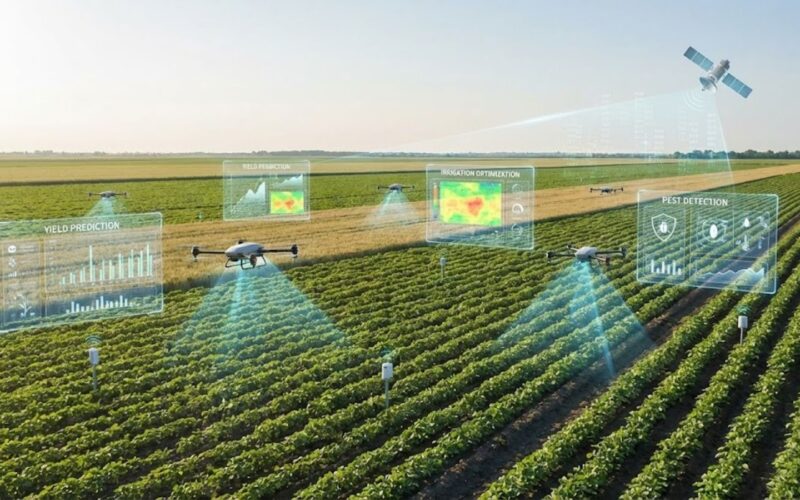
One of the most pressing concerns facing global agriculture today is how to feed a growing population with limited land, unpredictable weather, and shrinking labor availability.
Traditional methods built on experience and intuition can no longer keep pace with the volatility of modern farming. Machine learning in agriculture is emerging as a practical solution, analyzing vast datasets from soil sensors, drones, and satellites to help farmers make faster, data-driven decisions that improve yields and reduce waste.
By 2025 and beyond, over 60% of large farms worldwide are projected to adopt AI-powered precision farming technologies, illustrating growing trust in data-driven tools among large producers.
This shift marks a move from intuition-driven practices to quantitative decision-making, for example, using predictive models to determine crop health trends, optimize irrigation, and anticipate pest threats before visible symptoms appear.
This blog explores how machine learning is being applied in agriculture and what the future of data-driven farming will look like beyond 2026.
Key Takeaways
- Machine learning in agriculture delivers measurable gains, with studies showing 20–25% yield improvements and 20–40% reductions in water and fertilizer use when applied to irrigation, nutrient planning, and crop monitoring.
- The highest value comes from prediction, not observation: Yield forecasting, pest detection, and climate-risk modeling enable earlier, more precise decisions across the farm lifecycle.
- Profitability and sustainability are linked: ML lowers input costs, reduces energy use, and improves per-hectare output, thereby strengthening long-term farm ROI.
- Adoption barriers remain structural, including fragmented data, rural connectivity gaps, high hardware costs, and limited ML literacy among farm operators.
- AI crop advisors, carbon measurement models, autonomous equipment, and policy-backed data sharing frameworks will drive the next phase of ML in agriculture.
What Does Machine Learning in Agriculture Actually Mean Today?
Machine learning in agriculture is about teaching systems to recognize patterns in farm data and make better decisions, from predicting yield to adjusting irrigation in real time.
Instead of just reporting what happened, ML models learn from soil, crop, and climate data to forecast future outcomes and recommend actions to improve results.
How Machine Learning Differs from Traditional Analytics
Traditional analytics summarize the past, showing average rainfall, last season’s yield, or fertilizer use.
Machine learning, on the other hand, studies how multiple variables interact and predicts outcomes before they occur. It recognizes correlations that humans or basic analytics tools might miss.
For example, an ML model can analyze soil pH, rainfall, and satellite vegetation data together to flag early signs of stress before it’s visible. This shift means farmers move from reactive management to predictive farming.
From Data Capture to Data Insight
The hardware captures data while the IoT sensors measure soil moisture. The drones map canopy health, while the satellites monitor temperature variations.
The software that is machine learning algorithms, then converts that data into insight:
- It detects anomalies like nutrient deficiencies.
- It predicts events such as pest outbreaks or irrigation needs.
- It recommends actions based on confidence scores and past outcomes.
Core ML Models Used in Agriculture
Machine learning in agriculture relies on three main model types, each serving distinct functions:
- Supervised Learning: Trains on labeled datasets (e.g., past yields, soil test results) to predict quantifiable outcomes like moisture levels or harvest volume.
- Unsupervised Learning: Clusters unlabeled data, for instance, grouping soil samples by nutrient similarity, to reveal hidden patterns and inform tailored fertilizer plans.
- Reinforcement Learning: Powers autonomous farm equipment and robotics. Tractors and drones “learn” optimal paths and actions based on reward feedback from real-time conditions.
Together, these models use multi-source data, soil sensors, drone imagery, satellite imagery, and weather records to enable continuous learning and sharper predictions with each cycle.
Bring clarity, creativity, and user focus to your agri-tech innovation. Codewave’s Design Thinking services help transform machine learning ideas into products that truly work for farmers and businesses alike. Partner with us to turn user insights into measurable results.
Also Read: Top Gen AI Implementation Frameworks for 2026
Once the fundamentals are clear, the next step is to see how machine learning is applied in day-to-day farming operations.
Key Applications of Machine Learning in Modern Farming
Machine learning affects nearly every stage of agricultural operations, from planning before planting to managing post-harvest supply chains, by turning large, diverse datasets into precise recommendations. ML systems reduce uncertainty, optimize resource use, and improve overall farm efficiency.
Below are the key techniques, their practical uses, and both advantages and limitations.
1. Crop and Soil Monitoring
ML combines data from drones, satellites, and soil sensors with classification algorithms (such as Random Forest and Convolutional Neural Networks) to map field conditions and track plant health indicators.
This enables targeted interventions that reduce input waste and improve crop outcomes. Techniques like crop mapping and vegetation index analysis help reveal field variability at scale.
- Techniques used: Image classification, feature extraction, clustering
- Pros: Real-time insights, supports zone-specific management
- Cons: High cost of high-resolution imagery and preprocessing requirement
2. Predictive Yield Forecasting
ML models such as regression, Random Forests, and ensemble methods predict future yield based on historical output, weather patterns, and soil conditions.
Coupling traditional crop models with ML significantly reduces prediction errors and improves labor and logistics planning.
- Techniques used: Regression, ensemble models, hybrid crop model integration
- Pros: Helps plan resource allocation and market commitments
- Cons: Accuracy tied to data completeness and environmental variability
3. Pest and Disease Detection
Computer vision and deep learning models scan imagery from drones and field cameras to detect early signs of pest infestations or plant disease.
Deep learning architectures such as CNNs and transfer learning substantially increase detection accuracy. This enables precision interventions that curtail losses and reduce pesticide use.
- Techniques used: Convolutional Neural Networks, pattern recognition
- Pros: Early detection lowers treatment costs and crop loss
- Cons: Requires large labeled datasets for training
4. Precision Irrigation and Fertilization
Machine learning models integrate sensor data (e.g., soil moisture, weather forecasts) with prediction techniques to optimize irrigation and fertilizer application schedules. This approach supports more innovative water use and nutrient delivery, with research showing measurable improvements in resource efficiency.
- Techniques used: Supervised regression, optimization algorithms
- Pros: Reduces water and nutrient waste
- Cons: Sensor network costs and connectivity requirements
5. Supply Chain and Post-Harvest Optimization
ML supports agricultural supply chains by forecasting demand, optimizing storage, and improving logistics timing.
Algorithms analyze market trends and inventory patterns to reduce post-harvest losses and align production with demand. This application increasingly blends predictive analytics with real-time monitoring systems across the value chain.
- Techniques used: Time-series forecasting, clustering, predictive modeling
- Pros: Enhances market responsiveness and reduces waste
- Cons: Requires integrated data across producers, processors, and distributors.
Each application relies on machine learning algorithms such as Random Forests, Support Vector Machines, neural networks, and deep learning models, tailored to the specific task and dataset.
While these approaches yield measurable improvements in yield accuracy, resource use, and operational efficiency, deployment success hinges on data quality, sensor infrastructure, and effective preprocessing.
Also Read: How Technology and Farming Are Revolutionizing Agriculture for the Future
These applications only matter if they deliver results, so let’s look at how machine learning translates into measurable sustainability and financial gains.
How Machine Learning Improves Sustainability and Profitability
Machine learning improves both resource efficiency and financial performance when it is tied to clear farm objectives and reliable data.
Recent reviews of smart farming projects show that drone and IoT-based interventions have reduced water and fertilizer use in some trials by up to 96% and 40%, respectively.
Before assessing profitability, it helps to understand how ML affects core sustainability metrics in the field.
- Lower input costs through targeted application
ML models forecast irrigation and nutrient needs at the plot level, so water and fertilizer are applied only where the model predicts a measurable benefit.
Case studies on AI-assisted fertigation show up to 20% yield gains and roughly 15% lower fertilizer costs, as inputs shift from blanket use to targeted use.
- Optimized water use at scale
Smart irrigation systems driven by ML can combine soil moisture, crop stage, and weather forecasts to schedule watering.
- Lower carbon footprint from smarter inputs
When ML reduces unnecessary pumping and fertilizer use, it indirectly cuts emissions associated with energy and nitrogen fertilizer production.
Strategic reviews of AI in climate-smart agriculture highlight AI’s role in reducing both emissions and input intensity per unit of output by optimizing the timing and quantity of operations.
How ML Improves Profitability
The same ML interventions that improve sustainability also affect the income side of the equation.
- Higher and more stable yield per hectare
AI-guided monitoring and timely interventions have delivered significant yield increases in several crop studies by catching stress early and aligning practices with crop requirements at critical stages.
- Better planning and reduced operational risk
Yield forecasting models help producers plan storage, contracts, and logistics before harvest. This leads to fewer last-minute decisions, more predictable cash flows, and improved bargaining power with buyers.
- Improved ROI on technology and inputs
When AI projects combine yield gains with input savings, farms achieve higher return on investment than with input-intensive approaches alone.
Strategic guides on AI in agriculture frame successful deployments as those that deliver payback from both higher output and lower variability, not just from cost-cutting.
Bring the power of machine learning to the field. Whether it’s predictive yield modeling, smart irrigation, or agri-data analytics, Codewave’s AI/ML team builds systems that turn raw farm data into actionable intelligence. Talk to Codewave to explore AI solutions that make agriculture smarter and more sustainable.
Despite clear benefits, adoption is uneven. Understanding what holds farms back is key to scaling these solutions.
What Challenges Are Slowing Down Machine Learning Adoption in Agriculture?
Despite strong benefits, ML adoption in agriculture remains uneven. Studies on digital agriculture show that progress depends on reliable infrastructure, accessible tools, and farmers’ confidence in the technology.
1. Structural and data-related barriers
Before assessing skills and costs, it is important to understand the constraints on data and infrastructure.
- Data scarcity and fragmentation
Agricultural data is often scattered across devices, cooperatives, and agencies, stored in incompatible formats, and missing long historical records.
Reviews of AI in agri-food systems identify lack of standardized, high-quality datasets as a core obstacle for robust ML models and for transferring models between regions.
- Connectivity gaps in rural regions
Many farms still lack reliable broadband or cellular coverage. Research on AI-enabled irrigation and decision support notes that limited connectivity directly constrains the use of cloud-based ML services and real-time data flows, particularly for small and remote farms.
2. Economic and skills constraints
Once basic infrastructure is in place, the next hurdle to adoption is whether farms can afford and operate ML-based systems.
- Cost and accessibility of hardware and services
Drones, multi-spectral cameras, dense sensor networks, and commercial analytics platforms can be expensive relative to farm margins, especially for smallholders.
Studies on digital agriculture adoption highlight economic constraints and perceived financial risk as primary reasons many farmers delay investments in AI tools.
- Skill and trust gaps
Surveys of farmers’ engagement with machine-learning decision support systems indicate concerns about limited technical knowledge, low digital literacy, and limited trust in algorithmic recommendations, which reduce willingness to rely on ML outputs for critical decisions.
Local agronomists and advisors often lack training to interpret and explain ML model outputs, which deepens this gap.
3. Integration and change-management issues
Even when technology and skills are present, integration with existing workflows is not automatic.
- Integration with legacy systems and practices
Many farms still operate with manual records, basic machinery, and standalone tools. Bringing ML into this environment requires data cleaning, system integration, and process redesign, which can be disruptive and time-consuming.
Reviews of AI in agriculture emphasize that without structured change management, tools remain pilots rather than standard practice.
Also Read: Applications of Artificial Intelligence in Business
With today’s limitations in mind, it’s important to look ahead at how machine learning will shape farming over the next decade.
The Future of Machine Learning in Agriculture Beyond 2026
From 2026 to 2030, the biggest shift is not “more sensors.” It is decision automation at scale, where models move from reporting insights to triggering actions across planting, inputs, equipment, and compliance.
Government roadmaps also signal stronger public investment in predictive analytics for yield, sustainability, food safety, and biosecurity.
1. AI crop advisors move from dashboards to daily operations
These systems are becoming the “front door” to farm intelligence, translating complex data into field-ready actions.
- Natural-language farm copilots that answer questions like “what should I spray and where” using weather, pest pressure, and crop stage inputs.
- Prescription recommendations tied to confidence scoring and audit trails for agronomists and co-ops.
2. ML merges with climate modeling and regenerative practices
Climate volatility pushes farms to model risk, not just yield. ML is increasingly paired with climate and soil health signals to guide resilient practices.
- Stress forecasting for heat, drought, and disease windows to adjust planting dates and input timing.
- Regenerative analytics that track soil organic matter proxies, cover crop performance, and erosion risk to guide field programs.
3. Carbon and sustainability measurement becomes model-driven
As carbon markets and sustainability reporting mature, ML-backed measurement, reporting, and verification become a core workflow.
- Remote sensing plus ground truth models to estimate biomass, soil carbon indicators, and practice adoption at scale.
- Predictive certification support for sustainable yield programs where documentation quality matters as much as outcomes.
4. Agentic AI expands autonomy in drones and machinery
Autonomy is moving beyond “auto-steer” into adaptive decision loops that respond to changing field conditions.
- Drones that adjust scouting paths based on detected anomalies rather than fixed routes.
- Smart tractors and implements that optimize passes, application rates, and timing using reinforcement learning patterns.
The next wave is driven by three levers that are finally getting serious attention: policy, data sharing, and affordability.
FAO’s 2025 digital agriculture and AI dialogue points to federated approaches to agrifood data and AI innovation, aimed at moving from pilots to scalable programs.
Standards bodies are also developing AI and IoT guidance for digital agriculture, which will drive more consistent governance.
Why Codewave Is the Right Partner for AI and ML in AgriTech
AgriTech ML succeeds when your models align with farm workflows, data realities, and business KPIs. Codewave builds AI systems with that full picture in mind, combining delivery discipline with design thinking so solutions are usable by on-ground teams, not just analysts.
What Codewave brings to ML-led AgriTech delivery
Here is what you get when you work with Codewave on agriculture AI initiatives.
- AI and ML development for predictive analytics, automation, and intelligent systems, with an engineering process that covers data analysis, model development, testing, and deployment.
- Data analytics foundations for cleaning, structuring, and operationalizing farm, sensor, and supply chain data to ensure models remain stable across seasons.
- IoT-aware implementation to connect sensor streams and field devices into pipelines that ML can actually learn from and act on.
- Human-centered design that makes complex AI outputs usable for growers, agronomists, and ops teams through clear UX and decision flows.
Explore how Codewave turns AI and ML into shipped products across industries. Browse the work here.
Conclusion
Machine learning is shifting agriculture from reactive decisions to predictive, data-backed operations. The real value lies in using ML to reduce input waste, manage climate risk, and improve yield consistency at scale. As adoption grows, success will depend on clean data, usable systems, and solutions built for real farm workflows.
If you’re ready to move beyond experiments and apply machine learning where it delivers measurable impact, Codewave helps you design, build, and deploy AI systems that work in the field.
Explore what’s possible, start with Codewave, and turn agricultural data into outcomes.
FAQs
Q: How much historical data is needed to start using machine learning on a farm?
A: You don’t need decades of data to begin. Many ML systems start delivering value with one to three seasons of structured data, combined with regional climate and soil datasets. Accuracy improves as more data is added over time.
Q: Can machine learning work on small or mid-sized farms, or only large operations?
A: ML can benefit farms of any size, but the approach matters. Smaller farms often see faster returns from focused use cases like irrigation optimization or pest alerts rather than full-scale platform deployments.
Q: How reliable are ML predictions when weather patterns are increasingly unpredictable?
A: ML models handle variability better than static rules because they continuously retrain on new data. When combined with climate models and probabilistic forecasting, they improve resilience even in volatile conditions.
Q: What role do agronomists play once ML tools are introduced?
A: Agronomists remain critical. ML supports decision-making but does not replace domain expertise. The strongest results come when agronomists interpret model outputs and adapt recommendations to local field realities.
Q: How long does it typically take to see ROI from ML in agriculture?
A: ROI timelines vary by use case, but many farms see measurable savings or yield improvements within one or two growing cycles, especially for irrigation, fertilizer optimization, and early disease detection.

Codewave is a UX first design thinking & digital transformation services company, designing & engineering innovative mobile apps, cloud, & edge solutions.