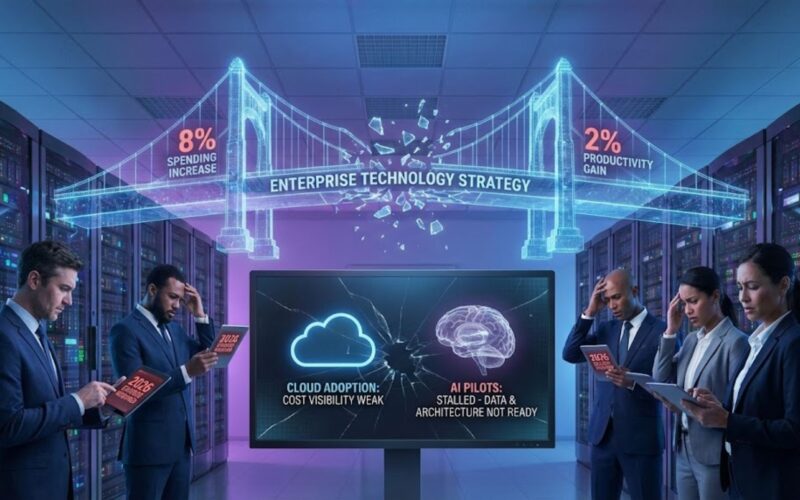






You are likely investing heavily in cloud platforms to achieve faster delivery, greater scalability, and stronger security. Yet in many enterprises, those gains remain out of reach. As cloud environments grow, costs rise, but operational friction remains the same. This gap exists because cloud adoption is often treated as an infrastructure move rather than a business transformation.
Fragmented systems, partial migrations, and legacy security models continue to slow teams down and limit visibility. Industry data reflects this challenge clearly. The 2025 Flexera State of the Cloud Report found that 84 percent of organizations struggle to manage cloud spend, making cost control the top cloud challenge for enterprises.
A digital enterprise cloud solution addresses this problem by aligning cloud architecture, governance, security, and integration with business objectives rather than with isolated workloads.
This guide explains why traditional cloud adoption falls short, how digital enterprise cloud solutions are structured, and what you should evaluate to implement cloud at enterprise scale with measurable results.
Key Takeaways
- A digital enterprise cloud solution is not cloud hosting. It is an operating model that aligns architecture, security, governance, and delivery with business outcomes.
- 84% of enterprises struggle to manage cloud spend, mainly due to weak governance, idle resources, and poor cost attribution.
- Enterprises fail when cloud is treated as a data center replacement, leading to slow releases, rising costs, and persistent technical debt.
- Scalable enterprise cloud platforms rely on cloud-native architecture, microservices, strong data governance, and identity-driven security.
- Choosing the right solution depends on business alignment, vendor risk, cost transparency, and phased modernization rather than feature-led vendor selection.
What Is a Digital Enterprise Cloud Solution and How Is It Different From “Moving to the Cloud”?
Most enterprises believe cloud adoption is complete once workloads run on AWS, Azure, or GCP. That assumption is the root cause of stalled outcomes. A digital enterprise cloud solution changes how systems are built, governed, and operated, not just where they run.
Key distinction explained:
A digital enterprise cloud solution combines architecture, delivery, security, and governance into a single operating model aligned with business goals.
| Area | Traditional Cloud Hosting | Digital Enterprise Cloud Solution |
| Architecture | VM-based, tightly coupled | Cloud-native, service-based |
| Deployment | Manual or semi-automated | CI/CD-driven releases |
| Scalability | Reactive scaling | Demand-driven scaling |
| Cost visibility | Account-level | Product and team-level |
| Security | Perimeter-focused | Identity and policy-driven |
Why enterprises fail with cloud-as-datacenter thinking
Whenlegacy applications are lifted without redesign, release cycles remain slow, infrastructure costs increase, and teams stay dependent on centralized IT. This approach preserves technical debt while adding complexity to cloud billing.
Business outcomes that signal real enterprise cloud maturity
- Faster release cycles without system-wide regression risk
- Clear cost ownership by product or business unit
- Built-in compliance rather than audit-driven fixes
- Consistent performance during demand spikes
Ready to move past slow systems and fragmented workflows? Codewave helps enterprises modernize with cloud-native platforms, microservices, and AI-driven automation built for scale. Clients see up to 3x faster go-to-market for new products and services.
Talk to Codewaveand start building a connected digital foundation that delivers real business impact.
Also Read: Why Cloud Computing Is Key to Digital Transformation
What Business Problems Push Enterprises Toward Digital Enterprise Cloud Solutions?
Enterprises do not adopt digital enterprise cloud solutions simply because cloud technology exists. They adopt them in response to visible failures in existing systems that directly impact cost, speed, scalability, security, andcustomer interactions.These failures become barriers to growth, regulatory compliance, and operational transparency.
Before outlining the solution architecture, it is essential to understand the operational drivers that push organizations toward comprehensive cloud solutions. Some primary operational triggers include:
1. Product delivery bottlenecks
Many enterprises face slow release cycles because legacy and monolithic systems require teams to synchronize changes across tightly coupled modules. This increases dependency, delays progress, and leads to risk-averse development practices. As a result, delivering features on time becomes a recurring executive-level concern.
2. Customer experience inconsistency
Separation between CRM, analytics, web, and mobile platforms often leads to disconnected data views. Customers have different experiences across channels, which affects satisfaction and retention.
Fragmented integration increases the effort required to unify experiences at scale, especially when data formats and APIs are inconsistent.
3. Security and compliance exposure
Security remains a critical adoption hurdle. Misconfigurations, inconsistent controls, and inadequate monitoring contribute to incidents. Roughly 23 percent of cloud security breaches stem from misconfigurations, and a notable share of enterprises report breaches in public cloud environments.
Multi-cloud environments further complicate consistent security practices, with many organizations struggling to enforce compliance standards uniformly.
4. Scaling constraints and fragmented data
As businesses expand into new regions or increase demand on applications, systems initially designed for predictable loads begin to fail. Fragmented tools and lack of centralized observability hinder performance tuning, which in turn slows time-to-value and increases operational risk.
Also Read: Cloud Automation in 2025: Tools, Use Cases, and the Future of Enterprise IT
Furthermore, these problems point to one requirement. Enterprises need cloud systems designed for continuous change, controlled scale, and shared ownership rather than isolated workloads.
Core Components of a Scalable Digital Enterprise Cloud Solution
Enterprise cloud success depends on how components work together. A patchwork of tools or siloed improvements does not provide scale, cost visibility, or security guarantees. Enterprise cloud solutions integrate architecture, data practices, deployment models, and governance into a consistent operating model.
A 2025 global survey found that 89 percent of organizations now use cloud-native techniques for some or most of their development and deployment, showing how widespread cloud-native architectures are in enterprise environments.
1. Architecture Layer
Enterprises must match deployment models to their security, compliance, and performance requirements rather than selecting a one-size-fits-all approach.
Deployment models and when they matter
- Public cloud for workloads that need rapid elasticity and access to managed services.
- Private cloud for highly regulated workloads with strict data sovereignty requirements.
- Hybrid and multi-cloud environments are required when resilience or strict compliance requires workloads to be divided across providers and on-premises environments.
Choosing the right model
Enterprise teams should evaluate network latency, data residency, compliance obligations, and vendor pricing differences before assigning workloads to a model.
2. Application Layer
Modern enterprise platforms rely on clear service isolation and autonomous scalability.
Service architecture principles
- Microservices divide large applications into small, independent units that can be developed and deployed separately. This enables updates without affecting unrelated features.
- Containers package applications and dependencies consistently across environments.
- Orchestration tooling (e.g., Kubernetes) automates scaling, load balancing, and failover across clusters.
Benefits realized
Microservices and containers together allow faster releases, reduce risk during updates, and support modular scaling without rearchitecting entire systems.
3. Data and Analytics Layer
Data must be accessible, governed, and reliable across teams and products.
Core data components
- Cloud data warehouses centralize historical and analytical data for reporting and business intelligence.
- Streaming pipelines support real-time processing where latency matters, such as fraud detection or live personalization.
- Governance and access control ensure appropriate data access and lineage tracking for compliance and analysis.
Value for enterprises
Well-governed data accelerates decision cycles and reduces duplication across business units.
4. Security Foundation
Security must be integral at every layer, not an afterthought.
Essential security controls
- Identity and access management (IAM) enforces least-privilege access.
- Encryption protects data at rest and in transit.
- Policy-driven access and auditing ensure compliance with external regulations and internal standards.
Consistent policies across environments prevent configuration drift and reduce risk.
5. Integration Layer
Enterprises rarely replace all systems at once. Clean integration enables gradual transformation.
Integration approaches
- APIs expose legacy system functionality without wholesale replatforming.
- Event-driven patterns decouple services so changes in one system do not break others.
- Integration platforms coordinate data and service flows between old and new systems, preserving business continuity.
A structured integration strategy prevents tight coupling and reduces future rework.
Also Read: Understanding Digital Strategy vs. Digital Transformation
How Enterprises Should Choose the Right Digital Enterprise Cloud Solution
Enterprise cloud decisions break when selection starts with vendor feature lists instead of operating requirements. Cloud is now too large a spend category to treat as an IT refresh. Gartner forecasts$723.4B in worldwide public cloudend user spending in 2025, which raises the bar on cost accountability and architecture discipline.
1. Decision criteria that matter
Start by answering a small set of questions that force clarity on outcomes, risk, and ownership.
| Decision area | What to evaluate in practical terms |
| Business alignment | Which products and workflows must improve and how you will measure it |
| Vendor risk | How hard it is to migrate data, identity, and platform services later |
| Cost model | Who owns spend and how it maps to products, teams, and regions |
| Delivery capability | Whether you can run CI CD, SRE, and security operations at scale |
| Governance readiness | Tagging, budgets, policy controls, and audit readiness from day one |
2. Cost reality check with figures
Cloud spend extends beyond compute and storage, and the line items that hurt are often the ones teams ignore early
Use these checks before committing to an architecture or a provider.
- Data transfer out fees can become a hidden tax in data-heavy products. AWS charges $0.09 per GB for the first 10 TB of data transfer out to the internet across multiple services.
- Idle resources rise fast without enforced ownership. Implement mandatory tagging and budget alerts before teams self-serve.
- Tool sprawl grows as each team buys its own monitoring, security, and FinOps stack. Consolidate around a small set of platform standards.
- Compliance and monitoring overhead adds recurring cost through log retention, SIEM, continuous compliance scanning, and audit evidence collection.
3. Security and compliance considerations
Enterprise cloud responsibility is shared, not transferred. Providers secure the underlying infrastructure, and your teams secure identities, data, access, and configuration.
Treat these as non-negotiables during selection.
- Define identity boundaries and privileged access flows, then map them to IAM and key management services.
- Require policy-as-code for network rules, identity controls, and encryption settings to ensure environments remain consistent.
- Validate audit support early by testing evidence collection, logging retention, and access review workflows against your compliance needs.
4. Migration vs modernization decisions
Not every workload needs immediate redesign. A clear sequencing plan reduces rework and prevents stalled programs.
| Scenario | Recommended approach | What to validate before you start |
| Low change systems | Lift and shift | Cost baseline, end-of-life timelines, and security controls |
| Customer-facing platforms | Re architecture | Latency, scale targets, release cadence, data model changes |
| Core enterprise systems | Phased modernization | Integration plan, data migration risk, compliance constraints |
A good rule is to modernize where speed, customer experience, and scale matter, and to migrate only when the workload is stable and nearing retirement.
Also Read: The Future of Big Data Solution Trends in 2026
How Codewave Helps You Build the Right Digital Enterprise Cloud Solution
Codewave is a design-thinking-led digital transformation company that helps enterprises build scalable, secure cloud platforms. The team works across cloud architecture, custom software, data, and platform engineering to replace fragmented legacy systems with enterprise-ready cloud solutions.
What this means for your enterprise
- Cloud strategy mapped to business goals, product roadmaps, and growth plans
- Enterprise-ready architecture using microservices, containers, and Kubernetes
- Cost governance models that provide clear ownership and spend visibility
- Security built into identity, data, and access layers from the start
- Integration patterns that allow legacy and modern systems to coexist safely
How Codewave executes
- Assessment of existing infrastructure, workloads, and cost structure
- Architectural design aligned to regulatory, scale, and performance needs
- Phased migration and modernization to reduce operational risk
- Ongoing optimization for cost, performance, and security
See how enterprises across fintech, healthcare, retail, logistics, and SaaS have implemented scalable cloud platforms with Codewave. Explore the Codewave portfolio.
Conclusion
Enterprises that treat cloud as a strategic platform rather than an infrastructure upgrade see clearer gains in speed, cost control, and system reliability. A digital enterprise cloud solution brings architecture, governance, security, and delivery into a single operating model that supports growth and compliance at scale. The difference comes down to execution choices made early and how well cloud aligns with real business priorities.
If you are evaluating or reworking your enterprise cloud strategy, Codewave can help you design and build a cloud platform that fits your operating model and growth goals. Connect with Codewave to assess your systems, reduce cloud risk, and move forward with confidence.
FAQs
Q: How long does it take to implement a digital enterprise cloud solution?
A: Timelines vary based on system complexity, regulatory needs, and modernization scope. Most enterprises see initial value within 3 to 6 months through phased migration, while full platform maturity often takes 12 to 18 months. A staged approach reduces disruption and avoids rework.
Q: Can enterprises control cloud costs without limiting innovation?
A: Yes. Cost control comes from governance, not restriction. Product-level cost ownership, mandatory tagging, and budget alerts allow teams to innovate while keeping spend visible and accountable. Organizations that adopt FinOps practices early see better ROI without slowing delivery.
Q: Is multi-cloud always necessary for enterprises?
A: No. Multi-cloud makes sense for regulatory separation, resilience, or vendor risk mitigation. For many enterprises, a well-architected hybrid or single-cloud setup delivers better operational clarity and lower complexity. The decision should follow risk and compliance needs, not trends.
Q: How does enterprise cloud impact regulatory audits and compliance?
A: When designed correctly, enterprise cloud simplifies audits. Policy-as-code, centralized logging, and identity-driven access controls reduce manual evidence collection and audit preparation time. Poorly designed cloud environments increase compliance risk instead of reducing it.
Q: What internal skills do enterprises need before modernizing to cloud-native systems?
A: Teams need basic cloud operations knowledge, CI/CD ownership, and security awareness. Platform engineering and SRE capabilities can be built gradually with partner support. Enterprises that delay modernization until skills are perfect often fall further behind.

Codewave is a UX first design thinking & digital transformation services company, designing & engineering innovative mobile apps, cloud, & edge solutions.