




If your service isn’t meeting customer expectations in 2026, the problem may not be the offering but how it was designed. As customer expectations continue to rise, businesses that do not adopt structured design approaches risk stagnation or churn.
Effective design methods help companies go beyond surface‑level improvements and build services that resonate with users, streamline internal processes, and produce measurable business outcomes such as higher retention and stronger revenue growth.
Despite this, only a small fraction of businesses consistently align their service activities with customer needs and expectations, leaving performance gaps that erode satisfaction and profit.
In this blog, you will learn five key design approaches that can help your business build customer‑centric, scalable, and efficient services that deliver value and measurable results.
Key Takeaways
- Effective service design methods such as Design Thinking, Agile, and User-Centered Design are essential for creating services that align with user needs and business goals.
- 81 % of customer experience leaders say easy access to internal knowledge improves decisions that affect service quality.
- Agile and UCD together ensure consistency across the user journey, improving adoption and engagement.
- Service Blueprinting helps visualize both customer-facing and internal processes, reducing inefficiencies and driving alignment.
- Early adoption of structured design methods reduces rework, enhances customer satisfaction, and delivers measurable business outcomes.
Why Service Design Is Critical in 2026
Service development is no longer only about functional delivery; it determines whether your customers stay, buy more, or walk away. Rising expectations have made experience quality a core business imperative, not a differentiator.
For 2026, research shows that customers expect consistent experiences across interactions, and businesses that fail to meet this will lose relevance and revenue. For example, 81 % of customer experience leaders say easy access to internal knowledge improves decisions that affect service quality.
Service design methods help integrate user insights, workflows, and service delivery logic to meet these expectations and measure impact. Early integration of structured design methods prevents costly rework and aligns teams around outcomes rather than assumptions.
Below are the key forces reshaping service design priorities and why adopting robust design methods is essential.
Customer expectations and experience demand
- Consistent context: Customers expect seamless continuity across touchpoints, with access to previous interactions and history informing each engagement.
- 24/7 accessibility: Around three-quarters of consumers now expect around-the-clock service support, which requires a design that enables proactive, flexible service logic.
Technology and data influence design decisions
- Integrated data flows: Modern services rely on unified data across channels and teams to tailor responses and avoid repetitive interactions.
- Cross‑channel processes: Omnichannel presence is no longer optional; services must be designed to operate holistically across web, mobile, support, and physical channels.
Early integration of structured design yields measurable outcomes
- Reduced inefficiencies: Methods such as service blueprinting provide visibility into both customer-facing and internal processes, revealing friction points early.
- Aligned team efforts: Bringing design thinking and agile workflows together drives faster iterations based on real customer data rather than assumptions.
Also Read: Design Thinking Process: A Human-Centric Approach to Problem Identification
Top 5 Essential Design Approaches for 2026
Service and product design in 2026 will emphasize methods that integrate deep human understanding, iterative learning, and cross-disciplinary coordination to create services that respond to complex user contexts and dynamic market expectations.
These approaches support measurable experience outcomes and strategic alignment across user, business, and technological dimensions.
1. Design Thinking: Putting Users at the Heart of Service Development
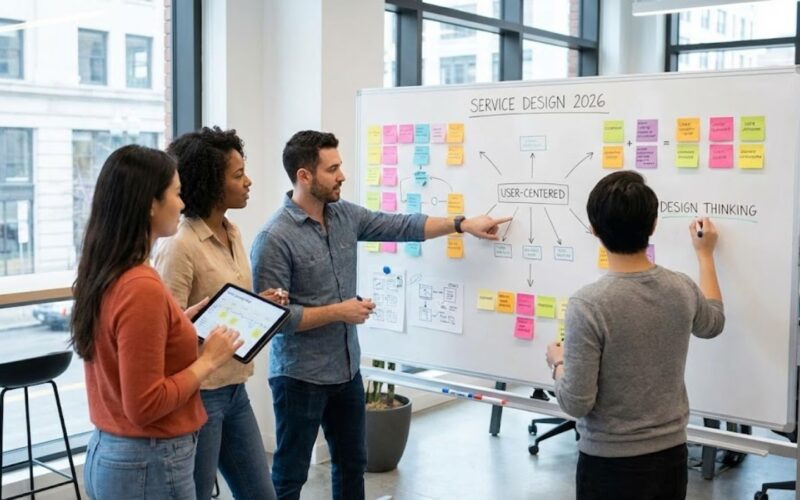
Design Thinking is a structured, human‑centered methodology that focuses on uncovering real user needs and shaping solutions through iterative learning cycles. It moves beyond assumptions to evidence‑driven problem framing and solution testing.
Core Principles
- Empathy: Gather direct user insights to understand behaviors and pain points.
- Ideation: Generate a wide set of concepts before refinement.
- Prototyping: Create low‑cost versions of ideas to validate them rapidly.
- Testing: Validate assumptions with real users and refine accordingly.
How It Aligns Service & Strategy
Design Thinking integrates user desirability, business feasibility, and technical viability so teams invest where user evidence supports value creation.
High‑Impact Examples with Sources
- IBM: Adopted Design Thinking across its enterprise to realign product development with user needs, generating measurable improvements in customer satisfaction and cross‑team alignment.
- Airbnb: Early user research and listing-quality experiments helped the platform shift from slow bookings to rapid growth by addressing trust and usability barriers.
- Bank of America – “Keep the Change”: Developed with IDEO, this savings program automatically rounded purchases to the nearest dollar, boosting participation by addressing real-world money‑management behavior.
Outcome Patterns
Teams using structured Design Thinking achieve more explicit problem definition, lower development risk, and improved adoption and ROI when user data drives decisions.
2. Agile Service Design: Adapting to Change and Accelerating Development
Agile Service Design applies iterative delivery principles (short cycles, frequent feedback, cross‑functional teams) to evolve services while keeping them aligned with user needs and market signals.
Operational Principles
- Incremental delivery: Regular, usable releases shorten feedback loops.
- Continuous feedback: User and stakeholder reviews at each iteration inform direction.
- Collaborative planning: Teams align on value and dynamically adjust priorities.
- Adaptability: Scope and features evolve based on real usage data and changing needs.
Measured Benefits
- Teams repeatedly report higher responsiveness to shifting requirements and faster delivery of value.
- Agile adoption at large enterprises (e.g., Spotify, ING, Microsoft) has been linked to improved innovation cadence and better alignment with customer outcomes.
Specific Case Insight
- John Deere: Agile transformation with Scrum at scale cut time‑to‑market by 87% and increased deployment frequency over 400%, demonstrating Agile’s capacity to accelerate execution and align services with evolving demands.
3. Service Blueprinting: Visualizing the Service for Operational Clarity
Service Blueprinting maps service delivery across customer interactions and internal processes, highlighting how frontstage touchpoints connect to backstage operations. This makes hidden processes visible and aids coordination across teams.
Key Blueprint Components
- Customer actions: The steps users take.
- Frontstage interactions: What the user experiences directly.
- Backstage processes: Internal activities supporting service delivery.
- Support systems: Tools, partners, and systems enabling operations.
Why It’s Valuable
Blueprints align departments on the actual workflow, reducing inefficiencies and clarifying decision points that affect user experience and internal costs.
Real Examples & Insights
- Airbnb, Spotify, and Starbucks have publicly shared service blueprint maps that show how multiple touchpoints and supporting processes form consistent service flows.
- Healthcare & Public Services: Blueprinting exposes bottlenecks and inefficiencies before operational change, enabling targeted improvements.
Business Outcome
Teams gain a shared operational “source of truth” that accelerates implementation, minimizes rework, and aligns leadership on where investments will yield improvements across customer journeys and internal workflows.
4. User‑Centered Design: Designing Services Around the Customer Experience
User‑Centered Design (UCD) focuses on iterative user involvement throughout the development process to ensure services reflect real behaviors, preferences, and constraints.
Operational Best Practices
- Early user research: Structured studies to understand real contexts.
- Usability testing: Iterative validation with representative users.
- Iterative refinement: Feedback loops improve design quality.
Outcome Evidence
Applying UCD principles improves usability metrics, such as task success rates and user satisfaction, reducing support costs and increasing engagement.
Case Insight
- Mobile AR Shopping Feature: A UCD implementation for an augmented reality shopping app helped align feature design with real user behaviors, increasing clarity and usability in testing scenarios.
UCD ensures services match how people actually work, reducing waste from assumptions and misaligned features and increasing adoption and retention, as measured by engagement metrics.
5. Systems Thinking: Optimizing the Entire Service Ecosystem
Systems Thinking treats services as interconnected networks of processes, stakeholders, policies, and environmental factors. It helps organizations anticipate how changes ripple through the service ecosystem, leading to more robust, scalable solutions.
Core Concepts
- Interdependencies: Recognize how components influence each other.
- Feedback loops: Identify reinforcing or balancing factors across the system.
- Holistic metrics: Go beyond local KPIs to assess ecosystem health.
Organizational Value
Systems approaches help uncover latent issues in complex processes and inform strategies that avoid unintended consequences by considering the full service environment.
Illustrative Insights
Government service projects applying Systems Thinking have improved alignment across programs by identifying shared constraints and relationships that were not obvious under traditional siloed analysis.
Also Read: Using AI to Enhance Customer Experience
Challenges in Implementing Design Methods for Service Development
Implementing service design approaches often falters because organizational culture, structures, and execution practices are not aligned with the collaborative, iterative, and data‑driven nature of these methods.
Addressing people, process, and technology issues up front increases the likelihood of real impact rather than stalled initiatives.
Some common barriers to successful service design include:
| Barrier | Description & Source |
| Lack of Alignment | Conflicting goals and priorities across stakeholders make it hard to converge on a unified service vision or outcomes, leading to fragmented work and rework. |
| Resistance to Change | Teams and leaders often resist altering workflows and established habits, slowing the adoption of collaborative design practices. |
| Siloed Mentality | Independent departments are reluctant to share information, block co‑creation, and reduce the quality of design insights. |
| Insufficient Data & Research | Weak user research or a lack of analytics infrastructure leads to decisions based on assumptions rather than evidence. |
| Complexity of Integration | Visual mapping, journey diagrams, and tool integration require time and expertise; legacy technology makes cohesion difficult. |
| Measuring Success | Design projects often struggle to define and measure meaningful ROI or experience outcomes, which can erode support. |
| Resource Constraints | Smaller organizations may lack training budgets, research resources, or dedicated design roles to execute sophisticated design libraries. |
How to Overcome These Challenges
Addressing the common barriers to implementing design methods requires strategic actions and commitment across all levels of an organization.
| Solution | Actionable Practice & Source |
| Establish Shared Goals | Define clear service objectives aligned with business strategy. Document user outcomes and review them with cross‑functional stakeholders to ensure everyone agrees on the success criteria. |
| Build Internal Champions | Appoint advocates across teams who understand and communicate the value of the design methods internally to reduce resistance. |
| Invest in User Research & Metrics | Structured design research correlates with meaningful adoption outcomes. Teams applying design thinking sometimes see up to a 40% increase in customer engagement and a 36% increase in service adoption, demonstrating the payoff of evidence‑driven approaches. |
| Start Small with Pilots | Run pilot projects to prove value quickly, refine methods, and gather favorable case data before scaling organization‑wide. |
| Facilitate Collaboration Spaces | Create forums (regular workshops, shared platforms) where cross‑discipline teams co‑design and review work together. |
| Define Evaluation Frameworks Upfront | Agree on KPIs and data collection methods before design work begins so progress can be tracked and communicated. |
Also Read: Understanding Enterprise Software Development Process
How Codewave Transforms Businesses with Innovative Service Design
At Codewave, we specialize in delivering tailored digital solutions that integrate modern design methodologies. Our approach blends agile development, user-centered design, and advanced technologies to create scalable, user-centric services that deliver measurable results.
As a top IT services provider, we help businesses solve complex challenges and enhance user experiences across various industries.
Why Codewave Stands Out
- Expertise in Design Thinking: We incorporate user insights, empathy, and continuous feedback into our development processes to ensure solutions align with real-world user needs.
- Agile Development Practices: We leverage agile methodologies to create iterative, flexible, and scalable services that evolve based on feedback and market dynamics.
- Tailored Solutions: Codewave’s offerings are customized for each client, ensuring that our services directly meet specific business goals and user expectations.
- Seamless Integration: We ensure smooth integration of new design methods and technologies with legacy systems, overcoming common implementation challenges.
- Collaborative Approach: Cross-functional collaboration is at the heart of our process, aligning design, development, and business teams to co-create impactful solutions.
Explore our portfolio to see how we’ve successfully transformed businesses and delivered impactful solutions across multiple sectors.
Conclusion
Service design methods such as Service Design Thinking, Agile, and User-Centered Design extend beyond visual interfaces, shaping backend processes, technology, and policies. These frameworks foster deeper customer loyalty and operational stability by focusing on holistic experiences.
However, only a small percentage of teams implement these methodologies effectively, often leaving the execution phase underdeveloped. Integrating Agile with UCD ensures consistency across the entire user journey, preventing fragmented experiences.
Contact Codewave today to discuss how we can integrate these proven service design practices into your organization’s strategy for measurable success.
Let’s build the future of your services together!
FAQs
Q: How does service design differ from UX design?
A: Service design covers the end‑to‑end experience, including customer interactions and internal operations, whereas UX design focuses mainly on the usability and experience of a specific product interface. In service design, both “front‑stage” user touchpoints and “back‑stage” processes are optimized to work together.
Q: Can design thinking be applied outside digital products?
A: Yes. Design thinking is a problem‑solving mindset used not just in digital product creation but in service delivery, organizational strategy, and complex non‑technical problems. It emphasizes empathy, experimentation, and redefining problems to create meaningful outcomes across industries.
Q: What common tools support service design beyond blueprints?
A: Tools like customer journey maps, stakeholder maps, and personas help teams visualize interactions and uncover opportunities for improvement across touchpoints. These methods reveal pain points and guide decision‑making beyond basic assumptions.
Q: How do design sprints fit into service development?
A: A design sprint applies structured phases of ideation, prototyping, and testing under time constraints, helping teams align on goals and validate ideas before full development. It blends Agile iteration with a design thinking focus, minimizing risk early in service planning.
Q: What’s a lesser‑known design method that complements UCD and service design?
A: Usage‑centered design focuses on user roles and task flows to structure services around what users actually do, not just what they say they need. It provides a structured view of user intentions and usage patterns to craft more intuitive services.

Codewave is a UX first design thinking & digital transformation services company, designing & engineering innovative mobile apps, cloud, & edge solutions.