





Assess Enterprise Readiness Before Automating
Why does this matter?
Enterprises waste resources automating broken processes without a strategy. This cheat sheet prevents chaos by treating automation as a managed transformation program.
Who is this for?
Operations leaders, automation center heads, process owners, and IT directors are responsible for scaling automation across departments. Anyone managing enterprise automation portfolios or evaluating readiness needs this framework.
What you get?
A practical automation readiness guide that evaluates processes, governance, operating models, and portfolio oversight. It provides clear indicators to determine when automation can scale reliably and where foundations need reinforcement first.
The Danger (Chaos)
Scaling automation without a solid foundation introduces several operational risks. These chaos points often arise when enterprises jump into automation without the right controls, processes, or alignment.
Common Chaos Points:
- Siloed Automation Efforts: Teams work in isolation, creating disconnected bots that don’t align across the enterprise.
- Unclear Ownership and Accountability: No one “owns” the automation program, leading to confusion about responsibilities.
- Fragile Processes: Automating broken or inefficient processes locks in inefficiencies and increases maintenance.
- Lack of Governance: No clear policies or oversight to ensure scalability, security, and compliance.
- Uncontrolled Scaling: Scaling too quickly without standardization or performance monitoring leads to system fragility.
- Data Inconsistencies: Poor data quality or fragmentation across teams impacts automation effectiveness and reliability.
- Resistance to Change: Employees resist new systems, delaying adoption and reducing automation success.
Enterprise Readiness Checklist
Process Maturity
- Process documented with clear inputs, outputs, and decision points
- Exception handling rules are defined and consistently applied across the team
- Current process runs without manual workarounds or shadow procedures
- Performance metrics exist and show a stable baseline before automation
Technical Infrastructure
- Systems provide API access or structured data extraction methods
- Authentication protocols support bot credentials without security exceptions
- Environment separated into dev, test, and production tiers
- Version control established for automation assets and configuration files
Organizational Readiness
- Executive sponsor committed to budget authority and change mandate
- Process owner identified who understands the end-to-end workflow intimately
- IT support allocated for infrastructure, security, and maintenance needs
- Change management resources are available to support user adoption efforts
Governance Foundation
- Automation center of excellence exists, or leadership approves establishment
- Standards defined for bot naming, documentation, and code quality
- Access controls established for production bot credentials and systems
- Incident response procedures documented for bot failures and escalations
FIX → STANDARDIZE → AUTOMATE LADDER
The Three-Stage Readiness Model
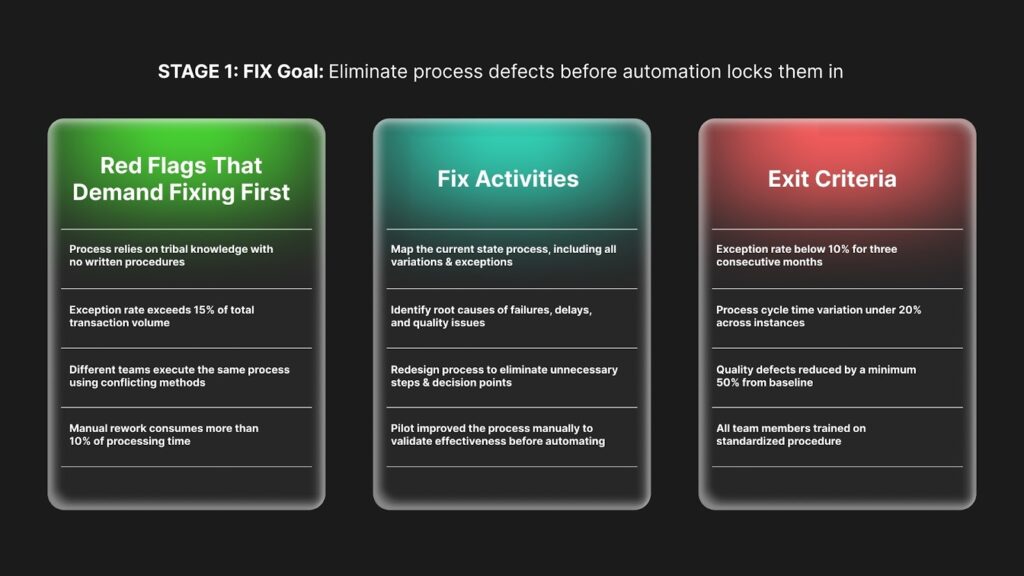
STAGE 1: FIX Goal: Eliminate process defects before automation locks them in
Red Flags That Demand Fixing First
- Process relies on tribal knowledge with no written procedures
- Exception rate exceeds 15% of total transaction volume
- Different teams execute the same process using conflicting methods
- Manual rework consumes more than 10% of processing time
Fix Activities
- Map the current state process, including all variations and exceptions
- Identify root causes of failures, delays, and quality issues
- Redesign process to eliminate unnecessary steps and decision points
- Pilot improved the process manually to validate effectiveness before automating
Exit Criteria
- Exception rate below 10% for three consecutive months
- Process cycle time variation under 20% across instances
- Quality defects reduced by a minimum 50% from baseline
- All team members trained on standardized procedure
STAGE 2: STANDARDIZE Goal: Create consistency across teams, systems, and locations
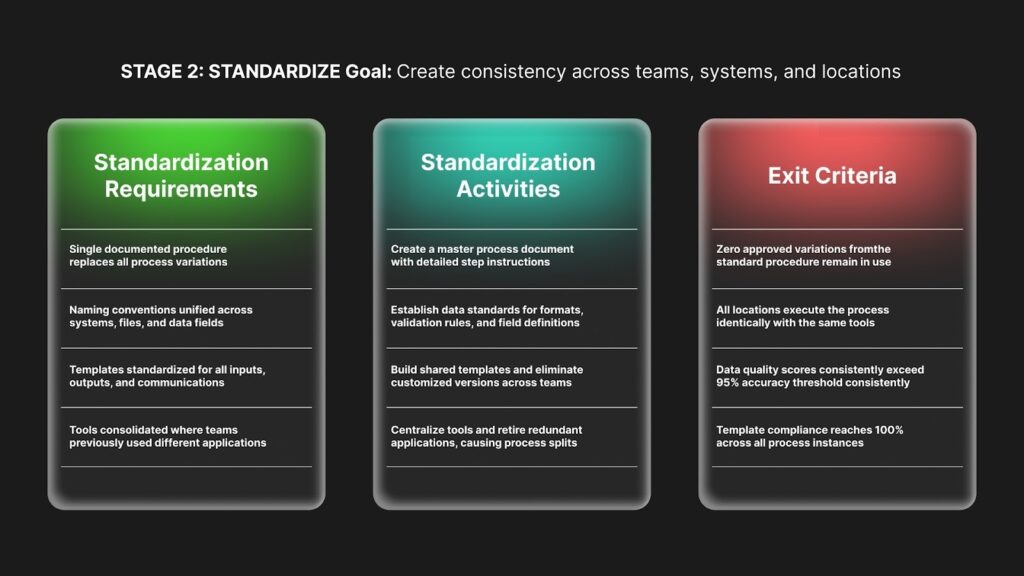
Standardization Requirements
- Single documented procedure replaces all process variations
- Naming conventions unified across systems, files, and data fields
- Templates standardized for all inputs, outputs, and communications
- Tools consolidated where teams previously used different applications
Standardization Activities
- Create a master process document with detailed step instructions
- Establish data standards for formats, validation rules, and field definitions
- Build shared templates and eliminate customized versions across teams
- Centralize tools and retire redundant applications, causing process splits
Exit Criteria
- Zero approved variations fromthe standard procedure remain in use
- All locations execute the process identically with the same tools
- Data quality scores consistently exceed 95% accuracy threshold consistently
- Template compliance reaches 100% across all process instances
STAGE 3: AUTOMATE Goal: Deploy automation that scales without brittleness
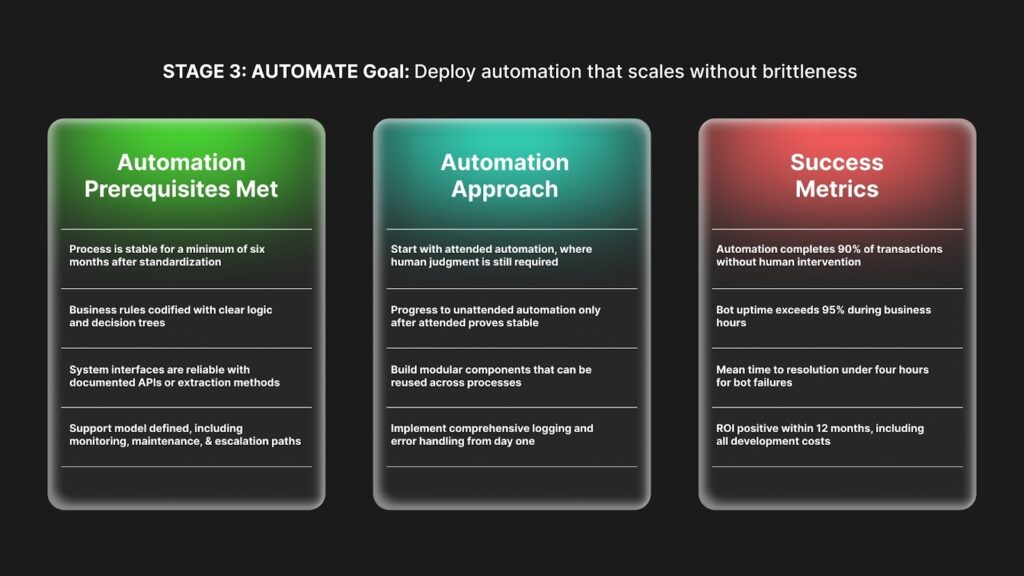
Automation Prerequisites Met
- Process is stable for a minimum of six months after standardization
- Business rules codified with clear logic and decision trees
- System interfaces are reliable with documented APIs or extraction methods
- Support model defined, including monitoring, maintenance, and escalation paths
Automation Approach
- Start with attended automation, where human judgment is still required
- Progress to unattended automation only after attended proves stable
- Build modular components that can be reused across processes
- Implement comprehensive logging and error handling from day one
Success Metrics
- Automation completes 90% of transactions without human intervention
- Bot uptime exceeds 95% during business hours
- Mean time to resolution under four hours for bot failures
- ROI positive within 12 months, including all development costs
Automation Prioritization Matrix
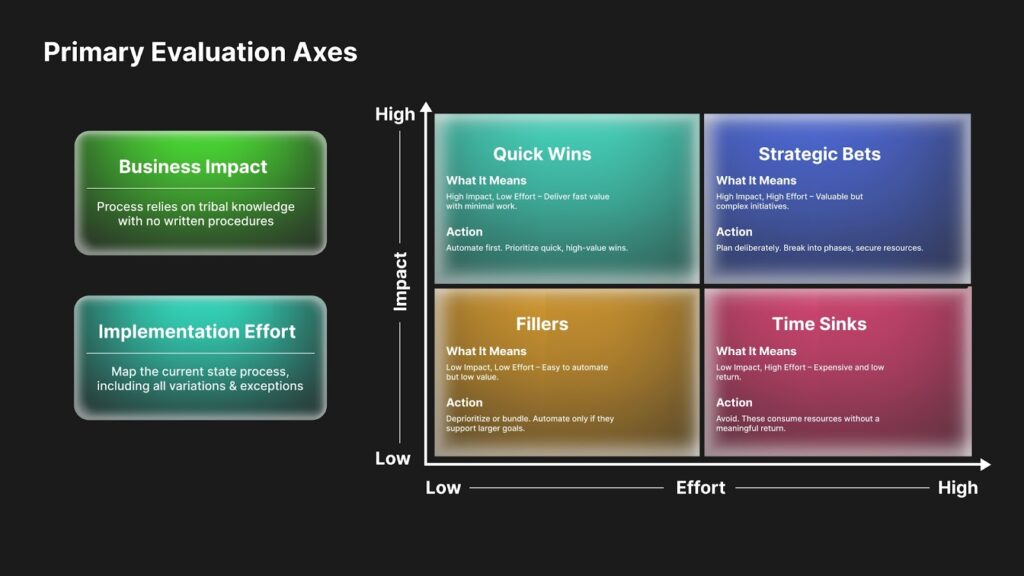
Enterprises scale automation effectively by prioritizing the right work, not the most visible work. This matrix helps teams compare automation candidates objectively and sequence efforts with discipline.
Primary Evaluation Axes
Business Impact
Measures the value automation delivers through cost reduction, cycle time improvement, risk reduction, or service reliability.
Implementation Effort
Assesses complexity across process clarity, system integration, data readiness, and exception handling.
Matrix Quadrants
| Quadrant | What It Means | Action |
| Quick Wins | High Impact, Low Effort – Deliver fast value with minimal work. | Automate first. Prioritize quick, high-value wins. |
| Strategic Bets | High Impact, High Effort – Valuable but complex initiatives. | Plan deliberately. Break into phases, secure resources. |
| Fillers | Low Impact, Low Effort – Easy to automate but low value. | Deprioritize or bundle. Automate only if they support larger goals. |
| Time Sinks | Low Impact, High Effort – Expensive and low return. | Avoid. These consume resources without a meaningful return. |
The Roadmap
Automation scales smoothly only when ownership is explicit, and governance is built in from the start. This model clarifies who decides, who builds, who operates, and who intervenes.
Core Ownership Roles
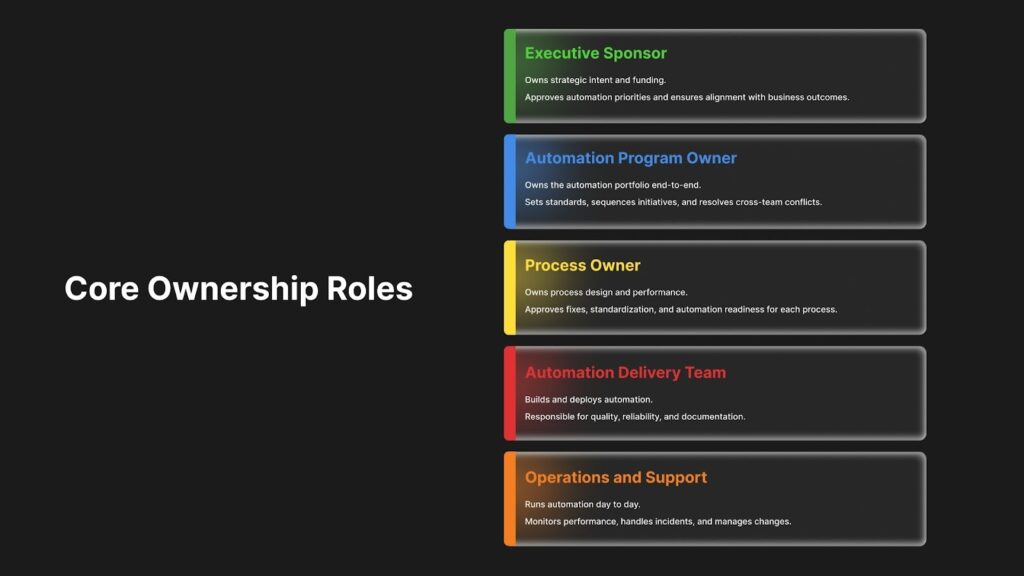
Executive Sponsor
Owns strategic intent and funding.
Approves automation priorities and ensures alignment with business outcomes.
Automation Program Owner
Owns the automation portfolio end-to-end.
Sets standards, sequences initiatives, and resolves cross-team conflicts.
Process Owner
Owns process design and performance.
Approves fixes, standardization, and automation readiness for each process.
Automation Delivery Team
Builds and deploys automation.
Responsible for quality, reliability, and documentation.
Operations and Support
Runs automation day to day.
Monitors performance, handles incidents, and manages changes.
Governance Decision Points
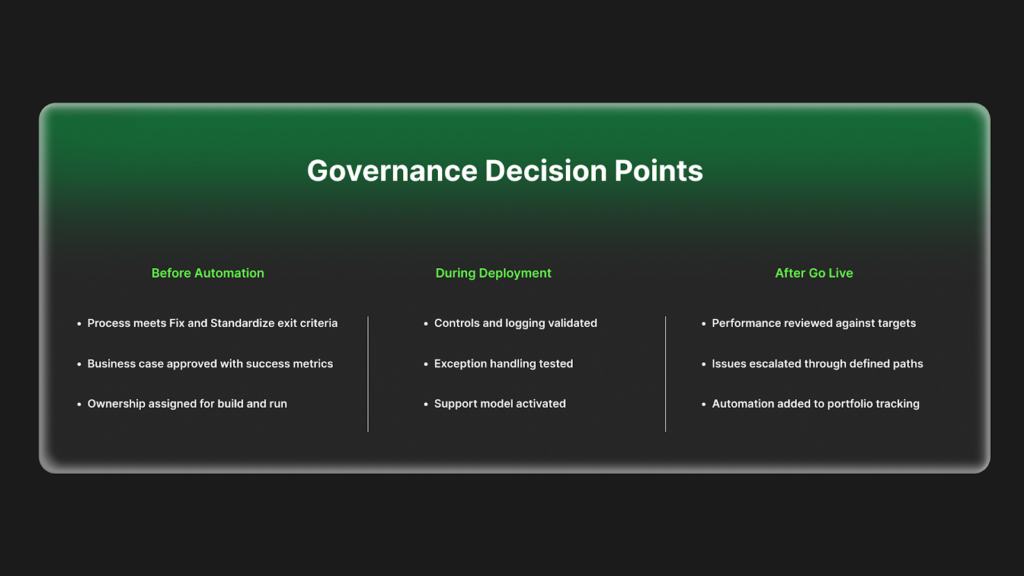
Before Automation
• Process meets Fix and Standardize exit criteria
• Business case approved with success metrics
• Ownership assigned for build and run
During Deployment
• Controls and logging validated
• Exception handling tested
• Support model activated
After Go Live
• Performance reviewed against targets
• Issues escalated through defined paths
• Automation added to portfolio tracking
Governance Signals That Scale Is Safe vs When It’s Not
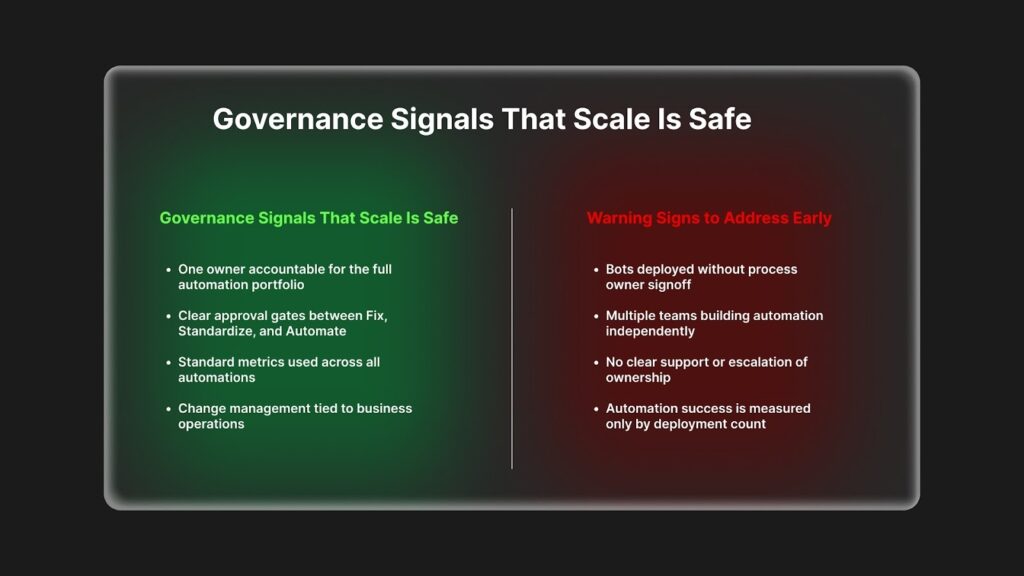
Governance Signals That Scale Is Safe
• One owner accountable for the full automation portfolio
• Clear approval gates between Fix, Standardize, and Automate
• Standard metrics used across all automations
• Change management tied to business operations
Warning Signs to Address Early
• Bots deployed without process owner signoff
• Multiple teams building automation independently
• No clear support or escalation of ownership
• Automation success is measured only by deployment count
Ownership prevents sprawl. Governance prevents fragility. Together, they turn automation into a managed enterprise capability instead of a collection of bots.
To give this a crisp, non-repetitive finish, we need to transition from the “how-to” mechanics into the financial and strategic stakes. Here is the “Satisfactory Ending” designed to wrap up the document with authority:
THE BOTTOM LINE: SCALE IS EARNED, NOT BOUGHT
Automation without readiness is simply accelerating inefficiency. To move from a collection of bots to an enterprise-grade automation engine, you must respect the hierarchy of scale.
The 1:10:100 Rule of Automation
- $1 to optimize a manual process today.
- $10 to fix a standardized process.
- $100 to repair a broken process once it has been automated at scale.
- Readiness is not a delay; it is the ultimate cost-saving measure.
30-Day Executive Action Plan
To stop the chaos and start the scale, execute these three steps immediately:
- The Pipeline Freeze: Audit your current automation backlog against the Prioritization Matrix. Pause any “Time Sinks” (Low Impact/High Effort) regardless of their current progress.
- The Gatekeeper Protocol: Formalize the Fix → Standardize → Automate ladder as a mandatory policy. No project receives budget without a signed “Stage 2 Exit Certificate.”
- Appoint the Pilot: Identify one high-impact process and run it through the full Readiness Model to create a “Gold Standard” blueprint for the rest of the organization.
The Choice: You can either spend your budget on Innovation (building new capabilities) or Remediation (fixing fragile bots).
Which one is your team currently funded for?

Codewave is a UX first design thinking & digital transformation services company, designing & engineering innovative mobile apps, cloud, & edge solutions.