



Are your current defenses keeping pace with the speed and intelligence of modern threats? If your business still relies on manual monitoring and static firewalls, your exposure is already growing.
Therefore,AI security is no longer a niche set of tools for early adopters. It is becoming a core component of how organizations detect, analyze, and respond to cyber risks at machine speed.
AI-driven attacks have increased by 47% globally in 2025, according to DeepStrike. For business leaders and IT heads, this means AI is now central to defense strategy. This blog breaks down how AI security works, key applications driving measurable impact, and the practical steps to integrate it across your operations.
Key Takeaways
- AI is redefining cybersecurity from reaction to prediction. Intelligent systems now detect anomalies, learn from every event, and respond in seconds.
- Most organizations are already adopting AI security. Over 73% of companies now use AI to strengthen detection, automate responses, and reduce alert fatigue.
- Manual, rule-based defenses are losing ground. With billions of data points flowing daily, AI-driven models filter noise, slash false positives, and surface the threats that truly matter.
- Behavior analytics and adaptive authentication are changing identity protection. Instead of static passwords, access adjusts in real time based on behavior, device trust, and session risk.
- AI-led vulnerability management brings precision to patching. Teams now focus on what’s exploitable and business-critical, not just what’s new, reducing remediation waste by double digits.
What Exactly Is AI Security and Why It Matters
Traditional security tools depend on fixed rules and known signatures. They require constant updating by human analysts and are limited to detecting threats that match predefined patterns.
In contrast, AI-enabled security adapts as new data arrives. It usesmachine learning and data analytics to detect, assess, and respond to cyber threats faster than human teams can.
For example, a rule-based system might block a known malware hash. Still, an AI model trained on hundreds of features could identify unusual lateral movement indicative of a breach before the malware signature is even cataloged.
How AI Security Works
AI-based defense mechanisms function through three key capabilities:
- Detection: Scans billions of data points in real time to pinpoint deviations from normal patterns, even if they’ve never been encountered before.
- Prediction: Forecasts which vulnerabilities or systems are likely to be targeted next using trend analysis and probability scoring.
- Automated Response: Executes predefined actions (such as isolating endpoints or blocking suspicious connections) when risk thresholds are met.
Core Technologies Behind AI Security
AI-driven defense systems rely on:
- Supervised and Unsupervised Machine Learning – For learning from historical and real-time data.
- Anomaly Detection Engines – To identify irregular behaviors across endpoints and networks.
- Behavioral Analytics – To establish “normal” baselines for users, applications, and devices.
- Reinforcement Learning Models – To fine-tune response accuracy with every incident.
Also Read: Everyday Applications and Examples of Artificial Intelligence in Business and Education
Once you understand what AI security does, the next step is exploring why it’s becoming essential and what problems it actually solves.
What Security Challenges Are Driving AI Adoption
Organizations today face cyber threats that evolve faster than they can be cataloged. Attackers now use AI to automate intrusions, mask identities, and bypass signature-based systems.
Key statistics that underline this shift:
- 16% of global breaches in 2025 began with phishing campaigns.
- 80% of ransomware attacks are now AI-assisted, enabling attackers to modify code and evade detection rapidly.
Why Traditional Systems Fall Short
Legacy, rule-based tools can’t handle this complexity. Their limitations include:
- Static detection models that fail against new attack variants.
- Manual rule updates slow down response time.
- High false positives, overwhelming analysts with noise.
- Scalability gaps are expected as data volumes surge across multi-cloud and IoT environments.
A report found that most enterprises lack the analytics infrastructure to process the immense volume of telemetry data effectively. As a result, genuine threats often get buried under thousands of irrelevant alerts.
The Critical Role of AI Security
AI-driven solutions address these weaknesses by automating threat detection and prioritization. They can:
- Analyze large-scale data across cloud, endpoint, and network systems in seconds.
- Rank alerts based on context and risk, reducing human triage time.
- Identify hidden threats, such as insider misuse or slow-moving zero-day exploits.
- Continuously learn, improving accuracy over time without manual intervention.
Want to harness GenAI but not sure where to begin? Codewavehelps you apply Generative AI to automate security, reporting, and customer engagement with measurable outcomes. Explore how our GenAI Development Services turn complex workflows into intelligent, self-learning systems.
Also Read: Step-by-Step Guide on Building AI Agents for Beginners
With the challenges clear, let’s look at where AI security delivers measurable impact through real-world applications.
Practical AI Security Applications You Can Deploy Today
The question is not whether AI security works, but where to apply it first to achieve a measurable impact. Below are practical applications you can deploy now, how they work, and what they deliver.
1. Intelligent Threat Detection
AI-based detectionengines continuously analyze network traffic, endpoint logs, and cloud events. Instead of matching only known signatures, unsupervised learning models and clustering algorithms learn what “normal” activity looks like.
When traffic patterns, device behavior, or login attempts fall outside this baseline, the system flags them as anomalies for review or immediate action.
Typical components include:
- Time series analysis on network flows.
- Clustering of similar events to spot outliers.
- Scoring engines that rank each event by risk.
Benefits for you
- Detects unknown or polymorphic threats that do not match any signature.
- Reduces missed incidents while keeping alert volume manageable.
- Provides your SOC with a prioritized queue rather than a flat list of raw events.
Example use cases
- Monitoring east-west traffic inside a data center to catch lateral movement after an initial compromise.
- Watching API calls in a healthcare portal to detect abnormal data export patterns.
- Tracking login and access patterns across SaaS tools for early account takeover detection.
2. Behavioral Analytics for Insider Threats
User and Entity Behavior Analytics (UEBA) tools create behavior profiles for users, devices, and applications by analyzing identity logs, file access data, VPN activity, and endpoint signals.
Machine learning models track normal patterns and flag anomalies, such as unusual data access or logins from distant locations, as elevated risks.
Despite high awareness of insider risk, only about 44% of organizations use UEBAto enhance detection, leaving a gap in many security programs.
Benefits for you
- Detects misuse of legitimate accounts, which traditional tools often miss.
- Reduces blind spots across cloud, endpoint, and on-premises systems.
- Lowers false positives by comparing a user to their own baseline rather than a fixed rule set.
Example use cases
- Flagging an employee who suddenly downloads large volumes of source code before resignation.
- Identifying compromised credentials used from new geographies with unusual access paths.
- Monitoring database admins in financial institutions for unusual data queries
3. Automated Incident Response
Security Orchestration, Automation, and Response (SOAR) platforms connect your SIEM, EDR, firewalls, ticketing tools, and threat intel feeds. AI models and rule logic decide what action to take based on the alert context.
When an alert meets defined criteria, the system triggers a playbook, for example, isolating a host, blocking an IP, creating a ticket, and notifying the on-call analyst.
Recent analyses show that AI-powered SOAR workflows can reduce incident response time by up to 70%, thereby reducing the potential impact of a breach.
Benefits for you
- Cuts mean time to detect (MTTD) and mean time to respond (MTTR).
- Frees analysts from repetitive triage tasks, so they focus on complex cases.
- Brings consistency to responses, regardless of who is on shift.
Example use cases
- Automatically isolating an endpoint when ransomware-like behavior is detected, then running scans and collecting forensics.
- Blocking a suspicious IP across cloud firewalls when a high-risk alert is confirmed.
- Auto-enriching alerts with threat intel and user context before an analyst even opens the case.
4. Fraud Detection in Financial Systems
In banking and fintech environments, AI models score each transaction in real time using features such as device fingerprinting, transaction history, geolocation, merchant type, and time of day. Supervised learning models are trained on historical fraud and non-fraud data and are continuously refined.
Studies show AI-based anti-fraud systems can reach detection accuracy above 99% while reducing false positives by around 80%, which is a major improvement over static rule-based systems.
Benefits for you
- Flags fraudulent transactions before settlement or payout.
- Cuts false positives that annoy genuine customers and overload review teams. Adapts quickly to new fraud patterns without rewriting long rule sets.
Example use cases
- Scoring card transactions for a retail bank and stepping up authentication only on high-risk payments.
- Monitoring peer-to-peer payments in a fintech app to detect mule accounts.
- Screening insurance claim submissions for anomalies in claim value, frequency, or metadata.
5. Vulnerability Prioritization
AI-driven vulnerability tools rank risks instead of just listing them. They analyze scanner data, asset importance, exploit availability, and exposure context to assign a risk score per asset.
This replaces first-in-first-out patching with impact-driven remediation, focusing on what could most affect the business.
Benefits
- Fixes critical vulnerabilities first.
- Cuts wasted effort on low-impact issues.
- Aligns patching with business priorities.
Use cases
- Patching exposed hospital systems before internal tools.
- Fixing production cloud misconfigurations before staging.
- Planning updates for industrial systems around downtime windows.
6. Secure Access Controls
AI brings intelligence to authentication. Models assess each login by device trust, IP risk, geolocation, and user behavior. Low-risk logins stay smooth while high-risk ones trigger stronger MFA or restricted access.
Continuous monitoring during sessions adds another layer of defense.
Benefits
- Reduces account takeovers.
- Keeps MFA adaptive and user-friendly.
- Bases access on real-time risk, not static rules.
Use cases
- Step-up MFA for large transactions from unknown devices.
- Limiting contractor access at unusual times.
- Securing cloud admin panels using device and behavior analytics.
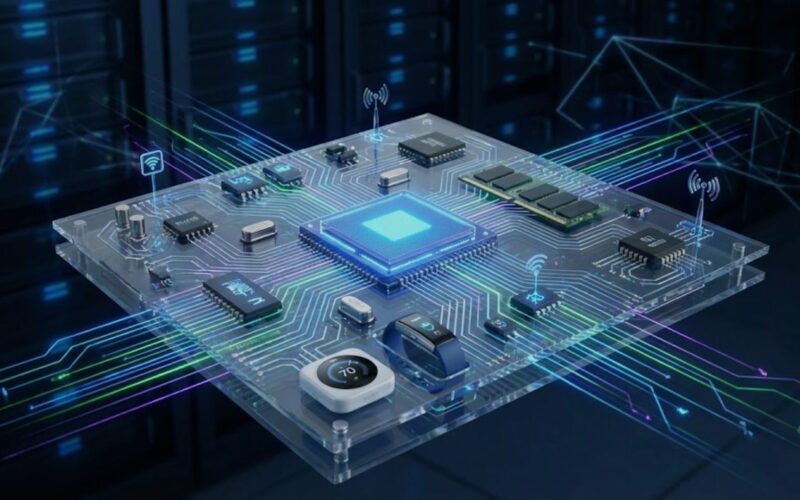
Struggling to secure your connected devices at the edge? Codewave’s Embedded Technology solutionsintegrate Edge-AI and secure firmware to protect data, detect anomalies, and respond in real time, right where threats emerge.
Our precision-engineered systems optimize performance, reduce patch cycles, and make your embedded products both intelligent and secure.
Also Read: Secure Application Development Best Practices Guide
How to Evaluate and Implement AI Security in Your Organization
To adopt AI security effectively, you need a structured process that moves from readiness assessment to real results.
The goal is not just to deploy technology, but to integrate AI where it reduces risk and improves operational outcomes. Below is a crisp, step-by-step framework you can apply.
1. Assess Readiness
Before you start, check if your environment supports AI-driven detection and automation.
Evaluate three essentials:
- Data quality: Ensure clean, timestamped logs from endpoints, cloud apps, and network sources.
- Logging maturity: Centralized visibility is non-negotiable for model training and correlation.
- Security goals: Define measurable outcomes, fewer false positives, faster detection, or improved automation.
Why this matters: AI systems rely on diverse, consistent data. Poor-quality inputs lead to weak or biased predictions. Choose solutions that integrate seamlessly with your stack and meet your operational priorities.
2. Select the Right Tools
Choose solutions that integrate seamlessly with your stack and meet your operational priorities.
Key criteria:
- Integration: Works with existing SIEM, SOAR, IAM, and EDR platforms.
- Performance & explainability: Transparent analytics that show why alerts are raised.
- Scalability: Handles rising data volume without latency.
- Customization: Let’s your team fine-tune models, not just run black-box detections.
Tools worth considering:
| Category | Function | Why It’s Useful |
| SIEM with ML analytics | Centralized log correlation | Core visibility for AI-driven detection |
| SOAR platforms | Automate triage and containment | Cuts response time drastically |
| UEBA systems | Learn behavioral baselines | Detects insider and credential-based threats |
| Custom ML pipelines | Build tailored models | Useful for niche or high-risk environments |
3. Run a Pilot Project
Start small, focus deep.
Choose high-impact areas:
- Endpoint anomaly detection
- Network traffic analysis for lateral movement
- Cloud workload monitoring
Define success metrics:
- Detection accuracy vs. baseline.
- Reduction in alert fatigue.
- Mean time to detect/respond (MTTD/MTTR).
Run the pilot 6–8 weeks, measure performance, and refine based on feedback.
4. Measure and Optimize
Quantify results:
- Detection rate: Did AI surface threats your team previously missed?
- Noise reduction: Track decline in false positives.
- Response speed: Measure how much faster incidents are contained.
Use results to adjust: Fine-tune model thresholds and validate improvements against your original KPIs.
5. Scale and Continuously Improve
Once validated, roll out AI across other layers—identity, cloud, application, and network security.
Refinement loop:
- Feed confirmed incidents and false alarms into retraining pipelines.
- Regularly review model drift and update baselines.
- Expand automation playbooks as confidence builds.
Potential Challenges
Be aware of common pitfalls:
Data Privacy and Compliance
- Ensure logging and analysis respect data retention policies, privacy laws, and access controls.
- Sensitive data (e.g., PII) must be masked or tokenized before model ingestion.
Model Drift
- Changes in network behavior, business processes, or applications can cause models to lose accuracy over time.
- Regular validation and retraining are essential.
Talent and Expertise
- Effective AI security requires both security knowledge and data science skills.
- Build or partner with teams that understand model tuning, threat hunting, and SIEM/SOAR operations.
Also Read: Artificial Intelligence Trends in Healthcare: What Will Matter Most In 2026
Codewave: Driving Secure Digital Transformation
Codewave brings design thinking, AI innovation, and deep technical expertise together to help businesses secure and scale with confidence.
With over 400 global projects delivered across 15+ industries, Codewave builds systems that blend intelligent automation, data-driven decisioning, and seamless user experience.
What We Do Best
- AI Security & GenAI Development: Building predictive, self-learning defense systems that detect threats before they escalate.
- Embedded Technology Solutions: Creating secure, high-performance hardware ecosystems with edge intelligence and adaptive firmware.
- Process Automation: Simplifying complex workflows with AI-driven automation and real-time analytics.
- Custom Software & App Development: Delivering scalable digital platforms optimized for performance and user experience.
- Design Thinking Workshops: Guiding enterprises from problem definition to prototype with user-centric innovation.
Explore our portfolioto see how we’re building secure, intelligent systems that redefine digital performance.
Conclusion
The next era of security will be defined by intelligence at speed. As networks, endpoints, and devices multiply, traditional protection models will fall short. The future belongs to systems that sense, decide, and act in real time, learning continuously and defending dynamically.
Businesses that invest now in adaptive security frameworks will not only mitigate risks but also build long-term trust and resilience.
Looking to future-proof your defense with intelligent systems? Contact Codewave to design a secure, scalable, high-performance infrastructure that grows smarter with your business.
FAQs
Q1: How does AI security reduce operational costs for enterprises?
A: AI security systems automate repetitive monitoring, triage, and response workflows. This reduces analyst workload, lowers dependence on large SOC teams, and reduces downtime from missed or delayed alerts, directly improving cost efficiency.
Q2: What industries benefit most from AI-driven vulnerability management?
A: Healthcare, fintech, and manufacturing see major impact because they manage critical assets with strict uptime and compliance requirements. AI tools prioritize high-risk vulnerabilities, ensuring business continuity without disrupting operations.
Q3: How does AI handle false positives in security alerts?
A: Machine learning models refine themselves over time using feedback from past incidents. As they learn the difference between normal and suspicious behavior, false positives drop, improving analyst focus and response speed.
Q4: Can small and mid-sized businesses afford to implement AI security?
A: Yes. Scalable cloud-based AI security tools now make enterprise-grade protection accessible to SMBs. Many platforms allow modular adoption—start with automated detection, then expand to response and analytics.
Q5: What’s the next evolution in AI security beyond detection?
A: The next phase is autonomous defense, systems that detect, analyze, and act independently while sharing threat intelligence across networks. This shift will redefine cybersecurity from a reactive process to a self-improving, continuous protection model.

Codewave is a UX first design thinking & digital transformation services company, designing & engineering innovative mobile apps, cloud, & edge solutions.