




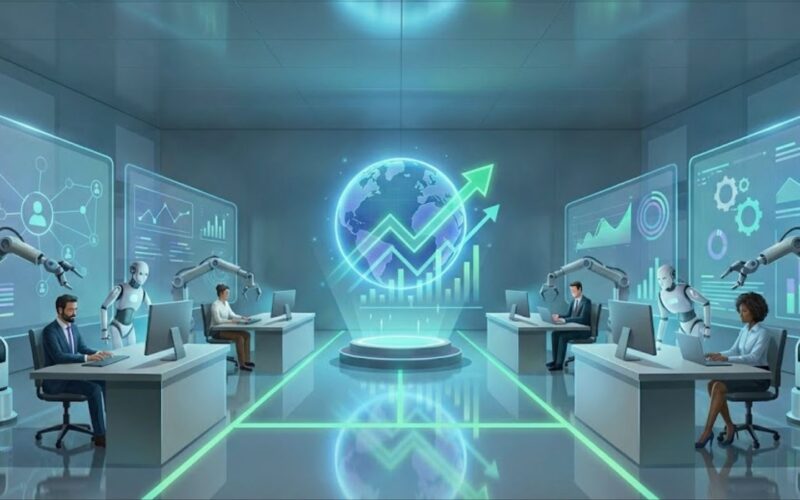
The workplace is experiencing a profound evolution right now. Artificial intelligence and automation have moved from experimental technology to everyday tools. Companies across industries are integrating smart systems into their operations.
The financial implications of this orbital shift are remarkable. Economists predict that by 2030, AI and automation technologies will inject roughly $15.7 trillion into the global economy. This represents one of the largest economic expansions driven by technology in history.
But this evolution also brings important questions. How do professionals adapt? What skills become valuable? Where do humans fit in an increasingly automated world?
This article examines how these technologies are changing job functions, what opportunities are emerging, and how to prepare for the next chapter of work.
Key Takeaways
- AI handles execution, humans handle judgment. Automation absorbs repetitive tasks while people focus on context, creativity, and relationship building that machines cannot replicate.
- Team structures flatten as coordination becomes automated. Organizations need fewer management layers when systems handle monitoring. Cross-functional collaboration strengthens, and decision cycles compress from weeks to days.
- Success metrics shift from activity to outcomes. Hours logged become irrelevant. Organizations now track time reclaimed, error reduction, customer experience improvements, and team health signals instead.
- Implementation failures stem from organizational issues, not technology. Most automation projects fail because teams automate broken processes, ignore data quality, or lack clear ownership of automated workflows.
What Changes First When AI and Automation Enter Work?
The first signs of change are often subtle but meaningful. Small improvements in daily routines begin to add up, creating more space for work that requires human judgment.
- Less Manual Effort in Everyday Tasks: Data entry, form filling, and document formatting happen automatically. Systems pull information from multiple sources and organize it without human intervention. The hours spent on administrative work gradually decrease.
- Faster Completion Without Longer Hours: Tasks that once took days now finish in hours. Reports generate themselves. Schedules optimize automatically. Teams accomplish more within regular working hours without needing to extend their days or sacrifice personal time.
- Clearer Priorities During the Workday: AI tools help identify which tasks need immediate attention. Notifications arrive when decisions are required. The noise of constant requests and alerts diminishes, making it easier to focus on what truly needs human expertise.
- Fewer Handovers Between People and Tools: Information flows smoothly from one system to another. Files don’t get lost in email chains. Teams spend less time coordinating logistics and more time collaborating on solutions that require creative thinking and experience.
- Quicker Access to the Right Information: Search functions become more intelligent. Relevant documents surface when needed. Knowledge bases organize themselves. Finding the right information no longer means digging through folders or asking multiple colleagues for help with simple questions.
- More Consistent Quality in Repeat Work: Standardized processes produce uniform results. Invoices, reports, and communications maintain quality regardless of workload. Human error in routine tasks decreases significantly, reducing time spent on corrections and revisions.
- Early Relief From “Busywork” That Drains Energy: Calendar management, expense reporting, and routine follow-ups happen in the background. Energy that once went to maintaining systems now goes toward problem-solving, building relationships, and developing new ideas.
Which Tasks Deliver the Fastest Return from Automation?
Some applications of automation deliver immediate, measurable results. Organizations that implement these tools often see productivity gains within weeks rather than months.
Workers using AI-powered systems report reclaiming approximately 52 minutes daily, which translates to nearly five hours weekly. That recovered time gets redirected toward strategic work, client relationships, and innovation that requires human insight.
Here are the industries where automation pays back quickest through practical, visible outcomes.
| Industry | Application | Outcome |
| Fintech | Transaction monitoring, compliance checks, and customer onboarding | Faster processing, fewer manual reviews, improved accuracy without added workload |
| Healthcare | Appointment scheduling, clinical documentation, and billing workflows | Reduced admin burden, more time for patient care, smoother operations |
| Retail | Inventory tracking, demand forecasting, customer support triage | Better stock availability, quicker responses, fewer operational gaps |
| Insurance | Claims intake, policy validation, risk assessment | Shorter claim cycles, consistent evaluations, lower processing friction |
| Transportation | Route planning, fleet monitoring, maintenance alerts | Improved efficiency, fewer delays, clearer operational visibility |
| Education | Grading support, student communication, administrative reporting | Less manual paperwork, faster feedback, improved staff focus |
The gap most teams face is execution. Opportunities are clear, use cases are obvious, yet automation breaks down once workflows grow complex or scale enters the picture. Tools promise relief but create new friction. Systems work in isolation. Results stall.
Codewave builds AI solutions that remove that friction. We design human-centric AI tools that simplify work, adapt as needs change, and scale without drama.
From conversational systems and intelligent automation to prediction-driven insights, every solution is built for accuracy, agility, and real-world use.
Tell us the one workflow you want automated first. We’ll map the quickest path to a working AI solution.
How AI Improves Decisions Without Taking Control
Good decisions still come from people. What changes is the quality of signals available before a call needs to be made. AI helps reduce noise, surface patterns, and support judgment at the right moment.
It works quietly in the background, offering clarity without removing responsibility.
- Pattern recognition across large data sets: AI identifies trends and anomalies across volumes of data that are impossible to review manually, bringing early clarity to complex situations.
- Recommendations that support human judgment: Suggestions are framed as options, giving decision makers context and confidence without forcing a single prescribed path.
- Reduced risk through early warnings: Potential issues are flagged sooner, allowing teams to act before small signals turn into costly problems.
- Better forecasting with fewer guesswork inputs: Predictions rely on observed behavior and historical patterns, reducing dependence on assumptions or incomplete estimates.
- Faster root cause clues during incidents: AI narrows likely causes quickly, helping teams focus investigation efforts instead of chasing unrelated symptoms.
- Smarter prioritization under time pressure: Tasks are ranked based on impact and urgency, helping teams respond effectively when everything feels important.
- Clearer tradeoffs between speed, cost, and quality: Decision paths are compared side by side, making consequences visible before commitments are made.
Where Human Work Becomes More Valuable
As automation absorbs repeatable effort, human contribution moves upstream. Value gathers around judgment, intent, and care. Work becomes less about execution and more about direction, meaning, and trust.
Problem Solving That Requires Context
Some problems resist clean definitions. They sit inside history, constraints, timing, and human consequences. AI can surface signals, but it cannot fully read the room.
People connect facts with lived experience and situational awareness. That context prevents technically correct solutions from becoming practical failures.
Example: Consider a team noticing a steady drop in customer engagement. The system points to lower email open rates and suggests sending more messages. A human leader remembers a recent pricing update that caused confusion.
Instead of increasing outreach, the team clarifies communication and simplifies choices. Engagement improves without overwhelming customers.
Creative and Strategic Contributions
Strategy forms when ideas, limits, and long-term intent meet. Creativity lives in synthesis, not prediction. AI can present options based on patterns, but humans choose which path fits their identity and ambition. This work involves imagination, restraint, and commitment without certainty.
Example: Picture a product team reviewing AI-generated growth ideas. One option promises fast adoption but pulls the product away from its core purpose. Leadership chooses a slower route that strengthens identity and trust. Growth follows through focus, not speed.
Relationship and Trust Building
Trust grows through consistency, empathy, and shared understanding. These qualities cannot be automated. AI may assist communication, but people interpret tone, intent, and emotion. Relationships often determine outcomes long before numbers do.
Example: Let’s say a long-term partner grows frustrated after a delayed delivery. Automated updates explain the delay, but tension remains. A human steps in, listens, explains tradeoffs honestly, and resets expectations. The relationship steadies because it feels understood, not managed.
Setting Goals and Defining “Good” Outcomes
AI optimizes toward targets it receives. Humans decide what deserves optimization. Goals reflect values, priorities, and tradeoffs beyond efficiency. Defining success requires judgment about impact, fairness, and long-term effect.
Example: Consider a team celebrating a faster turnaround after automation. Support tickets rise quietly in the background. Leadership reframes success to include experience and reliability. The system is adjusted, and quality stabilizes alongside speed.
Asking Better Questions and Framing Decisions
Strong outcomes begin with well-framed questions. Humans define scope, challenge assumptions, and choose where attention belongs. AI responds to prompts. It does not decide which problems are worth solving.
Example: Picture a support team asking how to close tickets faster. A leader reframes the question to ask why tickets repeat. Automation then supports fixing root causes rather than accelerating symptoms.
Reviewing AI Outputs With Sound Judgment
AI produces confident answers, not accountable ones. Humans review outputs, test alignment, and apply discretion. Judgment protects against bias, blind spots, and overreach. Responsibility remains human.
Example: Let’s say a risk model recommends rejecting an application. A reviewer notices recent context missing from the data. The decision is reconsidered, preventing an unfair outcome.
Handling Sensitive Situations With Care
Certain moments require empathy, discretion, and moral awareness. Layoffs, health issues, disputes, and crises demand human handling. AI can support preparation, but people carry responsibility for tone and impact.
Example: Consider a manager preparing a difficult workforce update. AI drafts the message. The manager rewrites it with clarity, care, and honesty. The message lands with dignity, not distance.
This is the space where many teams pause. They see automation working, yet struggle to design systems that respect human judgment, context, and responsibility.
Codewave builds native-AI systems designed around human decision points. Our focus stays on accuracy, adaptability, and clarity, so AI supports thinking instead of narrowing it.
Throughout the development process, we will keep your team in the loop, surface context before recommendations, and keep on adapting outputs based on real-world feedback.
Bring more consistency to the work that repeats daily. We’ll build solutions that reduces errors and keeps quality steady.
Schedule a strategy call today.
How Team Structures Evolve with Automation
Automation doesn’t just change what people do. It changes how teams organize themselves, communicate, and share responsibility.
The traditional hierarchies built around information flow and task handoffs start to look different when systems handle the coordination work.
Smaller Execution Layers
Organizations historically needed multiple management layers to oversee routine work and ensure quality.
Automation handles much of this monitoring and execution, reducing the need for supervisory roles focused on task management. Teams become flatter. Decision rights move closer to the work itself.
Stronger Cross-Functional Collaboration
When information flows freely between systems, silos become less defensible. Marketing sees sales data in real time.
Product teams access customer support trends immediately. This transparency makes cross-functional work easier. Teams naturally collaborate because they’re looking at the same information and chasing shared outcomes.
Clear Ownership and Accountability
Automated systems create detailed records of who did what and when. Teams need explicit ownership of outcomes, not just tasks.
When systems handle execution, humans own the decisions that guide those systems. Ambiguity about responsibility becomes expensive and harder to maintain.
New Roles Around Workflow Design
Someone needs to design how humans and machines work together. Organizations now need people who understand both technology capabilities and operational needs.
They map processes, identify automation opportunities, and orchestrate handoffs. These roles bridge technical teams and business functions, translating requirements in both directions.
More Emphasis on Productive “Ops” Functions
Operations roles gain prominence because they keep automated systems running smoothly. DevOps, RevOps, MarketingOps ensure tools are configured correctly and data flows properly.
As automation scales, operations expertise becomes strategic rather than purely technical. These teams prevent small issues from cascading across the organization.
Faster Decision Loops With Fewer Meetings
When systems surface insights automatically, teams don’t need as many meetings to gather information. Decisions that once required scheduling multiple people now happen asynchronously through shared dashboards.
Meetings become spaces for debate and creativity rather than status updates. Decision cycles compress from weeks to days.
Better Alignment Between Leadership and Delivery
Leadership historically relied on filtered reports traveling up through management layers. Automation gives leaders direct visibility into operations without burdening front-line teams with reporting.
They see what’s happening in near real-time. This creates better strategic decisions grounded in current reality.
How Success Is Measured in an Automated Environment
Traditional metrics were designed for human-driven work. They measured hours, activity levels, and output volume.
When automation is working, teams stop tracking effort and start tracking results. The question shifts from how busy people are to whether work is moving faster, cleaner, and with less strain. These measures show if automation is improving outcomes or just adding tools.
KPIs to track:
- Time reclaimed: Work takes fewer steps to complete, giving teams more uninterrupted time for problem-solving and decision-making.
- Fewer errors: Automation reduces manual handling, which lowers mistakes and keeps output consistent across repeated tasks.
- More predictable costs: Spending stabilizes because workflows run the same way each cycle, reducing surprises caused by rework or delays.
- Shorter delivery cycles: Requests move through systems with fewer pauses, making timelines easier to estimate and meet.
- Better customer outcomes: Customers experience faster responses, clearer communication, and fewer issues that require follow-ups.
- Less rework and escalation: Problems are caught earlier in the process, so fewer items bounce back or need urgent intervention.
- Healthier team load: Work feels more evenly distributed, with fewer spikes that lead to burnout or constant catch-up.
Common Mistakes That Limit Results
Automation projects fail more often than they succeed, and the reasons are usually predictable. Organizations rush to implement technology without addressing foundational issues.
They treat automation as a technical problem when it’s really an organizational one. Common pitfalls include:
- Automating Broken Processes: Automation makes processes faster, not better. If the underlying workflow is inefficient or poorly designed, automation just speeds up the dysfunction.
Teams end up with rapid execution of unnecessary steps, duplicate approvals, or outputs nobody uses. Fix the process first, then automate it. Otherwise, you’re investing in technology that locks in bad practices.
- Too Many Tools, Too Little Clarity: Organizations accumulate automation tools without a coherent strategy. Marketing uses one platform, operations uses another, finance has their own system.
None of these tools talk to each other. Information gets trapped in silos, teams duplicate efforts, and nobody has a complete picture. Fewer integrated tools usually deliver better results than many disconnected ones.
- Ignoring Adoption and Trust: Building the system is only half the challenge. People need to trust it enough to use it. If teams don’t understand how automation works or don’t believe the outputs are reliable, they’ll work around it.
They’ll double-check everything, maintain shadow spreadsheets, or ignore recommendations entirely. Technology only delivers value when people actually adopt it.
- Weak Data Foundations and Messy Inputs: AI and automation depend entirely on data quality. Inconsistent naming conventions, duplicate records, missing fields, and outdated information produce unreliable results.
Teams spend more time correcting automated outputs than they saved on execution. Clean, well-structured data is the foundation. Without it, even the best automation tools struggle to deliver value.
- No Clear Owner for the Automated Workflow: Automated processes need someone accountable for their performance. When things go wrong, teams need to know who fixes it. When requirements change, someone must update the system.
Without clear ownership, automated workflows deteriorate over time. Parameters become outdated, exceptions multiply, and what started as efficiency becomes a maintenance burden.
- Measuring Activity Instead of Outcomes: Organizations celebrate the number of processes automated or the volume of tasks completed by AI. These metrics miss the point.
What matters is whether automation improved customer experience, reduced costs, or freed people for strategic work. Activity metrics create busy work. Outcome metrics drive real improvement.
- Treating AI as “Set and Forget”: AI systems need ongoing attention. Business conditions change, customer preferences evolve, and new edge cases emerge. Models trained on last year’s data become less accurate over time.
Organizations that implement AI and move on find performance degrading quietly. Regular monitoring, retraining, and adjustment are essential to sustained value.
What You Should Pay Attention to Over the Next Few Years
The pace of change in AI and automation is accelerating, not stabilizing. What seems cutting-edge today becomes standard practice tomorrow. Professionals who track these developments position themselves for opportunity rather than disruption. Here’s what deserves close attention.
Skills That Machines Can’t Replicate Yet
The gap between human and machine capabilities keeps shifting, but certain skills remain firmly in human territory. These represent safe investments in professional development.
- Complex negotiation that requires reading subtle social cues and building rapport over time
- Creative problem solving in ambiguous situations where the problem itself isn’t clearly defined
- Ethical reasoning that weighs competing values and considers long-term societal implications
- Leadership that inspires people through uncertainty and helps teams navigate difficult transitions
- Strategic thinking that imagines entirely new business models rather than optimizing existing ones
Regulatory Changes Around AI Use
Governments worldwide are developing frameworks for AI governance. These regulations will determine how organizations can collect data, deploy algorithms, and make automated decisions.
- Privacy laws that restrict what customer data can be used to train AI models
- Transparency requirements that force companies to explain how automated decisions are made
- Liability frameworks that clarify who’s responsible when AI systems cause harm or make errors
- Industry-specific rules around AI in healthcare, finance, and education where risks are higher
- Employment protections that limit how AI can be used in hiring, promotion, and termination decisions
Industries Where Change Accelerates
Some sectors are moving faster than others. Watching these industries reveals what’s coming for everyone else.
- Healthcare automation in diagnostics, treatment planning, and administrative workflows is expanding rapidly
- Financial services using AI for fraud detection, credit decisions, and personalized wealth management
- Manufacturing, where robotics and predictive maintenance are becoming standard across facilities
- Legal services automating contract review, legal research, and case outcome prediction
- Creative industries where AI assists with design, content creation, and media production
Organizations Leading Implementation
Certain companies are pushing boundaries and setting standards that others will follow. Their successes and failures offer valuable lessons.
- Tech companies testing AI copilots that assist employees across all functions
- Retailers using computer vision and predictive analytics to reimagine customer experience
- Healthcare systems deploying AI for early disease detection and personalized treatment
- Financial institutions automating compliance and risk assessment at unprecedented scale
- Manufacturing leaders achieving near-autonomous production facilities with minimal human intervention
Conclusion
Automation works best when it feels natural. The real gains come from simpler workflows, clearer decisions, and time returned to work that needs human thought.
AI fits quietly into daily routines, reducing friction instead of adding pressure. When done right, work feels calmer, more focused, and easier to move forward with confidence.
Codewave helps teams reach that point. We design AI and ML solutions around real workflows, human judgment, and practical use.
Our approach combines thoughtful design, clean data foundations, and scalable engineering. The result is automation that supports decisions, improves consistency, and holds up as work grows.
Get in touch with us today to build AI that fits your work, supports your people, and delivers results you can rely on.
Frequently Asked Questions
- How will AI and the future of automation change my job role?
Routine tasks like data entry and scheduling will be automated. Your role shifts toward problem-solving and work requiring human judgment. Skills like creativity, relationship building, and strategic thinking become more valuable as automation handles execution.
- What industries are most affected by AI and automation?
Healthcare, financial services, retail, insurance, transportation, and manufacturing are seeing rapid adoption. These sectors benefit most from standardization and data-driven decisions. However, every industry will eventually integrate automation as technology becomes more accessible.
- How do I prepare my team for AI and the future of automation?
Fix broken workflows before implementing technology. Invest in data quality and assign clear ownership for automated systems. Focus on adoption and trust. Train teams to work alongside AI rather than compete against it. Measure outcomes instead of activity.
- What skills should I develop to stay relevant as AI and the future of automation advance?
Focus on capabilities machines cannot replicate: complex negotiation, creative problem solving, ethical reasoning, leadership through uncertainty, and strategic thinking. Technical literacy helps, but understanding how to collaborate with AI matters more than competing against it.
- How much does AI and the future of automation actually save in productivity?
Workers reclaim approximately 52 minutes daily, or nearly five hours weekly. Savings come from reduced manual effort, faster completion, and fewer errors. However, productivity gains depend entirely on implementation quality, data foundations, and whether teams actually adopt the technology.

Codewave is a UX first design thinking & digital transformation services company, designing & engineering innovative mobile apps, cloud, & edge solutions.