




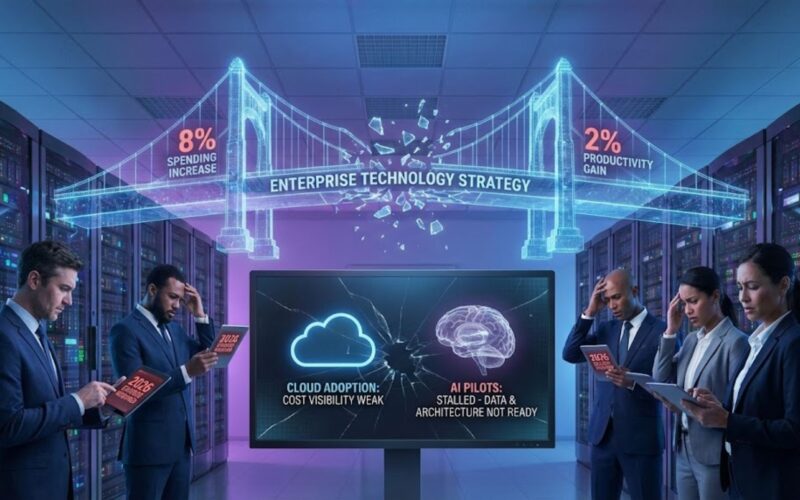
Enterprise technology spending continues to increase, yet productivity gains remain limited. In the United States, enterprise technology budgets have been growing at around 8% annually, while overall labor productivity has increased by about 2% over the same period. This gap shows that simply increasing IT investment does not automatically improve business performance.
Cloud adoption shows a similar pattern. Most enterprises now run critical workloads on cloud platforms, but cost visibility and control remain weak. At the same time, AI investments are stalling. Many enterprises launch pilots, yet only a small share move those initiatives into full production because data, architecture, and operating models are not ready.
These issues share a common cause. Many organizations operate without a defined enterprise technology strategy that links technology choices to business priorities.
This blog explains what needs to change, why it matters for growth and cost control, and how to execute a stronger strategy in 2026.
Key Takeaways
- Tool-first strategies break at scale. When tools, rather than business priorities, drive technology decisions, outcomes suffer. Only 48% of enterprise digital initiatives achieve their intended results.
- A few decisions drive most enterprise outcomes. Build vs buy choices, core platform selection, data architecture, and automation scope shape cost, speed, and risk far more than isolated tools.
- Scale starts with clarity, not technology. Enterprises that scale sustainably begin with business capability mapping, then audit applications, data, and infrastructure to identify real constraints.
- Structure enables speed. Clear architecture principles and federated governance reduce delivery friction while controlling security and cost as systems grow in size and complexity.
Why Enterprise Technology Strategy Keeps Falling Apart
Enterprise technology strategy failures often first manifest in how organizations make decisions, how legacy systemspersist, and how planning defaults to vendor timelines rather than business needs. These weaknesses have measurable effects on delivery, integration, security, and operating expense.
Examples of how a weak strategy shows up in core enterprise outcomes:
- Slow releases: A recent industry report found that internal IT builds miss deadlines or exceed budgets more than 70% of the time, and most require double the planned maintenance effort.
- Integration failures: Legacy applications are typically 15 years oldand create technical debt and a siloed architecture that complicate data sharing and system interoperability.
- Security exposure: Nearly half of IT pros say outdated systems directly contribute to vulnerabilities, increasing the risk of breaches and compliance gaps.
- Rising operational costs: Enterprises report that legacy systems cost hundreds of millions annually in maintenance, failed modernization efforts, and technical debt.
These data points show that without a unified, business-led strategy, technology investments are absorbed by maintenance and patches rather than enabling outcomes aligned with enterprise goals.
Also Read: AI’s Role in Boosting Operational Efficiency
What Has Changed in Enterprise Technology Strategy Since 2025
Enterprise technology priorities have shifted from experimentation toward embedding key capabilities into core operations. Recent industry reporting and surveys reveal measurable changes in how business leaders plan, fund, and govern technology decisions.
These shifts matter because older approaches that treated new technologies as isolated projects no longer support enterprise scale in 2026.
Since 2025, several strategy changes have become clear:
1. AI adoption is moving into production workflows
AI is now expected to compete with traditional enterprise priorities like cybersecurity and process automation. According to industry surveys, AI/ML climbed into the top five enterprise technology priorities after trailing for years, signaling that leaders are allocating budget and governance attention to it alongside core systems.
2. Cloud cost accountability is tightening
Finance teams and CFOs are increasingly involved in cloud planning and approvals as organizations try to constrain runaway infrastructure expense. This reflects growing scrutiny at the board level, not just the IT level, over recurring cloud spend.
3. Security is being built into the architecture earlier
Cloud securityresearch finds that over 70% of organizations face elevated risks associated with AI and cloud configurations, particularly identity and access challenges. This pushes security planning upstream into architectural decisions rather than treating it as a post-deployment checklist.
Data and AI strategy guidance from enterprise reports emphasizes a structured data architecture and cross-departmental integration, making shared platforms a priority for scaling productivity and control over one-off tools.
Are rising technology costs eating into your enterprise margins?
Codewave helps enterprises reduce technology costs by up to 30 percent by modernizing legacy systems, strengthening cloud governance, and operationalizing AI across core platforms. Contact Codewave today!
Also Read: 20 Technology Trends With Measurable Impact in 2025
Which Technology Decisions Actually Shape Enterprise Outcomes?
These decisions determine whether your enterprise technology strategy produces measurable business results or is spent without impact. Independent research shows that only about 35% of digital transformation initiatives meet value targets, underscoring the critical role of disciplined decisions in outcomes.
Before listing decision areas, it’s important to assess technology choices against expected business outcomes, not technical buzz.
1. Build vs Buy vs Extend
- Build custom systems when functionality directly affects core capabilities such as proprietary workflows or differentiated services.
- Buy commercial platforms when mainstream needs can be met with market-proven, supported solutions.
- Extend existing systems using APIs or modules when it reduces integration risk and protects current investments.
Enterprises that use a structured framework to make these decisions experience fewer costly rewrites and a lower risk of technology mismatch. A multi-criteria evaluation (business process alignment, integration, and governance) improves selection clarity and reduces lock-in.
2. Core Platform Selection and Lock-In
Platform selection affects scalability, integration, and maintenance costs for years to come. Selecting platforms without clear data portability and interoperability criteria can lead to vendor lock-in, forcing redesigns as business needs evolve. Prioritize platforms that support open standards, modular integration, and clear separation between business logic and underlying services.
3. Data Architecture as a Growth Constraint
Strong data architecture enables effective AI and analytics. Data leaders report that 76% feel pressured to generate value from data, yet poor data quality and fragmentation hinder progress.
Over 80% acknowledge the need for a complete overhaul of their data strategy to succeed with AI initiatives.
Structured data pipelines, unified data models, and real-time access frameworks reduce inconsistencies and increase confidence in analytical outcomes. Without these, insights are slow to emerge, and AI initiatives stall.
4. Automation Beyond Cost Reduction
Automation that targets only task reduction has a limited impact. When automation integrates with operational workflows (e.g., workflow orchestration and process optimization), it improves throughput and reduces decision latency.
Research shows that automation, coupled with data integration, has one of the strongest positive effects on performance outcomes.
Is design driving outcomes or just visuals in your enterprise strategy?
Codewave applies design thinkingto align user needs with business goals, helping teams achieve up to 60 percent higher user adoption through validated problem discovery and rapid prototyping.
Work with Codewaveto turn user insights into decisions, products, and experiences that deliver measurable business results.
How Do You Build an Enterprise Technology Strategy That Survives Scale?
A strategy that can handle enterprise scale must connect business capability planning, architectural rigor, governance clarity, and execution metrics. According to industry reports, only about 48% of enterprise digital initiatives meet or exceed their outcome targets, with the rest underperforming due to execution gaps and poor integration.
Below are the steps that materially improve success and scalability.
1. Map Business Capabilities Before Tool Selection
Enterprise capability mapping directly links business needs with technology choices. According to research, organizations with mature capability maps achieve about 30% better alignment between business strategy and IT investment than those without formal capability mapping.
Implementation actions with measurable focus:
- Identify core business capabilities that drive revenue, compliance, or customer retention.
- Map supporting applications, data, and processes to each capability.
- Quantify capability performance gaps to prioritize technology investment.
Capability mapping reduces redundant systems and clarifies where modernization yields measurable value.
2. Conduct a Technology Audit Across Applications, Data, and Infrastructure
Technical debt and integration gaps increase risk and slow delivery. Independent surveys report that71% of in-house development projects fail to meet timelines or budgets, with many delivered late or abandoned due to weak planning and governance.
Audit checkpoints that drive strategic clarity:
- Inventory applications by age, usage, and dependency patterns.
- Measure data quality, lineage, and ownership across domains.
- Identify infrastructure inefficiencies and unused cloud resources.
- Evaluate security controls and compliance gaps.
An audit is not documentation; it produces a prioritized list of constraints that must be resolved before scaling.
3. Define Architecture Principles for Scalability and Security
Clear architectural principles limit ad-hoc deviations that lead to brittle systems. Enterprises that embed scalable principles see sustained improvements in delivery cohesion and integration standards.
Core architectural controls to specify:
- Service boundaries and domain ownership.
- Standard API contracts and event streams.
- Unified identity and access standards.
- Centralized standards for logging, tracing, and monitoring.
These controls reduce rework and align development teams to consistent engineering targets.
4. Implement Governance That Accelerates Decisions
Enterprises with federated governance models report faster decision cycles because governance does not bottleneck delivery. Governance should establish guardrails, not approve each technical choice.
Governance elements tied to execution velocity:
- Ownership assignment for platforms, data domains, and integration layers.
- Risk-based approval thresholds.
- Clear escalation pathways for exceptions.
Effective governance keeps teams moving and ensures strategic guardrails are enforced.
5. Tie Execution Roadmaps to Quarterly Business Outcomes
Outcomes matter more than outputs. Enterprises that link technology roadmaps to business KPIs, such as customer onboarding time, defect rates, and infrastructure cost per workload, can track value delivery instead of milestones.
Roadmap practices that produce measurable results:
- Define quarterly outcome targets tied to enterprise goals.
- Align architectural improvements with measurable improvements (e.g., latency, error rates).
- Review performance against metrics quarterly and adjust investment priorities.
Connecting roadmaps to outcomes ensures technology strategy becomes a tool for sustained value, not an IT checklist.
Also Read: Understanding How to Use Enterprise Design Thinking
How Codewave Turns Enterprise Technology Strategy into Execution
Most enterprise technology strategies fail at execution, not intent. Codewaveoperates at the point where strategy must translate into architecture decisions, delivery models, and systems that perform under scale.
Codewave works with enterprise leadership teams to move from fragmented modernization efforts to a cohesive, execution-ready enterprise technology strategy.
Where Codewave Creates Measurable Enterprise Impact
Codewave engagements typically address systemic issues that surface as cost overruns, stalled initiatives, and slow delivery cycles.
- Legacy system modernization at scale: We break monoliths into modular, cloud-native architectures using microservices and APIs to reduce dependencies and speed up releases.
- Cloud cost and architecture optimization: Codewave redesigns cloud environments to improve workload efficiency, enforce cost controls, and eliminate wasted infrastructure.
- AI and GenAI in production: We move AI from pilots into core workflows by fixing data readiness and setting up governance for security and monitoring.
- Enterprise automation beyond tasks: Codewave automates end-to-end workflows across operations and finance to cut cycle time and reduce manual decisions.
- Unified data architecture: We consolidate fragmented data pipelines into governed platforms that support analytics, real-time insights, and AI.
- Design thinking for enterprise complexity: Codewave runs focused workshops to align stakeholders, validate high-impact problems, and reduce rework early.
Explore our portfolioto see how these strategies translate into real systems and outcomes.
Conclusion
Industry analysts now show that enterprises must move beyond pilots and experimentation toward deploying technology where it directly improves operations, governance, and resilience.
This year’s strategic technology trends emphasize platforms that integrate AI, security, and governance, with AI-native development and pre-emptive cybersecurity rising to the top of CIO agendas.
Hybrid and multi-cloud strategies persist as enterprises balance scalability with regulatory and security needs, making cloud foundations central to future planning.
Is your enterprise technology strategy ready for what’s next?
Codewavepartners with you to modernize platforms, operationalize AI, and strengthen governance so strategy turns into execution that supports future growth.
Contact us today to learn more.
FAQs
Q: How often should an enterprise technology strategy be reviewed?
A: Strategy should be reassessed regularly to ensure alignment with business goals and technology shifts. Experts recommend reviewing key elements annually, while tactical roadmaps and execution priorities may be reviewed quarterly to keep pace with changing needs and emerging risks.
Q: What questions help align IT strategy with business priorities?
A: Leaders should ask whether technology supports critical business outcomes, if current systems deliver measurable value, and whether the approach is flexible enough to support future needs. These questions ensure that strategies respond to evolving priorities rather than static assumptions.
Q: How should enterprises prioritize AI use cases within a broader technology strategy?
A: Prioritization should focus on clear business outcomes, such as efficiency gains or customer experience improvements, rather than technology novelty. AI should not be pursued for its own sake, but rather integrated where it aligns with strategic needs and is feasible to implement.
Q: What role does data strategy play in enterprise technology planning?
A: A solid data strategy ensures quality, consistency, and accessibility for analytics and AI. Without well-governed data pipelines and clear ownership, insights become unreliable, and technology initiatives underperform.
Q: What structural framework helps integrate disparate systems in large organizations?
A: An integration competency center (ICC) functions as a shared service to unify system integration, data exchange, and enterprise application functionality. This structure improves data consistency and operational cohesion across complex landscapes.

Rakshith D is a Software Engineer at Codewave with expertise in full-stack development, cloud-native architectures, and scalable digital systems. He writes on web and mobile app development, microservices, and backend engineering—drawing from hands-on experience building high-impact digital products for startups and enterprises.