



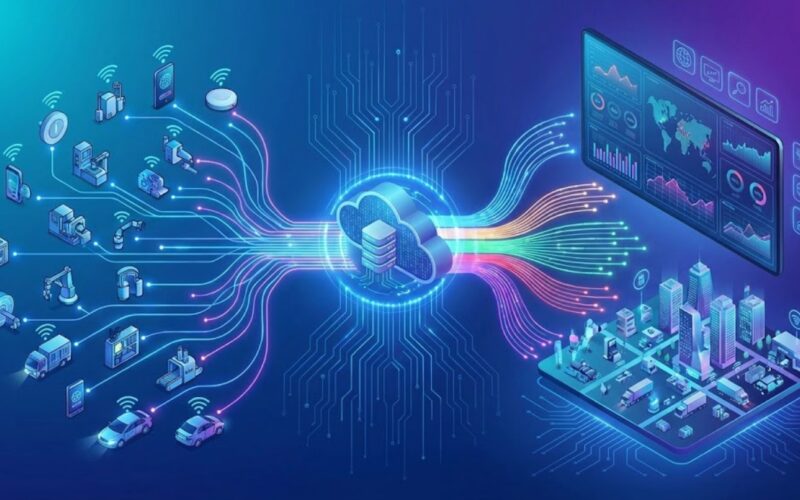
You’re likely deploying hundreds or even thousands of connected devices, but most organizations still struggle to turn that connection into actionable insights. Simply connecting sensors and endpoints doesn’t translate into better decision-making unless the underlying software can process, secure, and contextualize the data in real time.
According to industry research, the number of global IoT-connected devices is expected to exceed 30 billion by 2025, underscoring the scale of data and connectivity management required.
Yet, manyIoT initiatives fail because the software can’t handle data overload, lacks security, or struggles to integrate with existing systems. In industries such as logistics, healthcare, energy, and retail, these issues impede progress and undermine operational efficiency and customer trust.
This guide explains how IoT software development works, covering architecture, data management, security, platform selection, and scaling from pilot to production.
Key Takeaways
- IoT software development connects devices, cloud platforms, and business systems to turn raw data into actionable insights.
- Successful IoT systems must handle data ingestion, processing, security, and scalability from day one.
- Network reliability, data quality, and security risks are the primary challenges that need careful planning.
- IoT software development requires a multi-layered architecture with secure, scalable components, from devices to enterprise integrations.
What Does IoT Software Development Really Include?
IoTsoftware developmentis often misunderstood as just building apps for connected devices. In reality, it’s a full-stack discipline that integrates hardware and business systems.
Hardware, Firmware, and Software: What’s the Difference?
- Hardware is the physical device with sensors and actuators that measures or acts on real‑world conditions.
- Firmware runs on the hardware, controlling the device’s basic operations, connectivity, and sensors.
- Software sits above these layers and makes the data useful to people and systems.
If you focus only on firmware or apps, you miss the broader ecosystem: data pipelines, business processes, storage, analytics, and integration. In fact, 70 percent of IoT project value comesfrom software infrastructure and integration, not from physical hardware.
The Role of IoT Software
IoT software does three core jobs:
- Data ingestion – Capturing raw data from devices.
- Processing and storage – Filtering, normalizing, and storing information for use.
- Action and integration –Surfacing insights through dashboards, alerts, or API calls into enterprise systems like ERPs, CRMs, and analytics tools.
This means IoT software development is less about the front‑end app and more about the systems that integrate business logic, analytics, workflows, and devices into a single, reliable platform.
How Connections Become Actionable Outcomes
Consider a fleet monitoring system. Thousands of trucks send location, engine, and environment data every minute. If the software doesn’t aggregate this data, detect patterns, and alert supply chain planners, all that connectivity adds operational noise, not clarity.
Why Treating IoT Like a Traditional App Fails
Traditional app development focuses on user interfaces and backend logic. IoT software development must handle real‑time streams, diverse protocols, edge constraints, device management, security policies, and massive data volumes. Treating IoT as “just another app” leads to architectures that collapse under load, expose data risks, and fail to integrate with existing enterprise systems.
Also Read: Emerging IoT Trends and Technologies to Watch in 2025
Next, we’ll break down the architecture of IoT systems, exploring the key layers and how each one contributes to a seamless, efficient system.
How Does an IoT Software Architecture Actually Work?
Successful IoT systems are layered architectures, with each layer purpose‑built. Let’s walk through what each layer does and why it matters.
Device Layer
This includes the actual sensors, actuators, and embedded firmware. Typical considerations here are:
- Power constraints and operating system choices
- Reliable connectivity to gateways or networks
- Local preprocessing, when possibl,e to reduce upstream data loads
Firmware must be designed for remote updates, resilience, and diagnostics. If the firmware is brittle, the rest of your system will be fragile.
Connectivity Layer
Devices use various protocols depending on range, power, and throughput needs:
- MQTT for lightweight publish/subscribe messaging
- HTTP for simple request/response integrations
- CoAP for constrained networks
- Cellular, Wi‑Fi, LPWAN for network connectivity
Choosing the right protocol affects throughput, latency, device battery life, and network cost.
Data Layer
This is where raw measurements become usable:
- Ingestion pipelines capture streams reliably and in sequence
- Processing nodes, cleaning, and normalizing data
- Storage solutions may include time‑series databases for sensor data and traditional stores for business records.
A robust data layer provides historical context and real‑time processing without overloading systems.
Application Layer
Once data lands in the system, the application layer:
- Creates dashboards and alerts for users
- Offers APIs for other business systems
- Supports workflows, analytics, and reporting
This layer is where insights become decisions: automated triggers, scheduled reporting, and integrated enterprise actions.
Control Layer
This manages device fleets:
- Over‑The‑Air (OTA) updates
- Firmware rollouts
- Device configuration and decommissioning
Without robust control services, managing a few devices is possible, but scaling to thousands quickly becomes infeasible.
Also Read: 7 Steps For a Beginner to Website Development
Having understood the architecture, it’s crucial to dive into the technologies that power IoT solutions, enabling these systems to scale, integrate, and operate in real time.
Which Technologies Power Modern IoT Software Development?
IoT software development draws from cloud, data engineering, and distributed systems. Key technologies include:
1. Backend Frameworks
Distributed systems frameworks support scalable ingestion and processing. Common patterns use microservices that isolate functionality (ingestion, rules engines, user management) so each part can scale independently.
2. Cloud Services
Cloud platforms such as AWS IoT Core, Azure IoT Hub, and Google Cloud IoT offer prebuilt connectivity, device registry, and messaging services that reduce the effort required to build custom solutions. These services can scale elastically and handle spikes in device traffic.
3. Data Processing Tools
Real‑time tools like Apache Kafka or managed streaming services let you build pipelines that filter, aggregate, and route device data where needed. Batch tools like Spark or cloud batch services handle historical analysis.
4. Edge Computing
Not all processing should happen centrally. Edge computing enables lightweight decision-making closer to the device, reducing latency and bandwidth costs, especially for time‑sensitive use cases such as industrial control.
5. APIs and Integrations
APIs connect IoT systems to ERP, CRM, supply chain, and analytics platforms. Choosing standards‑compliant, secure API patterns ensures your IoT data is actionable across business functions rather than siloed within device dashboards.
Also Read: 8-Step Guide to CRM System Design & Development
What Security and Data Risks Do IoT Systems Face?
As IoT deployments scale, security and data risks increase across devices, networks, and integrated systems. Weak controls at any layer can expose the entire operation.
- Device identity and authentication: Each device must have a unique identity. Weak or shared credentials allow attackers to impersonate devices and inject false data.
- Data transmission and encryption: Unencrypted telemetry can be intercepted or altered. Strong in-transit encryption, key management, and certificate rotation are required.
- Firmware vulnerabilities: Outdated or unsigned firmware exposes devices to remote exploits, as seen in widely used networking stack vulnerabilities.
- Access control across systems: IoT platforms span device consoles, cloud services, and enterprise tools. Inconsistent access rules create security gaps.
- Data integrity risks: Faulty or compromised devices can send misleading data. Without validation and anomaly detection, decisions are made on unreliable inputs.
- Compliance Requirements: In regulated industries such as healthcare and energy, IoT data must comply with standards such as HIPAA and NERC CIP, which govern encryption, logging, and auditing.
A 2025 security report highlighted that nearly half of network connections from IoT devices come from high‑risk endpoints with vulnerabilities, underscoring the importance of strict segmentation and security controls.
Also Read: AI Security Use Cases That Are Transforming Enterprise Protection in 2026
Once security is addressed, scaling is the next big hurdle. Let’s explore how to design IoT systems that not only function well in small pilots but also scale effectively for full deployment.
How Do You Build IoT Software That Scales Beyond Pilots?
Many IoT pilots never become long‑term deployments. Common pitfalls include architecture choices that fail under scale, underestimated data volumes, and reactive security planning.
Why Pilots Stall
Gartner research shows thataround 30 percent of IoT projects fail to scale because solutions designed for small device sets cannot maintain performance at thousands of endpoints.
Designing for Scale from Day One
- Architect modular microservices so each part can grow independently
- Use cloud services that auto‑scale instead of fixed servers
- Separate real‑time and batch processing for efficiency
Handling Device Growth and Data Volume
As the fleet grows, so does telemetry volume. Time‑series databases and partitioned storage strategies help maintain performance stability. Monitoring tools should flag bottlenecks early.
Monitoring and Failure Handling
Operational observability is essential. Track device health, connectivity, latency, error rates, and throughput. Alerts tied to remediation processes keep issues from cascading.
Deployment and Lifecycle Strategies
Automated CI/CD pipelines with staged rollouts reduce risk. Firmware updates must be tested in representative environments before fleet‑wide deployment.
Also Read: Cloud Native Application Architecture: How Modern Products Are Built and Scaled
Common IoT Software Development Use Cases by Industry
IoT projects must align with specific industry needs. Below are high‑impact use cases supported by current market trends and adoption data.
1. Logistics and Fleet Monitoring
Connected sensors and telematics devices provide real‑time location, route, and vehicle-performance data. When software captures, processes, and correlates this telemetry, you can optimize fleet routing, reduce idle time, and schedule maintenance before breakdowns occur. Efficient IoT systems can improve delivery timeliness while lowering fuel and service costs.
2. Healthcare Device Platforms
Patient monitoring devices and wearables continuously generate vital health data. Secure IoT software integrates this information with clinical systems such as electronic health records, enabling care teams to identify trends, trigger alerts, and act without manual chart checks.
Healthcare IoT has grown as clinical environments seek insights across devices, driving system upgrades.
Energy and Utilities Monitoring
Smart meters and grid sensors send consumption and system health data back to central platforms. Advanced software aggregates readings, generates demand forecasts, and flags anomalies that may indicate faults. Utility companies use these insights to balance loads, reduce outages, and plan infrastructure upgrades.
With billions of IoT connections expected globally, utilities are among the sectors poised for significant growth in data throughput.
Retail and Smart Infrastructure
In retail, IoT solutions include inventory sensors, RFID systems, and smart facility controls. When software correlates these inputs with point-of-sale and customer-behavior data, you achieve automated stock replenishment, efficient store operations, and targeted promotions.
Retailers with IoT‑enabled systems can respond faster to supply chain shifts and customer preferences.
Even after deployment, teams often face challenges they didn’t anticipate. Here, we’ll discuss the critical hurdles that can derail an IoT project if not carefully managed.
IoT Software Development Challenges Teams Underestimate
Effective IoT software requires foresight around operational, data, and team challenges. Below is a breakdown of common obstacles with their business effects.
| Challenge | What It Means | Business Impact |
| Network Reliability Issues | IoT systems rely on diverse networks (LPWAN, cellular, Wi-Fi) and often experience packet loss and latency. | Missed alerts, inaccurate analytics, operational delays, and system downtime. |
| Data Quality and Noise | Sensors can produce noisy or drifting data. Software must be cleaned and validated before use. | Poor decision-making, inaccurate forecasting, and operational inefficiencies. |
| Long-Term Maintenance Costs | Continuous updates, firmware management, and long-term support for IoT devices. | Increased costs, downtime during updates, technical debt, and missed SLAs. |
| Cross-Team Coordination | Lack of alignment between hardware, software, security, and operations teams. | Project delays, integration issues, and inconsistent solution standards. |
| Security Risks | IoT devices often have critical vulnerabilities that pose risks if not addressed through security protocols. | Data breaches, regulatory fines, reputational damage, and system outages. |
| Data Volume Management | IoT devices generate massive data volumes, requiring effective data storage and processing solutions. | Overwhelmed storage systems, slow data processing, and costly infrastructure needs. |
Why Choose Codewave for IoT Software Development?
Codewaveis your trusted partner in end-to-end IoT software development, specializing in delivering secure, scalable, and efficient solutions for connected devices. Our approach encompasses the entire ecosystem, prioritizing seamless integration among hardware, software, cloud platforms, and business systems.
This strategy enables organizations to maximize the value of their IoT investments effectively.
What Sets Codewave Apart?
- Custom IoT Solutions: Codewave tailors its software to meet your specific business needs, ensuring robust integration across hardware, cloud services, and enterprise systems.
- Secure and Scalable Architectures: We build IoT systems that are secure and scalable, ensuring seamless transitions from pilot projects to large-scale operational deployments.
- Cross-Functional Expertise: Our team integrates hardware, software, cloud infrastructure, and analytics to deliver end-to-end IoT solutions that improve operational efficiency and drive business outcomes.
- Agile Delivery: We follow agile methodologies, enabling faster time-to-market, quick iterations, and the flexibility to adapt as requirements evolve.
With over 400 successful projects across 15 countries, Codewave has proven experience delivering innovative IoT solutions across sectors, including logistics, healthcare, energy, and retail. Explore our portfolioto learn more.
Conclusion
IoT software development is essential for businesses looking to turn connected devices into reliable, actionable insights. From data ingestion and processing to security and scalability, the success of IoT initiatives depends on a robust software infrastructure that integrates smoothly with existing systems.
The challenges, such as network reliability and security vulnerabilities, can be addressed with the right approach and technology.
At Codewave, we specialize in building secure and scalable IoT systems tailored to your business needs. Our expertise ensures that your IoT deployments can handle large-scale data, integrate with enterprise systems, and maintain security.
If you are ready to scale your IoT systems effectively, contact us to begin your journey.
FAQs
Q: What makes IoT software development different from regular app development?
A: IoT software development involves handling real-time data from devices, ensuring seamless integration with cloud services and enterprise systems. Unlike traditional apps, it must manage large-scale data streams, support device control, and maintain high security.
Q: How does IoT software ensure data security across devices?
A: IoT software implements robust encryption, authentication, and access control protocols to ensure secure data transmission and storage. Additionally, regular security updates and vulnerability assessments are essential to maintain protection against potential breaches.
Q: What are the common IoT software development pitfalls to avoid?
A: Key pitfalls include poor network reliability, lack of scalability, data overload, and inadequate security measures. Failing to address these challenges early can lead to operational inefficiencies and data integrity issues.
Q: How do IoT solutions scale as device networks grow?
A: Successful IoT systems are designed with scalable architectures that allow for seamless integration of new devices and growing data volume. Utilizing cloud-based infrastructure, edge computing, and data partitioning ensures performance is maintained as the system expands.
Q: How long does it take to deploy an IoT solution?
A: The timeline depends on the complexity of the solution and industry requirements. Typically, from proof of concept to production deployment, the process can take anywhere from a few months to over a year, given integration, testing, and scalability.

Pruthviraj Karur S is a Software Engineer at Codewave who specialises in building robust digital solutions across web, mobile, and cloud platforms. His writing covers software engineering best practices, technology architecture, and digital transformation—drawn from real-world experience delivering custom applications for global clients.