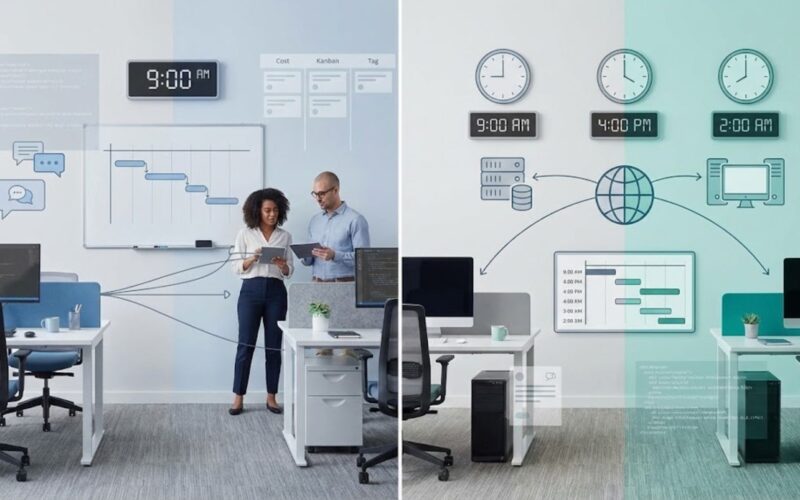






Building great software shouldn’t mean choosing between quality and cost. You need both, and nearshore outsourcing might just be your answer.
Companies across North America are discovering that partnering with development teams in similar time zones delivers the technical expertise they need without the traditional offshore headaches.
The collaboration feels natural, the communication flows easily, and the results speak for themselves. Right now, Indian IT firms pull in 62% of their outsourcing revenue from U.S. clients alone, proving that distance doesn’t determine success when you find the right partner.
We’re going to walk you through exactly how to choose a nearshore development partner who gets your vision, meets your deadlines, and helps your business grow.
Key Takeaways
- Nearshore outsourcing delivers technical expertise within similar time zones, enabling real-time collaboration without the delays of offshore partnerships across continents.
- Test communication early by speaking with actual developers, not sales reps, to evaluate how they explain concepts and handle misunderstandings in practice.
- Start with a pilot project to assess technical skills, deadline adherence, and team chemistry before committing to long-term contracts or major engagements.
- Transparent pricing models and flexible contracts prevent budget surprises, so clarify what’s included in rates and how scope changes get managed upfront.
- Company stability matters as much as technical skills since financial troubles or high turnover can disrupt your projects at critical moments.
What Is Nearshore Outsourcing Development?
Nearshore outsourcing means hiring software development teams in countries close to yours, usually within a few time zones.
Unlike offshore outsourcing, where teams might be halfway across the globe, nearshore partners work during hours that overlap significantly with your business day.
This proximity makes real-time collaboration practical and keeps projects moving without the delays that come from working in completely different time zones.
Benefits of Nearshore Outsourcing Development
The advantages of nearshore software development go beyond just convenience. When you partner with teams in nearby regions, you gain operational flexibility that directly impacts your bottom line and project outcomes.
- Real-time collaboration – Your teams can jump on calls, troubleshoot issues, and make decisions together during normal business hours instead of waiting overnight for responses.
- Cultural alignment – Similar business practices and communication styles reduce misunderstandings and help teams gel faster, so you spend less time clarifying and more time building your software.
- Cost efficiency – You get skilled developers at rates lower than local hiring while avoiding the rock-bottom pricing that often comes with quality compromises.
- Easier travel and meetings – When face-to-face matters, a few hours on a plane beats a 20-hour journey, making it feasible to build genuine relationships with your development partner.
- Reduced project risk – Overlapping work hours means problems get spotted and fixed quickly, keeping your project on track and your stress levels manageable.
Key Criteria for Evaluating a Nearshore Outsourcing Development Partner
Finding the right development partner requires more than scanning through portfolios and comparing rates. You need a systematic approach that evaluates technical capabilities, cultural fit, and long-term reliability to ensure your partner becomes a true extension of your team.
1. Evaluate Their Technical Expertise and Stack Compatibility
Start by confirming whether the team really works with your technology stack and has solved problems similar to yours. A partner who understands your technical environment from day one saves you weeks of ramp-up time and reduces the risk of architectural mismatches.
- Ask for specific examples of projects using your exact frameworks and languages
- Check if their developers hold relevant certifications and stay current with emerging technologies
- Verify they’ve solved technical challenges similar to what you’re facing
- Request code samples or GitHub repositories to assess their coding standards
2. Review Their Portfolio and Client Case Studies
Look beyond polished screenshots to understand how they approach complex challenges and deliver results. Quality case studies reveal their problem-solving process, the obstacles they encountered, and the business outcomes they achieved.
- Pay attention to projects in your industry or with similar technical requirements
- Ask for references you can actually call and speak with directly
- Look for detailed explanations of challenges faced and solutions implemented
- Reach out to former clients for unfiltered feedback about communication and deadlines
3. Assess Communication Practices and Language Proficiency
Clear communication makes or breaks remote partnerships, so test this early and thoroughly. Schedule video calls with the actual developers who’d work on your project, not just sales representatives.
- Notice how they explain technical concepts and ask clarifying questions
- Test their responsiveness by observing reply times during initial conversations
- Evaluate their willingness to ask questions when something’s unclear
- Confirm they use collaboration tools you’re already comfortable with
4. Verify Their Security Standards and Data Protection Policies
Your intellectual property and customer data deserve serious protection, so dig into their security protocols before signing anything. Understanding their security posture prevents costly breaches and compliance issues down the road.
- Ask about compliance certifications like ISO 27001, SOC 2, or GDPR adherence
- Understand how they handle code repositories, access controls, and data encryption
- Request details about their NDAs and employee background check processes
- Clarify what happens to your data if the partnership ends
5. Check Time Zone Overlap and Availability
Having overlapping work hours sounds basic, but it fundamentally changes how projects unfold day to day. Calculate exactly how many hours your teams will share each day and whether those hours align with your critical meeting times.
- Determine the exact overlap hours and whether they match your peak collaboration needs
- Ask how they handle urgent issues outside standard overlap hours
- Verify their willingness to adjust schedules for launch periods or emergencies
- Consider whether four-hour versus eight-hour overlaps meet your project requirements
6. Understand Their Development Process and Methodology
You need partners who follow structured processes that mesh with how your team operates. A partner with clear, documented processes reduces chaos and keeps everyone aligned on expectations throughout development.
- Ask whether they use Agile, Scrum, Kanban, or hybrid approaches
- Understand their sprint planning, code review practices, and testing protocols
- Clarify how they handle bug fixes and technical debt management
- Verify their flexibility in adapting to your existing workflows and preferences
At Codewave, we are a leading software development company with a proven track record of helping over 400 global enterprises. Our services range from custom software development and cloud solutions to GenAI development, just to name a few.
Our self-managed teams deliver weekly demos and milestone releases that create real impact, not just code. We work as an extension of your team, stepping in to expedite your time to market, improve throughput, and bridge critical skill gaps.
With design thinking and agile methodologies, we ensure every sprint creates measurable value for your business.
Explore all our services and see how we can drive your business forward.
7. Examine Their Team Structure and Scalability Options
Understanding who’ll work on your project and how easily you can grow the team matters enormously. Clear team structures prevent confusion about responsibilities and decision-making authority.
- Ask about team composition, including developers, QA engineers, project managers, and designers
- Find out how they handle team member turnover and knowledge transfer
- Clarify whether you can scale up or down based on project phases
- Verify how quickly they can onboard additional developers without compromising quality
8. Analyze Their Pricing Model and Contract Flexibility
Transparent pricing prevents unpleasant surprises that strain partnerships and budgets. Understanding the full cost structure upfront helps you make informed decisions and avoid hidden fees.
- Determine whether they charge hourly, offer fixed-price projects, or use a dedicated team models
- Ask what’s included in the rates and what costs extra, like project management or QA
- Review contract terms around payment schedules and intellectual property rights
- Understand termination clauses and how they handle inevitable scope changes
9. Test Their Problem-Solving Approach With a Pilot Project
Nothing reveals a partner’s true capabilities like working together on real deliverables. Start with a small, defined project that matters but won’t sink your business if things go sideways.
- Choose a project that tests their technical skills relevant to your needs
- Evaluate their communication style and deadline adherence in practice
- Observe how they handle unexpected challenges and roadblocks
- Use this phase to determine if your teams actually enjoy working together
10. Investigate Their Company Stability and Long-Term Viability
You’re building a partnership that could last years, so your vendor’s financial health and stability directly affect you. A partner facing financial troubles creates continuity risks that can disrupt your projects at critical moments.
- Research how long they’ve been in business and their growth trajectory
- Look for signs of organizational maturity, like documented processes and training programs
- Check employee retention rates as indicators of workplace stability
- Verify that they have a stable client base rather than depending on one or two major accounts
Questions to Ask a Nearshore Outsourcing Development Partner Before Hiring
At Codewave, we always encourage transparency from the first conversation because the right questions reveal whether a partnership will thrive or struggle. Clarity on expectations, processes, and capabilities upfront saves you from costly misalignments later.
- How do you handle communication across time zones, and what’s your typical response time for urgent issues?
- Can you walk me through a project similar to mine and explain the challenges you faced and how you solved them?
- What’s your team’s experience with our specific technology stack, and can we speak with the actual developers who’d be working on our project?
- How do you ensure code quality, and what does your testing and QA process look like?
- What happens if a key team member leaves mid-project, and how do you manage knowledge transfer?
- Can you provide references from clients in our industry, and may we contact them directly?
- What security certifications do you hold, and how do you protect our intellectual property and data?
- How do you handle scope changes, and what’s your process for managing additional requests or pivots?
- What does your pricing include, and are there any additional costs we should anticipate?
- Can we start with a pilot project to test the partnership before committing to a longer engagement?
Why Choose Codewave for Your Next Nearshore Software Development Journey?
Codewave isn’t just another development shop. We’re 10x thinkers and change makers who’ve served 400+ businesses globally, from VC-backed startups to government agencies.
Our approach combines human-centric design thinking with emerging technologies to build high-impact products ready for scale from day one.
- Pre-vetted talent matched to your needs – We rigorously screen IT professionals based on your specific project requirements, ensuring that only the best-suited talent joins your team.This results in highly skilled professionals who integrate quickly and deliver high-quality work from the start.
- 50% reduction in recruitment time – With our pre-vetted talent pool and streamlined processes, we eliminate long hiring cycles. This means you can start building your team in days, not months, accelerating your time to market.
- Weekly demos and continuous feedback – Our teams deliver regular demos to showcase progress and gather your input. This continuous feedback loop helps fine-tune the project, keeping it aligned with your vision and ensuring timely, high-quality delivery.
- Self-managed teams – Our developers are trained to work autonomously, requiring minimal oversight while maintaining a high standard of performance. This empowers you to focus on strategic priorities while we handle execution with efficiency and expertise.
Our services range from mobile app development, IoT solutions, and custom software development to cloud-based solutions, all crafted with a design-led thinking approach to ensure user-centric, scalable, and impactful products.
Ready to scale your tech team faster and smarter? Start Building Your Perfect Team With Codewave today
Conclusion
Choosing the right nearshore outsourcing development partner starts with asking the right questions and trusting your instincts during early interactions.
Technical skills are important, but natural communication and a genuine understanding of your vision make the real difference. When those elements align, you get more than just code delivery.
You get a partnership that accelerates your growth and turns ambitious timelines into reality.
Codewavesteps in to address the struggle of finding skilled developers and managing project delays. These challenges can lead to higher costs and stalled progress.
Our nearshore development teams work closely with your in-house staff, ensuring quick communication and alignment.
They actively challenge assumptions, identify opportunities, and provide weekly demos that keep your product moving forward, all while staying responsive and flexible to meet your business needs.
See How We’ve Helped Businesses Like Yours
FAQs
- What is nearshore outsourcing development?
Nearshore outsourcing means hiring software teams in nearby countries within similar time zones. This proximity enables real-time collaboration during overlapping business hours, making communication and project coordination much smoother.
- How does nearshore outsourcing differ from offshore outsourcing?
Nearshore partners work within a few time zones of your location, allowing daily overlap for meetings. Offshore teams often operate 8-12 hours apart, requiring overnight wait times for responses.
- What are the main benefits of nearshore outsourcing development?
You gain cost-efficient access to skilled developers while maintaining real-time collaboration. Cultural alignment reduces miscommunications, travel is easier, and overlapping schedules help catch issues quickly.
- How do I evaluate a nearshore development partner’s technical capabilities?
Request project examples using your technology stack, review code samples, verify certifications, and speak directly with developers who’d work on your project. Always check references from similar clients.
- Should I start with a pilot project before full commitment?
Yes, pilot projects reveal capabilities portfolios can’t show. They let you test technical skills, communication, and team chemistry on real deliverables before committing long-term.

Codewave is a UX first design thinking & digital transformation services company, designing & engineering innovative mobile apps, cloud, & edge solutions.