


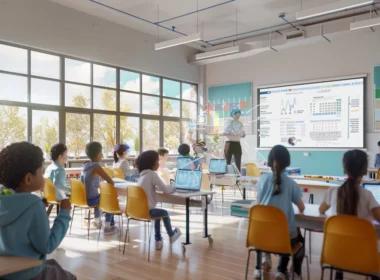



Education technology has reached an inflection point. AI is no longer a future possibility but a present reality reshaping how students learn.
The sector’s trajectory is unmistakable: AI in education grew to $5.88 billion in 2024 and is set to reach $32.27 billion by 2030, expanding at 31.2% each year.
Students demand learning that fits their pace and style. Schools are responding with intelligent tutoring systems, conversational chatbots, and analytics that reveal what’s working.
However, rapid adoption creates genuine challenges as well. This piece examines AI’s educational promise, its potential pitfalls, and the balance institutions must strike.
Key Takeaways
- AI can help education when used with guardrails and human oversight, combining personalization and efficiency with protection for privacy, equity, and human connection.
- Real gains come from specific use cases. Personalized learning, teacher workload reduction, after-hours support, better analytics, and accessibility for diverse learners, not vague “AI in classrooms.”
- Risks are serious, not theoretical. Data misuse, bias, over-reliance, weaker critical thinking, loss of human touch, and widened inequality can all grow if AI is adopted blindly.
- The strongest results come from hybrid models. AI handles routine tasks, practice, and data, while humans focus on mentoring, context, emotional support, and complex judgment. Both roles are essential.
- Before adopting AI, institutions must ask hard questions about problems solved, privacy, equity, long-term costs, and exit plans instead of chasing tools for their novelty.
Should AI Play a Role in Education?
Yes, but with significant guardrails and human oversight. AI offers genuine benefits in personalization, efficiency, and accessibility that can improve learning outcomes.
However, it also poses real risks around privacy, bias, over-reliance, and the loss of human connection that makes education transformative. Here’s a concise rundown of where AI adds value and where caution is essential.
| Reasons in Favor of AI | Reasons Against AI |
| Personalized learning at scale. AI adapts lessons to each student’s pace and needs. | Serious data privacy risks. Student information becomes vulnerable to breaches and unclear data-sharing practices. |
| Teachers reclaim teaching time. Automation reduces grading and admin workload. | Weaker critical thinking. Students may rely on AI instead of struggling through problems. |
| Support beyond classroom hours. Chatbots and tutoring tools help when students study. | Algorithmic bias. AI trained on historical data can reinforce inequities. |
| Data-driven insights. AI spots learning gaps early and guides targeted interventions. | Loss of human connection. Technology cannot replicate mentorship or emotional support. |
| Improved accessibility. Tools support non-native speakers, disabled students, and remote learners. | High implementation costs. Under-resourced schools struggle to adopt or maintain AI. |
| Long-term cost efficiency. Scaling AI is cheaper than scaling staff or physical materials. | Unreliable outputs. AI can confidently generate incorrect or misleading information. |
AI in education isn’t a simple yes or no decision. It’s a careful balance of what technology can genuinely improve and what should remain firmly human.
If you want to understand the reasoning behind each point and see how these benefits and risks play out in real classrooms, the next sections will walk you through the details.
Part 1: The Benefits of AI in Education
AI is making promises that education has chased for years. Personalized learning for every student. Teachers with time to actually teach. Support that doesn’t end when the bell rings. Here’s what’s working and why it matters.
1. Personalized Learning at Scale
Every classroom tells the same story. Thirty students learn thirty different ways, and one teacher tries to reach them all. AI is finally solving this problem by adapting to how each student actually learns.
How It Works
AI platforms track how students interact with material. They notice when someone breezes through algebra but struggles with word problems.
They adjust difficulty in real time, moving students forward when they’re ready or providing extra practice when they need it. The system watches, learns, and responds without waiting for the next class period.
Key Insights:
- Students in personalized learning programs score higher on standardized tests compared to those in traditional classrooms.
- AI-driven learning platforms show a 25% improvement in grades, test scores, and engagement across university students.
- AI can also make real-time adjustments based on performance. If mistakes repeat, it might loop back, offer remedial exercises, or change the method of presentation.
- In practice, this happens through tools like intelligent tutoring systems and adaptive learning platforms that analyze responses and guide next steps automatically.
2. Reduced Teacher Workload Through Automation
More than 270,000 teachers are projected to exit the profession each year on average between 2016 and 2026. Teachers aren’t leaving the profession because they don’t like teaching. They’re leaving because everything else is drowning them.
The Problem AI Solves
AI addresses this problem by taking over routine tasks like grading, scheduling, and administrative tracking so teachers are not buried in busywork. It speeds up feedback cycles and removes hours of manual checking from a teacher’s week.
It organizes data automatically, giving teachers clear insights without digging through reports. With the repetitive load gone, teachers can spend their time on planning, mentoring, and real classroom connections.
Key Insights:
- Many routine tasks, such as grading, attendance tracking, and administrative paperwork, gobble huge chunks of a teacher’s time. AI can handle a large share of that.
- 60% of teachers use AI tools for their work, and 30% use it at least weekly, saving an estimated 5.9 hours per week.
- Over 80% of teachers say AI meaningfully reduces their weekly workload. About 64% regain 1 to 5 hours each week, and roughly 3% recover more than 10 hours.
- Automation also brings consistency: grading and feedback become fairer and more uniform, avoiding fatigue or bias that sometimes creep into human grading.
3. Enhanced Student Engagement
Questions don’t stop at 3 PM when school ends. Students hit walls doing homework at night, studying on weekends, and preparing for tests. AI support doesn’t clock out.
Why Students Respond
AI chatbots provide instant help when students are actually doing the work. They answer the same question five different ways without getting impatient. They don’t judge.
For students who hesitate to raise their hand in class, this removes the fear of looking stupid.
GenAI chatbots allow students to connect in human-like ways, encouraging interaction without the fear of criticism, which minimizes language learning anxiety.
Key Insights:
- AI chatbots had a significant effect on students’ learning outcomes in a meta-analysis of 24 studies.
- 70% of K-12 students have a favorable view of AI chatbots, rising to 75% among undergraduates.
- 75% of K-12 students are now familiar with ChatGPT, up from 37% just over a year ago.
- 48% of students use AI chatbots at least weekly
4. Data-Driven Insights for Better Outcomes
Teachers have always made decisions based on intuition and experience. AI adds data to those instincts, revealing patterns humans can’t easily spot.
What the Data Reveals
AI tracks which students consistently struggle with specific concepts. It identifies early warning signs before a student fails. It shows which teaching methods work best for different learners.
Schools can intervene when problems are small instead of waiting until students are already behind. The data also reveals equity gaps that might otherwise stay hidden, letting schools target resources where they’re needed most.
Key Insights:
- 61% of teachers using AI receive better insights about student learning or achievement data.
- 57% of teachers say AI tools help improve their grading and student feedback.
- AI predicts problems before they become failures, enabling early intervention
- Analytics help teachers understand not just what students know but how they’re learning it
5. Accessibility and Inclusivity
AI opens doors for students who often get left behind due to language, ability, or location. It creates learning environments where support adjusts to each student’s needs without making them feel singled out.
Tools that translate, read aloud, or customize pacing turn barriers into workable paths. The result is a more equitable system where every learner has a real chance to keep up and succeed.
Breaking Down Barriers
Speech recognition helps students with mobility impairments control devices through voice. Text-to-speech enables students with visual impairments to access written content. Real-time captioning supports deaf and hard-of-hearing students.
Translation tools help non-native speakers. For students in remote areas, AI provides access to quality education that geography once made impossible.
Key Insights:
- AI-based interventions showed a medium effect on students with disabilities’ learning outcomes in a meta-analysis of 29 experimental studies.
- Nearly 60% of teachers agreed that AI improves the accessibility of learning materials for students with disabilities.
- AI-driven assistive technologies support students with disabilities through personalized learning, adaptive assessments, and intelligent tutoring systems.
- Virtual tutors offer expert instruction regardless of location
- AI tools are built into the learning experience, making education more inclusive by design
6. Cost Efficiency Over Time
The upfront investment isn’t small. But the long-term savings are substantial, and they compound as systems scale.
Where the Savings Come From
Automated administrative tasks reduce staffing costs. Digital materials cost less than textbooks that need replacing every few years. Cloud-based solutions eliminate expensive on-site server maintenance.
As institutions grow, AI systems handle increased volume without proportional cost increases. What starts as an investment becomes a competitive advantage that keeps delivering returns.
Key Insights:
- Automating tasks with AI could reduce administrative costs in higher education by a huge margin.
- Because AI systems scale more easily than traditional teaching models, they can grow with institution size without linear cost increases.
- Initial training costs give way to ongoing efficiency gains that improve year after year.
- Over time, reduced manual workload, lower physical resource needs, and optimized operations translate into better resource allocation and operational savings.
Part 2: The Risks of AI in Education
Every tool powerful enough to transform education is also powerful enough to harm it. AI brings real problems alongside its promises. These aren’t hypothetical concerns. They’re happening now in classrooms using these systems.
1. Data Privacy and Security Concerns
AI systems need data to function. Lots of it. Student names, grades, behavioral patterns, learning struggles, and sometimes even biometric information. All of it gets stored digitally, creating targets for hackers and raising questions about who really owns this information.
Key Problems:
- Data breaches expose sensitive student information: Hackers target educational institutions because they store valuable personal data with often inadequate security infrastructure.
- Third-party vendors may share data without clear disclosure: AI platforms often partner with other companies, and student information can move between entities without explicit consent.
- Compliance with privacy regulations adds complexity: Schools must navigate FERPA, GDPR, and other laws while vendors operate across different jurisdictions with varying requirements.
- Students have limited control over their own data: Once information enters these systems, removing it or controlling its use becomes nearly impossible for the individuals it describes.
- Long-term data storage creates future risks: Information collected today could be used for purposes not yet imagined, potentially affecting students years later.
2. Over-Reliance on Technology
Students who let AI do their thinking stop developing the ability to think for themselves. When every question has an instant answer, the struggle that builds understanding disappears. The mental effort required for real learning gets replaced by algorithmic shortcuts.
Key Problems:
- Students bypass necessary mental operations: AI handles complex reasoning before students develop those capabilities themselves, creating gaps in foundational cognitive skills.
- Reduced human interaction affects social development: Learning happens in conversation and collaboration, skills that screen-based education cannot fully replicate or replace.
- Dependency forms quickly and becomes hard to break: Once students rely on AI for basic tasks, reverting to independent problem-solving feels unnecessarily difficult.
- Balance between technology and traditional learning erodes: Schools struggle to maintain equilibrium when AI tools offer easy efficiency gains that compromise deeper learning.
- Memory and retention suffer when AI provides instant answers: Students don’t encode information the same way when they know external systems will always have the answer.
3. Bias in AI Algorithms
AI learns from historical data. That means it learns historical discrimination too. Systems trained on decades of educational inequality will reproduce those patterns. An algorithm doesn’t need to be programmed with bias to be biased. It just needs to learn from a biased past.
Key Problems:
- AI perpetuates existing educational inequalities: Systems amplify historical patterns of discrimination, systematically disadvantaging students from marginalized communities through seemingly objective processes.
- Assessment and recommendations can be systematically unfair: Algorithms make decisions about student placement, scholarships, and opportunities based on biased training data.
- Marginalized groups face compounded discrimination: Students already facing barriers encounter additional obstacles from AI systems that misunderstand or misrepresent their capabilities.
- Training data quality directly determines outcomes: If historical data reflects inequality, the AI will recommend unequal treatment while appearing neutral and data-driven.
- Institutional leaders often don’t understand algorithmic bias: Schools implement systems without fully grasping how they perform differently across demographic groups, making oversight nearly impossible.
4. Loss of Human Touch in Education
Education isn’t just information transfer. It’s a relationship. Mentorship. Inspiration. The moments when a teacher sees something in a student that they don’t see in themselves. AI can’t replicate that. It can deliver content and track progress, but it can’t care.
Key Problems:
- Teacher-student relationships weaken with increased AI mediation: Personal bonds that motivate learning and build trust diminish when interactions flow primarily through technology.
- Emotional intelligence and empathy cannot be automated: AI lacks the capacity to understand feelings, read context, or provide the human warmth essential to effective teaching.
- Mentorship requires human connection and understanding: Life-changing guidance comes from people who know you as an individual, not systems that know your data.
- Education becomes transactional rather than transformational: Learning reduces to content delivery and assessment when the relational elements that inspire growth get automated away.
- Surveillance concerns increase student anxiety: Constant AI monitoring creates stress and damages the trust necessary for open learning environments where students feel safe taking risks.
5. Implementation Costs and Technical Barriers
The upfront investment in AI isn’t small. Software licensing, hardware upgrades, technical infrastructure, staff training, and ongoing maintenance.
For many institutions, particularly smaller schools or those serving low-income communities, these costs are prohibitive. The digital divide widens when only well-funded schools can afford effective AI implementation.
Key Problems:
- High upfront investment excludes smaller institutions: Schools with limited budgets cannot afford the infrastructure, software, and support staff required for effective AI implementation.
- Ongoing maintenance costs strain school budgets: AI systems require continuous updates, technical support, and infrastructure improvements that compound initial investment costs over time.
- Teacher training requires significant time and resources: Educators need extensive professional development to use AI effectively, taking time away from teaching and requiring additional funding.
- Technical infrastructure requirements create barriers: Schools without adequate internet connectivity, devices, or IT support cannot implement AI systems regardless of software affordability.
- Unequal access increases educational inequality: Well-funded institutions gain AI advantages while under-resourced schools fall further behind, widening existing achievement gaps.
6. Accuracy and Reliability Issues
AI makes mistakes. Sometimes small ones. Sometimes catastrophic ones. And it delivers wrong answers with the same confidence it delivers correct ones.
Students receiving flawed guidance often lack the knowledge to identify errors. They trust the system because it seems authoritative.
Key Problems:
- AI provides incorrect information with false confidence: Systems generate wrong answers that appear authoritative, and students often lack the knowledge to identify inaccuracies.
- Limited contextual understanding creates misleading guidance: AI misses subtleties and nuance that change meaning, providing technically accurate but contextually inappropriate responses.
- Students develop misconceptions from flawed AI output: Learning from incorrect information creates foundational misunderstandings that compound over time and resist correction.
- Quality control becomes challenging at scale: When AI generates content rapidly across many subjects, verifying accuracy for everything becomes practically impossible.
- Teachers must verify AI-generated content: The time required to check AI work for accuracy reduces the efficiency gains that justified implementation.
7. Ethical Concerns Around Student Assessment
AI-driven grading standardizes evaluation in ways that can miss what matters most. Creativity. Original thinking. The unique perspective that doesn’t fit the algorithm’s expectations.
When AI grades work, it looks for patterns it recognizes. A brilliant but unconventional answer might score lower than a mediocre conventional one.
Key Problems:
- AI grading misses creative and critical thinking: Standardized evaluation rewards conventional responses while penalizing original thought that doesn’t match training data patterns.
- Standardization stifles unique perspectives and approaches: Assessment systems that optimize for consistency discourage the unconventional thinking that drives innovation and deep understanding.
- Students learn to manipulate AI rather than learn: Once students understand they’re being assessed by algorithms, they optimize for algorithm preferences instead of genuine comprehension.
- Authentic learning conflicts with performance metrics: Real education involves struggle, experimentation, and failure, but AI systems reward clean patterns that suggest surface learning.
- Evaluation focuses on measurable rather than meaningful: AI assesses what it can quantify, shifting educational focus away from qualities that matter but resist algorithmic measurement.
Part 3: Finding the Right Balance
AI in education isn’t a binary choice between full adoption or complete rejection. The institutions getting this right are the ones asking harder questions before implementation and staying flexible after it.
- Start with Clear Policies
You need explicit guidelines on AI use before the first system goes live. Define what data gets collected, how long it’s stored, who can access it, and what happens when someone requests deletion. Make these policies public. Parents and students deserve to know.
Privacy protections should be specific, not vague. Detail which third parties might receive data and under what circumstances. Establish protocols for data breaches before they happen. Outline the consequences when policies are violated.
- Invest in Teacher Training
Technology only works when people know how to use it well. Teachers need training that goes beyond basic functions.
They need to understand what AI can and can’t do. When to trust it and when to override it. How to spot bias in outputs. How to integrate AI without letting it replace human judgment.
This isn’t a one-time workshop. It’s ongoing professional development. AI tools are evolving at a breakneck pace today. So, teachers need continuous support as systems change and new applications emerge.
- Choose Hybrid Approaches
The best implementations combine AI capabilities with human instruction. Use AI for what it does well: personalized practice, instant feedback, administrative automation, and data analysis.
Reserve human teachers for what they do best: building relationships, inspiring curiosity, teaching critical thinking, providing emotional support, and recognizing context that data misses.
- Evaluate Effectiveness Regularly
Implementation isn’t the finish line. Monitor outcomes continuously. Are students actually learning better?
Are teachers genuinely saving time or just shifting workload? Are certain groups of students benefiting while others fall behind? Is the technology creating new problems while solving old ones?
Be willing to adjust or abandon systems that aren’t working. Sunk cost shouldn’t drive decisions about student welfare. If an AI tool promises personalization but standardizes outcomes, stop using it.
- Maintain Transparent Communication
Tell students and parents what AI is being used, how it works, and why you chose it. Explain what data it collects and what safeguards protect privacy. Share results honestly, including problems that emerge.
Create channels for feedback. Students often spot issues before administrators do. Teachers see implementation challenges, but leadership doesn’t. Parents raise concerns that data alone won’t reveal. Listen to all of them.
Questions to Ask Before Implementation
- What specific problem does this AI tool solve?
If you can’t articulate the problem clearly, you’re not ready to evaluate solutions. Avoid implementing technology because it’s impressive or because competitors are using it. Focus on actual needs.
- How will this improve learning outcomes?
Efficiency gains matter, but student learning matters more. If a tool saves teachers time but reduces educational quality, it’s not worth deploying. Demand evidence that the technology improves actual outcomes, not just processes.
- What safeguards protect student privacy?
Understand exactly what data the system collects, how it’s stored, who can access it, and how it’s protected. Ask about the vendor’s security track record. Review their privacy policy thoroughly. Know your legal obligations under FERPA, GDPR, or relevant regulations.
- Do we have resources for proper implementation?
Count all costs: software licensing, hardware upgrades, technical support, teacher training, ongoing maintenance, and system updates. Budget for the long term, not just the initial purchase. Underfunded implementation often fails.
- How do we maintain human connection?
Identify which aspects of education absolutely require human interaction and protect them. Define where AI should assist and where it shouldn’t replace. Establish boundaries before deployment, not after problems emerge.
- What happens if it doesn’t work?
Have an exit strategy. Know how to extract your data. Understand contract terms for cancellation. Plan for transition back to previous systems if needed. Being locked into failing technology helps no one.
- Are we creating or closing equity gaps?
Consider whether all students have equal access to necessary technology and internet connectivity. Evaluate whether the AI system performs equally well for all demographic groups. Examine whether the implementation advantages some students while disadvantaging others.
How Codewave Can Support Your AI-in-Education Vision
Implementing AI in education requires more than good intentions. It demands expertise in building systems that balance innovation with responsibility, efficiency with empathy, and technology with human connection.
Codewave specializes in creating AI solutions that serve real educational needs without compromising what makes learning meaningful. We’ve worked with over 400 businesses globally to deliver technology that solves actual problems rather than creating new ones.
What we help you build:
- AI-powered learning platforms and tutoring systems: We design adaptive learning tools that personalize instruction, offer real-time feedback, and support students with guidance tailored to their pace and needs.
- Smart analytics dashboards for student insights: We create dashboards that reveal learning patterns, highlight struggling students early, and help educators make faster, evidence-based academic and operational decisions.
- Accessible, multilingual, human-centered digital experiences: We build inclusive interfaces that support diverse languages, assistive technologies, and intuitive interactions so every learner can participate confidently.
- Scalable mobile and web apps for modern learning: We develop flexible apps that handle growing user bases, enable instant updates, and ensure consistent learning experiences across devices and locations.
Want to see what this looks like in action? Explore our portfolio to learn more.
Conclusion
AI is reshaping education in ways that can strengthen learning when used with intention and clear boundaries. The real opportunity lies in blending human judgment with intelligent systems that support teachers and students.
Institutions that approach AI thoughtfully will build more responsive, equitable learning environments. The next step is understanding how to apply these ideas in real products and workflows.
Codewave helps you build software that’s ready for the next decade of intelligent, accessible, and scalable learning experiences.
What we bring to the table:
- Human-centered design that makes technology intuitive for learners and educators.
- AI integration expertise to power personalization, automation, and smarter decision-making.
- Secure architectures aligned with data protection and compliance standards.
- Scalable engineering that grows with your institution or product footprint.
- Rapid development cycles to turn ideas into working solutions without long delays.
Ready to explore what this could look like for your organization? Book a free 15-minute strategy session with us to plan your next step.
FAQs
1. Should AI play a role in education at all?
Yes, but with clear limits. AI should assist teaching, not replace it, and must always operate under strong privacy, safety, and equity safeguards.
2. What are the main benefits of AI in education?
AI enables personalized learning at scale, reduces teacher workload, offers support beyond school hours, improves accessibility, and provides data that helps educators intervene earlier and plan better.
3. What are the biggest risks of using AI in education?
Key risks include data privacy breaches, biased algorithms, over-reliance that weakens critical thinking, reduced human connection, and larger gaps between well-funded and under-resourced schools.
4. How can schools use AI responsibly?
Start with clear policies, transparent data practices, and ongoing teacher training. Use AI for support tasks while keeping humans in charge of final decisions and student relationships.
5. Will AI replace teachers in the future?
AI is unlikely to replace teachers. It can handle routine work and practice, but it cannot match human empathy, mentorship, and the relational side of learning.

Codewave is a UX first design thinking & digital transformation services company, designing & engineering innovative mobile apps, cloud, & edge solutions.