
Introduction: The AI Efficiency Shift in Investment Banking
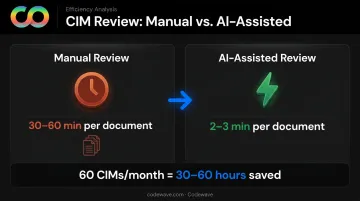
Investment banking has always been a document-heavy business. Every deal cycle — from initial screening through due diligence to close — generates thousands of pages of unstructured information that analysts must read, extract, and synthesize manually. The math is brutal: a mid-market bank reviewing 60 CIMs per month burns roughly 30-60 hours on document triage alone before any real analysis begins.
According to McKinsey, generative AI can improve productivity in core corporate and investment banking activities by 30% to 90% and save analysts 30% of time spent creating pitch books. Those are not incremental gains — they fundamentally change what a deal team can accomplish in a given quarter.
Understanding where those gains come from is the practical question. This article covers where manual workflows break down, which AI use cases are already delivering measurable results, what tools practitioners are using today, and what to evaluate before committing to implementation.
Key Takeaways:
- AI reduces CIM review time from 30-60 minutes to under 5 minutes per document
- Multi-agent document analysis cuts due diligence timelines from weeks to days
- Specialized finance-native tools outperform general-purpose LLMs for deal workflows
- Start with one narrow use case — prove ROI before scaling
- Compliance, explainability, and data governance are non-negotiable prerequisites
Where Investment Banking Workflows Break Down
The CIM Overload Problem
A typical bank receives dozens of CIMs per month — each a 50-100 page unstructured PDF covering financials, customer concentration, debt structure, and management commentary. Analysts spend 30-60 minutes per document manually scanning for the handful of metrics that determine whether a deal is worth pursuing.
At 60 CIMs per month, that's 30-60 hours of analyst time before a single model gets built. At 100 CIMs, the math no longer works — and that's before accounting for the follow-up questions, internal memos, and IC summaries that come next.
Due Diligence Multiplies the Problem
Once a deal advances, the document burden compounds. According to V7's M&A due diligence research, a mid-market acquisition routinely generates 5,000 to 12,000 data room documents and 200 to 400 structured diligence questions. Regulated or cross-border transactions can exceed 600 questions.
Traditional due diligence timelines run 30 to 90 days for most mid-market deals — a direct reflection of the manual work involved:
- Cross-referencing financial statements against legal contracts
- Checking employee counts across multiple documents
- Validating management presentation claims against payroll records
The Downstream Ripple
Every hour lost to manual extraction creates a chain reaction across the deal team:
- Senior bankers wait longer for synthesized insights
- Pitch books take days instead of hours to populate
- Mandate capacity shrinks as junior staff hit capacity limits
- Deal teams miss windows in competitive sell-side processes
Existing tools like Capital IQ and FactSet solve the market data retrieval problem well. They don't solve the unstructured document problem — the CIMs, scanned contracts, appraisal reports, and email attachments where most deal-critical information lives.
Key AI Use Cases Transforming Investment Banking Efficiency
Deal Screening and Document Intelligence
AI document extraction agents can read a 75-page CIM and pull key metrics — revenue, EBITDA, growth rate, customer concentration, debt covenants — into a structured output in minutes. V7 Go's deal screening agent, for example, extracts financials, scores opportunities against an investment thesis, and triages deal flow automatically.
The critical detail here is citation-level accuracy: every extracted value links back to the source page and paragraph. This matters for IC memo defense and audit trails, not just speed. Analysts aren't taking AI outputs on faith — they're verifying against the original document with a single click.
V7 reports deal analysis dropping from 30-60 minutes to 2-3 minutes per document. Across a 60-CIM monthly pipeline, that compression adds up fast — even at more conservative real-world rates.
Due Diligence and Data Room Analysis
Multi-agent AI platforms can search across an entire data room and surface answers to targeted questions in seconds. A query like "identify all change-of-control provisions across customer contracts" — which might take an analyst two days — can return results in minutes with source citations attached.
AI also flags cross-document inconsistencies automatically. If the employee count in the CIM differs from payroll records in the data room, the system surfaces that discrepancy before LOI rather than after. That kind of catch has real financial consequences.
Two documented outcomes from institutional users illustrate what's possible:
- Houthoff Buruma used Luminance to review thousands of M&A data room documents, categorize them by contract type and language, and flag anomalies — integrated directly with VDR providers like Intralinks
- Oak Hill Advisors achieved 6x ROI using Hebbia, with analysts cutting document review times by up to 75%
Financial Modeling and Market Research
AI tools now assist with populating 3-statement models, DCF frameworks, and comparable company analyses by pulling structured data from filings and financial databases. On the research side, comprehensive industry overviews, M&A trend summaries, and competitive landscape analyses that previously took analysts two days can now be generated in hours.
That said, AI handles data retrieval and first-pass structuring — the banker still validates model logic, stress-tests assumptions, and applies deal-specific judgment that no system can replicate.
Pitch Preparation and Client Relationship Work
NLP and generative AI enable relationship managers to synthesize data from filings, news, and client interactions to generate personalized investment theses and pitch materials. The pitch book workflow is where this shows up most concretely:
- AI generates first drafts of CIM sections and executive summaries
- Investment highlights get populated from extracted deal data
- Formatting and structure are handled automatically
According to McKinsey, this translates to analysts saving 30% of pitch book creation time — time that can shift to strategy, client relationships, and deal execution rather than formatting and writing.
Risk Management and Regulatory Compliance
AI anomaly detection reviews 100% of transaction-level data rather than relying on sampling. Patterns that manual review frequently misses under time pressure surface automatically, including:
- Round-dollar entries and duplicate vendor payments
- Weekend transactions outside normal authorization windows
- Unusual approval chains or sequencing anomalies
Generative AI also assists with stress testing simulations and auto-drafting regulatory reports, including ESG disclosures and audit documents. Compliance teams and regulators require full transparency into how AI-generated outputs were produced — explainability isn't optional, it's a condition of use.
Measurable Efficiency Gains AI Delivers to Investment Banks
The efficiency case for AI in investment banking is increasingly concrete:
| Workflow | Baseline | AI-Assisted | Source |
|---|---|---|---|
| CIM review per document | 30-60 min | 2-3 min | V7, 2024 |
| Analyst pitch book time | Baseline | 30% reduction | McKinsey, 2023 |
| Document review time | Baseline | Up to 75% reduction | Hebbia/OHA |
| Buy-side deal timeline | Baseline | ~20% reduction | Datasite, 2024 |
| Financial spreading | 2-3 weeks | 3-5 days | V7, 2024 |
| CIB core activity productivity | Baseline | 30-90% improvement | McKinsey, 2023 |
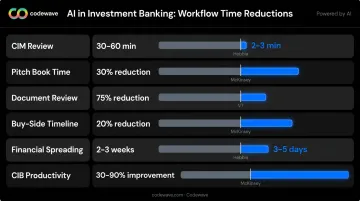
What the speed advantage means competitively: In sell-side processes, the firm that screens faster wins more mandates. A boutique that can evaluate 100 opportunities per month rather than 40 — without adding headcount — is structurally advantaged against larger competitors still running manual triage.
These benchmarks align with what Codewave has observed in fintech implementations: clients have achieved a 90% reduction in data errors and 40% less reporting time after automating manual data workflows. The gains aren't one-time — they compound across every reporting cycle as the underlying processes run faster and cleaner.
For boutique and mid-market banks specifically, the productivity multiplier matters most. AI-assisted teams can pursue more mandates simultaneously, compress timelines to compete with bulge-bracket execution speed, and reduce the burnout cycle that drives junior banker attrition.
What AI Tools Do Investment Bankers Use Today?
The current tool landscape breaks into three practical categories:
Document intelligence and data extraction:
- Hebbia — Finance AI platform used by asset managers, investment banks, and law firms; supports CIM extraction, expert-call transcript analysis, and page-level citations. SOC 2 Type II and ISO/IEC 42001 certified.
- V7 Go — PE deal screening and M&A diligence agents; extracts revenue, EBITDA, ARR, and scores opportunities against investment thesis. SOC 2 Type II and ISO 27001 certified.
Research and market intelligence:
- AlphaSense — Used by 80% of top investment banks and 80% of top PE firms; supports due diligence, precedent transactions, KPI benchmarking, and private company monitoring. SOC 2 Type II certified.
- Bloomberg Terminal AI — Pre-earnings preparation, attribution to original documents, investment research synthesis.
- Perplexity Finance — SEC filing search (10-K, 10-Q, S-1, S-4, 8-K); useful for public-company research workflows.
AI drafting and synthesis:
- Claude for Finance (Anthropic) — Connects to market data, research, and internal systems including FactSet and S&P Capital IQ.
- ChatGPT Enterprise — More appropriate than the consumer version for firm use; OpenAI does not train on enterprise data and supports advanced data analysis.
Off-the-Shelf vs. Custom Solutions
Off-the-shelf tools deploy quickly but often lack multi-step workflow logic, legacy system integration, and the compliance controls large financial institutions require. Custom AI solutions require more upfront investment but deliver tailored logic, audit-ready outputs, and seamless integration across existing tech stacks.
Tool selection should be driven by use-case specificity — a firm struggling with CIM overload needs a different solution than one focused on regulatory reporting automation. Define the workflow problem first, then evaluate tools against it.
What to Consider Before Implementing AI in Investment Banking
Start Narrow, Prove ROI, Then Scale
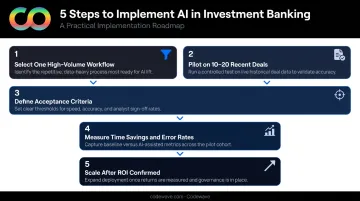
The most common implementation failure is attempting broad transformation before proving the concept. A better approach:
- Select one high-volume workflow — CIM triage is the most common starting point
- Pilot on 10-20 recent deals where you already know the correct outputs
- Define acceptance criteria — for example, 90%+ accuracy on core financial fields, 100% citation accuracy
- Measure time savings and error rates against the manual baseline
- Scale only after ROI is confirmed
Deloitte's 2025 financial services research found that 74% of GenAI pioneers in financial services estimated ROI above 10% from their most advanced initiatives — versus 44% of followers. The difference is disciplined piloting, not technology choice.
Data Infrastructure Is a Prerequisite
AI systems need access to clean, consolidated data. Before deploying any AI tool, audit your current data architecture for:
- Completeness — are all relevant documents accessible to the system?
- Accessibility — can the AI connect to your document management systems?
- Integration capability — can outputs flow into your existing CRM and workflow tools?
This is where implementation partners add real value. Look for partners who prototype against your actual workflows before full build-out — simulating outcomes on real deal data before committing to a production deployment substantially reduces the risk of expensive failed pilots.
Compliance and Governance Requirements You Can't Ignore
Financial institutions face specific requirements that general-purpose AI tools often don't address:
- Auditability — AI outputs must be traceable to source documents (not just summaries)
- Data security — Deal-sensitive materials require SOC 2 Type II certified vendors at minimum
- Model explainability — Regulators and compliance teams need to understand how outputs were generated
- Regulatory alignment — The OCC's 2026 revised model risk guidance explicitly addresses generative and agentic AI; FINRA highlights model explainability and data integrity as core concerns for securities firms
The SEC has already charged investment advisers for false statements about AI use. That precedent makes governance a front-line risk concern, not an afterthought — firms that treat compliance as infrastructure from day one avoid the liability that comes with retrofitting it later.
Frequently Asked Questions
What AI do investment bankers use?
Three categories dominate: document intelligence tools (Hebbia, V7 Go) for CIM triage and data room analysis; market research platforms (AlphaSense, Bloomberg Terminal AI, Perplexity Finance) for sector research and comp analysis; and LLM-based drafting tools (Claude for Finance, ChatGPT Enterprise) for memos and pitch content. The right choice depends on whether your bottleneck is deal screening, research synthesis, or document generation.
Is ChatGPT Pro worth it for investment banking?
ChatGPT Pro is useful for drafting pitch content, executive summaries, and industry overviews, but it lacks access to proprietary deal data and institutional-grade financial databases. For firm use, ChatGPT Enterprise is more appropriate, since it doesn't train on your business data. Treat it as a drafting and synthesis aid, not a primary analytical tool for deal-specific workflows.
Can AI fully replace investment bankers?
No. AI handles data extraction, formatting, and first-draft generation — tasks that consume most of a junior banker's time — but strategic judgment, client relationships, deal structuring, and negotiation remain human. The profession is evolving, not disappearing.
What are the biggest risks of using AI in investment banking?
Three risks matter most: hallucination in extracted financial data (always require citation-verified outputs), data security for deal-sensitive materials (look for SOC 2 Type II certified vendors), and regulatory compliance around model explainability and data governance. The SEC has already taken enforcement action against firms making misleading AI claims.
How long does it take to implement AI in an investment bank?
A focused pilot on a single workflow, such as CIM triage, can typically be live in weeks, depending on data readiness and tool selection. Full integration with CRM, document management, and email systems takes longer, with timeline driven by legacy system complexity and compliance requirements. A clean, well-scoped use case is the fastest path to ROI.
What are the measurable benefits of AI in investment banking?
Documented outcomes include significantly reduced per-document review time, faster due diligence cycles, fewer data errors in financial reporting, and improved mandate capacity for deal teams. McKinsey quantifies the upside at 30-90% productivity improvement in core CIB activities. That advantage grows when faster screening directly translates to more mandates won in time-sensitive sell-side processes.