Introduction
VR and AR are no longer pilot programs. Enterprises in healthcare, manufacturing, retail, and education are deploying immersive technology as production systems embedded in daily workflows — from surgical training simulations to factory floor AR guidance.
According to MarketsandMarkets, the global AR and VR market is projected to reach $97.41 billion in 2026, growing at 18.4% CAGR through 2032. That growth has drawn in hundreds of development shops, from boutique studios to full-scale enterprise integrators.
The result: vendor selection has become genuinely difficult.
The real risk is selecting a development partner that builds impressive demos but fails when those systems need to integrate with enterprise infrastructure, handle real workloads, and sustain over time.
This article covers five leading VR and AR development companies in 2026 — what each specializes in, where they excel, and how to evaluate which is the right fit for your organization's scale and use case.
Key Takeaways
- VR and AR development has moved beyond novelty — enterprises now require production-grade systems, not proof-of-concept demos
- Technical depth in Unity/Unreal Engine and cross-platform deployment capability separate production-ready shops from the rest
- Outcome alignment, IP ownership, and post-launch support matter as much as the portfolio
- PwC research found VR training can be up to 4x faster than classroom equivalents at scale — making adoption a financial decision, not just a technical one
- Each company featured — Codewave, Treeview, CXR Agency, Delta Reality, and Groove Jones — was selected for proven enterprise delivery, not just an impressive demo reel
VR and AR Development in 2026: Market Context
VR and AR development companies build immersive software for enterprise use — spanning headsets, mobile, and web platforms. Core applications include training simulations, remote collaboration, product visualization, assembly guidance, and customer engagement.
The market reflects that demand clearly. Grand View Research values the global extended reality market at $368.7 billion in 2026, projecting growth to $1.069 trillion by 2030 at a 32.9% CAGR. The verticals driving the highest enterprise adoption:
- Healthcare — surgical simulation, patient education, clinical training
- Manufacturing — assembly guidance, maintenance AR, safety training
- Retail — virtual try-on, AR product visualization, immersive showrooms
- Education and corporate training — immersive learning, skills simulation, onboarding
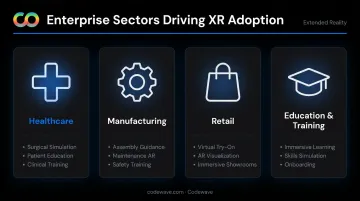
Each company listed below has a proven track record of delivering production-ready VR and AR solutions — not just prototypes — across at least one of these high-demand verticals.
Top VR and AR Development Companies in 2026
These companies were shortlisted based on engineering depth, portfolio diversity, cross-industry relevance, and proven track records delivering VR/AR solutions with measurable business impact.
Codewave
Headquarters: Austin, TX | Founded: 2013
Codewave builds AI-powered and immersive digital products for 400+ businesses across 15+ industries — including healthcare, fintech, education, and retail. Its XR practice spans the full immersive stack: VR, AR, MR, spatial computing, and WebXR, supported by Unity, Unreal Engine, ARKit, ARCore, Vuforia, AFrame, and Microsoft Mixed Reality Toolkit.
What separates Codewave from most development shops is its engagement model:
- ImpactIndex™ — clients pay for measurable outcomes, not hours logged
- QuantumAgile™ — compresses the path from idea to validated output
- ZeroDX™ — removes account management layers so clients work directly with the builders
Recognized with the ZeroDX Award 2024-25 and Best in Industry 2025, Codewave holds a 4.8/5 Clutch rating (27 reviews) and a 70–80% client retention rate — reflecting sustained delivery quality across multi-year engagements.
| Category | Details |
|---|---|
| Key Services | Custom VR/AR/MR application development, spatial computing, AI-powered analytics, product design, digital transformation across enterprise workflows |
| Industries Served | Healthcare, Fintech, Retail, Education, Insurance, Agriculture, Transportation, Energy |
| Key Differentiators | Outcome-based ImpactIndex™ engagement model, 70–80% client retention, 95%+ data accuracy, 25% average cost reduction for clients |
Treeview
Headquarters: Enterprise XR studio (multinational)
Treeview builds production-grade Mixed Reality systems for enterprise clients, with Microsoft, Meta, Toyota, and Medtronic among its named client examples. The studio has been developing enterprise AR applications since 2016 and covers the full delivery lifecycle: strategy, product design, 3D production, development, QA, deployment, and post-launch support.
The studio's senior-only team structure is a meaningful differentiator on complex, long-duration enterprise projects, where technical debt and mid-project team turnover frequently derail delivery. Treeview also guarantees full IP ownership transfer to clients — worth confirming explicitly during any vendor evaluation.
| Category | Details |
|---|---|
| Key Services | Custom MR/VR/AR application development, spatial computing, enterprise systems integration, strategic consulting |
| Industries Served | Healthcare, Manufacturing, Industrial, Life Sciences, Education, Training |
| Key Differentiators | Full IP ownership transfer to clients, senior-only engineering team, end-to-end lifecycle capability, Unity and Unreal Engine expertise |
CXR Agency
Headquarters: Brooklyn, NY | Founded: 2009
CXR Agency is a multidisciplinary creative agency and IT consultancy with over 15 years of XR experience — one of the longer track records in the space. The agency combines deep technical XR development with brand-driven creative design, serving clients including Richemont, HBO Max, Dropbox, and LiveNation across web, mobile, VR/AR, and blockchain-enabled applications.
Its cross-technology capability spanning AI, XR, and Web3 makes it a practical fit for enterprises that need immersive experiences integrated into broader digital ecosystems rather than deployed in isolation.
| Category | Details |
|---|---|
| Key Services | Custom AR/VR development, mobile app development, UX/UI design, staff augmentation, Web3 and XR integration |
| Industries Served | Enterprise, Retail, Media and Entertainment, Finance, Events, Gaming |
| Key Differentiators | Operating since 2009 with deep XR expertise, cross-technology capability (AI + blockchain + XR), notable enterprise and consumer brand portfolio |
Delta Reality
Headquarters: Zagreb, Croatia
Delta Reality is an XR studio with a cross-functional team focused on VR, AR, and mixed reality — with particular depth in training simulations, educational experiences, and museum and visitor installations. The studio won Best Art or Film at the AWE Auggie Awards 2023 and holds a Red Dot 2023 Design Concept nomination.
The Frauscher Learning Academy project — immersive VR training built for railway engineers — demonstrates Delta Reality's ability to pair design quality with documented skills transfer outcomes, which is the distinction that matters most in enterprise training contexts.
| Category | Details |
|---|---|
| Key Services | VR/AR/MR development, training simulations, product visualization, museum and visitor experiences, educational XR |
| Industries Served | Training and Education, Public Sector, Cultural and Museum, Industrial, Enterprise |
| Key Differentiators | Award-winning design (Auggie Awards, Red Dot nomination), high-volume XR project track record, proven measurable learning outcomes |
Groove Jones
Headquarters: Texas, USA
Groove Jones is a Texas-based XR agency that uses its proprietary GrooveTech™ platform to deliver extended reality experiences across AR, VR, and mixed reality. Built on patented tools, the platform enables faster, more scalable XR production with built-in quality controls — particularly useful for brand campaigns and events running on compressed timelines.
Recent client work includes the Alcon Magic Mirror, HSBC using Apple Vision Pro to visualize quantum computing, and the Adobe Summit Mantra Machine, reflecting cross-sector capability across enterprise training, brand activation, and marketing.
| Category | Details |
|---|---|
| Key Services | AR/VR/MR experiences, animation and CGI, social AR filters, interactive web apps, audience engagement installations, mobile app development |
| Industries Served | Marketing and Brand, Events and Experiential, Enterprise, Retail, Consumer |
| Key Differentiators | Proprietary GrooveTech™ platform, cross-format XR production (social AR, WebGL, CGI, volumetric), strong US enterprise and brand presence |
How We Chose the Best VR and AR Development Companies
Most organizations pick VR/AR vendors on portfolio aesthetics or brand name. Few ask whether those companies can integrate with existing enterprise infrastructure, scale past a pilot, or sustain performance after launch. This list is built to close that gap.
Evaluation criteria used:
- Technical depth: Unity and Unreal Engine proficiency, WebXR capability, and coverage across standalone headsets, mobile, and tethered platforms
- Industry-specific experience: proven delivery within a specific vertical, not just generalized XR work
- Production-ready track record: enterprise-integrated deployments on record, not only demos or MVP builds
- Measurable outcomes: client results tied to operational metrics such as training efficiency, cost reduction, and productivity gains
- Post-launch support: ongoing maintenance, iteration cycles, and monitoring after deployment
- IP ownership: clients should receive full ownership of the developed software — non-negotiable at the enterprise level
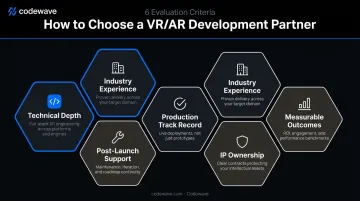
Team structure and engagement model also shaped the rankings. Companies with direct collaboration, outcome-aligned pricing, and strong client retention scored higher than high-volume shops with low repeat business.
Conclusion
Choosing a VR or AR development company is a business outcomes decision, not a technology selection alone. The right partner should align with your operational goals, integrate with your existing systems, and stay accountable through post-launch performance — measured in adoption rates and workflow impact, not just a polished demo.
Before committing to any development engagement, evaluate potential partners on scalability, post-launch support, enterprise integration capability, and transparency around IP ownership. These factors determine whether your immersive investment earns a permanent place in your operations or stalls after the first pilot.
If you're looking for a partner that builds immersive solutions tied to measurable business outcomes, Codewave's ImpactIndex™ model ensures your investment translates into real operational value — with accountability baked in from kickoff to post-launch. Reach out to explore how Codewave can bring your immersive product vision to life.
Frequently Asked Questions
How much does it cost to hire a VR development company?
Project costs vary significantly based on scope and complexity. Pilots and proof-of-concept builds typically range from $50,000–$100,000, standard VR projects from $100,000–$250,000, and large enterprise deployments from $250,000 and above. Pricing also depends on platform (standalone vs. tethered headset), integration requirements, and whether the engagement is time-and-materials or outcome-based.
What is the difference between AR and VR development?
AR overlays digital content onto the real world — accessed via smartphone or smart glasses — while VR creates fully immersive digital environments experienced through a headset. The right choice depends on the use case. Mixed Reality (MR) blends both, and is increasingly common in enterprise workflows where users need contextual digital data without full immersion.
Which industries benefit most from VR and AR development?
Healthcare (surgical simulation, clinical training), manufacturing (assembly guidance, safety procedures), retail (virtual try-on, product visualization), and education and corporate training (immersive learning, onboarding) are the strongest verticals for enterprise VR/AR adoption in 2026.
How long does it take to develop a VR or AR application?
Pilot builds typically take around 3 months. Standard VR/AR projects run 6–9 months. Complex, enterprise-integrated systems can require 9–18 months, typically delivered in phases depending on scope, platform targets, and integration depth.
What should I look for when choosing a VR or AR development partner?
Key criteria to evaluate:
- Proven Unity or Unreal Engine expertise
- Experience in your specific industry
- End-to-end delivery capability (not just design)
- Clear IP ownership terms and post-launch support
- Willingness to define success metrics before the project starts
A partner's retention rate and how early they commit to measurable outcomes signal whether they're accountable to results, not just deliverables.
Can VR and AR solutions integrate with existing enterprise systems?
Yes — production-grade VR/AR systems are built to integrate with ERP, IoT platforms, LMS, and business data systems. Choose a partner with enterprise integration experience, or immersive tools risk becoming isolated from the operational data that makes them genuinely useful.