Intelligent automation (IA) gives operators a way out. By combining AI, machine learning, robotic process automation, and IoT sensor networks, IA shifts O&G companies from reactive firefighting to continuous, data-driven operations. This guide covers what IA actually means in an oil and gas context, where it delivers the strongest results across the value chain, what's blocking broader adoption, and how to build a credible implementation roadmap.
Key Takeaways
- Only 30% of O&G companies have successfully scaled digital operations beyond pilot programs, per McKinsey
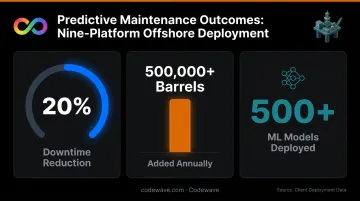
- Predictive maintenance across nine offshore platforms reduced average downtime 20% and added 500,000+ barrels annually
- IA spans the full value chain: drilling optimization, pipeline monitoring, back-office automation, and emissions compliance
- Legacy SCADA/ERP integration and data quality remain the primary barriers, not the technology itself
- Start with two or three high-volume use cases before attempting enterprise-wide deployment
What Is Intelligent Automation in Oil and Gas?
Intelligent automation (IA) is a layered architecture that combines several technologies to handle both structured and unstructured data — and to make decisions rather than just execute instructions.
IA vs. Basic RPA
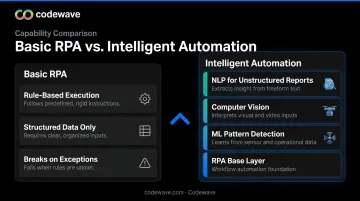
Standard robotic process automation (RPA) follows rules. It can extract data from a field report, populate a spreadsheet, or route an invoice for approval — but only if the inputs are consistent and the exceptions are predictable. In O&G, they rarely are.
IA adds a cognitive layer on top of RPA: machine learning models that detect patterns in noisy sensor data, computer vision that inspects equipment from drone footage, and natural language processing that reads unstructured inspection reports. The result is a system that can handle the dynamic, messy reality of oilfield operations rather than breaking whenever conditions deviate from the expected.
The Digital Oilfield Connection
The "digital oilfield" concept describes the integration of physical sensing, operational data streams, and enterprise decision-making into a continuous feedback loop. IA is what closes that loop — translating raw data streams into actions that operations teams can actually use.
Without IA, drilling telemetry, SCADA readings, and production logs sit in disconnected systems — collected but rarely acted on quickly enough to matter.
With IA, those streams feed into analytical models that surface specific, timely recommendations: adjust a drilling parameter now, flag a pump for maintenance before it fails, alert the compliance team about a pressure anomaly. That shift — from passive data collection to automated decision support — is where the operational value lives.
Key Applications Across the O&G Value Chain
Upstream: Drilling Optimization
Well planning traditionally requires geoscientists, drilling engineers, and reservoir specialists to manually synthesize geospatial surveys, historical flow data, and real-time telemetry. IA compresses that process — often dramatically.
An SLB offshore Indonesia case reduced well evaluation time from three days per well to hours across an entire field — a reported 90% reduction in review time. A 12-well autonomous drilling campaign documented by SPE achieved a 48% improvement in rate of penetration versus manual operation and 25% versus advisory mode.
These aren't sector-wide averages; they're bounded results from specific deployments. But they point to a consistent pattern: when IA integrates cross-disciplinary data and dynamically adjusts drilling parameters in real time, operators drill faster and more accurately.
Upstream: Predictive Maintenance
Equipment failure in O&G doesn't just cost money. Unplanned shutdowns cascade — a single compressor failure can idle an entire production platform.
AI-powered predictive maintenance systems analyze continuous sensor readings (temperature, pressure, vibration) from wellheads, pumps, and compressors to identify anomaly patterns before failure occurs. McKinsey's analysis of a nine-platform offshore program found that predictive maintenance reduced average downtime by 20% and added more than 500,000 barrels of production annually. The program deployed more than 500 ML models over two years, which illustrates why data readiness has to come before model deployment.
The financial stakes are concrete: McKinsey's 2024 refinery analysis found the annual reliability-related profit gap between median and top-quartile midsize refineries runs $20M–$50M per year.
Midstream: Pipeline Monitoring
Many US natural-gas pipelines were installed more than 60 years ago and remain in service, according to PHMSA. For aging infrastructure like this, continuous integrity monitoring is a regulatory requirement, not an optional upgrade.
IA enables real-time pipeline monitoring through sensor fusion and ML-based anomaly detection, flagging pressure irregularities, corrosion indicators, and potential leak signatures before they escalate. Total US pipeline incidents fell 23% from 2019 to 2023 (87 fewer incidents), per API — though no direct causal link to ML specifically has been established. What the data does confirm is that the industry is moving toward continuous monitoring, and automated detection is a core part of that shift.
Downstream and Back Office
Midstream and downstream operators often run disconnected accounting, land management, and compliance platforms — the result of decades of acquisitions and point-solution purchasing.
IA can unify these data streams and automate high-volume processes:
- Invoice processing — automated extraction, validation, and approval routing
- Volume reporting — automated aggregation from production systems to regulatory submissions
- Lease administration — contract review and approval workflows that currently require manual handoffs
- Compliance documentation — automated assembly of permit applications and inspection records
BSEE conducts approximately 20,000 annual offshore inspections across regulatory, lease, and operational requirements. The compliance documentation burden alone makes back-office automation a high-value target for most operators.
Business Benefits of Intelligent Automation
Reduced Operational Costs
IA cuts costs in two directions simultaneously. Direct savings come from reducing labor on repetitive, high-volume tasks. Indirect savings come from avoiding unplanned downtime, equipment damage, and rework. The reliability profit gap cited above — $20M–$50M annually for a midsize refinery — represents the ceiling for what predictive maintenance and automated monitoring can protect.
Improved Worker Safety
The BLS recorded 65 US oil and gas extraction fatalities in 2024, down from 78 in 2023. Automation directly reduces human exposure to the highest-risk tasks:
- Drone-based pipeline inspection replaces personnel in confined or hazardous areas
- Remote monitoring systems flag dangerous pressure or chemical conditions before human entry
- Autonomous equipment monitoring in toxic or high-pressure environments reduces contact time
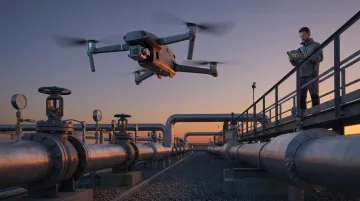
Aramco reported that drones and wearables cut inspection time at Uthmaniyah by approximately 90% — the primary benefit being less time for workers in the field, not just cost savings.
Enhanced Production Efficiency
Continuous automated optimization outperforms periodic human review. Aramco's Khurais field digitalization — using more than 40,000 sensors — reportedly increased production 15% and doubled troubleshooting response speed. These are self-reported figures, but the mechanism is straightforward: continuous monitoring and adjustment outperforms weekly review cycles on every meaningful production metric.
Faster Decision-Making and ESG Progress
IA eliminates the lag between data collection and action. Instead of waiting for written field reports, engineers receive real-time dashboards and automated alerts. That same real-time visibility is now closing the gap on emissions compliance:
- The IEA estimates existing technologies could cut oil and gas methane emissions by ~75%
- EPA's waste-emissions charge for excess methane climbs from $900/ton in 2024 to $1,500/ton by 2026
Automated methane detection, emissions logging, and compliance reporting aren't just ESG initiatives — they're direct and growing financial exposures.
Overcoming Barriers to Implementation
Legacy Infrastructure and Data Silos
The most common blocker isn't technology — it's the infrastructure underneath it. Many O&G operators run decades-old SCADA and ERP systems that were never designed to share data with modern AI platforms. McKinsey identifies fragmented technology, point solutions, and insufficiently modern data platforms as the primary reasons digital transformations stall at the pilot stage.
The proven approach is to layer an automation platform over existing environments rather than replace them wholesale. This preserves operational continuity while enabling data unification — a non-disruptive path that most O&G operators can pursue without shutting down production systems.
Codewave's technology stack includes Apache Kafka for high-volume streaming data ingestion and Apache Flink for real-time anomaly detection — both directly applicable to connecting legacy SCADA historians with modern ML pipelines without requiring infrastructure replacement.
Data Quality and Standardization
O&G generates enormous data volumes, but much of it is unstructured, inconsistently labeled, or siloed by department or asset. Common examples include:
- Sensor readings from different equipment vintages using incompatible formats
- Field reports stored as unstructured text documents
- Maintenance logs scattered across departmental spreadsheets
Investing in data governance and master data management before deploying AI is non-negotiable. Models trained on inconsistent data produce unreliable predictions. McKinsey links stalled O&G transformations directly to weak data architecture and the inability to deploy analytics consistently across assets.
Change Management
Technical implementation is only half the challenge. Operators who skip workforce preparation consistently underperform those who invest in it. The practical requirements:
- Knowledge transfer from experienced field personnel to the teams managing automated systems
- Upskilling engineers and operations staff to interpret AI outputs and override when warranted
- Clear communication that automation handles the repetitive and hazardous work, while human judgment remains essential for complex decisions
IA works best when positioned as augmenting expertise, not replacing it. Organizations that frame it this way see faster adoption and fewer implementation failures.
How to Get Started
Start with High-Impact, Bounded Use Cases
Attempting enterprise-wide automation from day one is how implementations fail. Instead, identify two or three processes that are:
- High volume — happening dozens or hundreds of times per month
- Error-prone — currently generating rework, exceptions, or compliance exposure
- Measurable — with clear before/after KPIs already tracked
Good candidates for most O&G operators include production reporting, equipment inspection scheduling, and invoice processing. These deliver fast ROI, build organizational confidence, and generate proof points for broader investment.
Build a Cross-Functional Roadmap
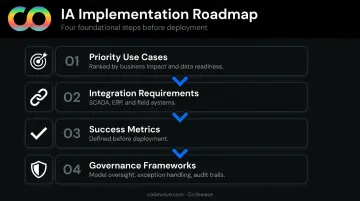
Once your pilot use cases are defined, the next challenge is alignment. IA implementations that stay inside IT rarely succeed — the roadmap needs buy-in across operations, compliance, finance, and leadership before any technology is deployed. A workable roadmap defines:
- Priority use cases, ranked by business impact and data readiness
- Integration requirements for connecting IA to existing SCADA, ERP, and field systems
- Success metrics agreed upon before deployment — not retrofitted after the fact
- Governance frameworks covering model oversight, exception handling, and audit trails
Partner with an Outcome-Focused Vendor
The right implementation partner works from measurable results, not technology deployments for their own sake. That means defining success metrics upfront, building toward them, and being accountable when they aren't met.
Codewave's ImpactIndex™ model is built on this principle: clients invest in solutions that perform and deliver measurable business value. Across 400+ implementations in data-intensive industries, Codewave has delivered 40% productivity increases and 90% reductions in data errors — the kind of results that matter when you're running high-volume, accuracy-dependent operations at scale.
The Future: Autonomous Oilfields and Agentic AI
Digital Twins and Edge Computing
The next layer of IA capability in O&G centers on digital twins — virtual models of physical assets that update continuously from sensor data and simulate operational scenarios before changes are made in the field. SPE describes twins that integrate models and field data throughout an asset's full lifecycle, enabling operators to test interventions in the digital environment before committing resources.
For digital twins to function at remote sites, edge computing is essential. Rather than routing all sensor data to a central cloud, edge platforms perform real-time analysis at the source — a non-negotiable capability for offshore platforms and remote wellsites where bandwidth is constrained and latency can't be tolerated.
Agentic AI: Self-Optimizing Operations
The most significant near-term shift is from automated workflows to agentic AI systems — models that can set sub-goals, coordinate across multiple data sources, and continuously optimize production without human intervention at each step.
An SPE/JPT case from ONGC used an agentic framework for large-scale offshore well modeling and reported more than 1,000 engineering hours saved across two examples. SPE commentary identifies agentic systems as applicable across:
- Well planning and subsurface workflows
- Integrity management and production optimization
- Model governance with human review as a required guardrail
In practice, this means well-governed systems handling high-frequency optimization decisions continuously — freeing engineers for the complex judgment calls that still require human expertise. The operational gap between operators who deploy these systems now and those who don't will widen as production margins tighten and reservoir complexity increases.
Frequently Asked Questions
What is automation in the oil and gas industry?
Oil and gas automation uses digital technologies — including IoT sensors, AI, and RPA — to perform tasks across drilling, production, pipeline management, and back-office operations with reduced human intervention. The goal is improved efficiency, safety, and cost control across the full value chain.
What does intelligent automation do?
Intelligent automation combines AI and machine learning with workflow and robotic automation to handle complex, judgment-requiring tasks. Unlike rule-based RPA, IA analyzes unstructured data, identifies patterns, makes context-aware decisions, and continuously improves from operational outcomes.
What are the 5 layers of automation?
Five layers are commonly referenced in industrial automation frameworks:
- Field/sensor layer — data collection from physical equipment
- Control layer — PLCs and SCADA systems executing commands
- Supervisory layer — monitoring and human oversight
- Enterprise layer — ERP and business system integration
- Intelligent/cognitive layer — AI-driven decision-making and continuous optimization
What is the difference between RPA and intelligent automation in O&G?
RPA handles structured, repetitive, rule-based tasks — data entry, report generation, invoice routing. Intelligent automation adds AI and ML to manage unstructured data, handle exceptions, and make context-aware decisions. The dynamic, data-heavy reality of O&G operations demands IA rather than basic RPA.
What are the biggest challenges of implementing intelligent automation in oil and gas?
Three challenges consistently surface during O&G automation implementations:
- Legacy infrastructure — SCADA and ERP systems were not designed to integrate with modern AI platforms
- Data quality — siloed operational systems make standardization difficult before automation can scale
- Workforce change — automation reshapes both field and back-office roles, requiring deliberate change management