Introduction
Procurement teams are caught in a bind. Workloads are projected to rise 10% in 2025 while budgets grow just 1%, according to The Hackett Group—a pressure gap that conventional tools simply can't close. Add supply chain volatility, geopolitical disruptions, and tightening compliance demands, and the case for a fundamentally different approach is hard to argue with.
According to EY's 2025 Global CPO Survey, roughly 80% of global CPOs plan to deploy generative AI within three years—yet only 36% have done so in any meaningful way. The gap between intent and execution is wide, and closing it requires more than enthusiasm.
This guide covers what generative AI actually does in procurement, the use cases generating the most value, the measurable benefits CPOs are reporting, and a practical implementation path. Whether you're evaluating your first pilot or scaling across source-to-pay, you'll get a direct look at where GenAI delivers—and where the real challenges lie.
Key Takeaways
- Generative AI turns unstructured procurement data—contracts, invoices, emails—into actionable insights across the full sourcing lifecycle
- Leading use cases include spend analytics, contract management, RFP automation, supplier risk monitoring, and invoice processing
- CPOs rank enhanced decision-making as the #1 value driver of GenAI—ahead of direct cost savings
- KPMG simulations estimate GenAI can automate 50–80% of current procurement work
- GenAI augments procurement professionals—it doesn't replace them
What Is Generative AI in Procurement?
Traditional procurement automation follows rules. If an invoice matches a PO, approve it. If a supplier hits a risk threshold, flag it. These systems work—but only when data is clean, structured, and fits the predefined logic.
Generative AI works differently. It uses large language models (LLMs) to read and reason across unstructured data—contract PDFs, supplier emails, market news feeds, audit reports—and generate new content, summaries, and recommendations from that raw material. Where older RPA and ML tools need structured inputs to function, GenAI can handle the messy, real-world data that procurement teams actually deal with.
Three Modes of Value
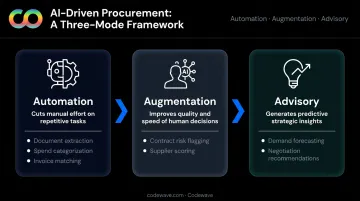
Generative AI doesn't deliver value in one way. It operates across three distinct modes:
- Automation — Cuts manual effort on repetitive, time-intensive work (document extraction, spend categorization, invoice matching)
- Augmentation — Improving the quality and speed of human decisions (contract risk flagging, supplier scoring, scenario analysis)
- Advisory — Generating predictive, strategic insights (demand forecasting, risk early warnings, negotiation recommendations)
Deloitte identifies proactive risk management, process automation, and decision support as GenAI's greatest procurement opportunities — each corresponding to one of these three modes.
What GenAI Is Not
Generative AI is not plug-and-play. It requires:
- Clean, connected data across ERP, CLM, and spend systems
- Integration with existing procurement platforms
- Human oversight to validate outputs, particularly for high-stakes decisions like contract approvals and supplier selection
Organizations seeing real returns build GenAI into a governed capability with clear validation workflows and accountability structures.
Top Generative AI Use Cases in Procurement
Generative AI use cases span the full source-to-pay lifecycle. Deloitte's 2024 Global CPO GenAI survey found that spend analytics, contract management, and sourcing automation were the most commonly explored areas—with 38% of early adopters already piloting or deploying GenAI in spend dashboards.
Spend Analytics and Classification
Manual spend classification is slow and inconsistent. Analysts spend hours categorizing transactions, and even then, misclassification rates create blind spots that mask savings opportunities.
Generative AI automates spend categorization across structured and unstructured data sources, then generates natural-language summaries that surface patterns in plain English. Instead of a dashboard an analyst must interpret, a CPO gets: "Tail spend in MRO categories increased 18% QoQ, with 34 unapproved vendors accounting for 60% of transactions."
The result: faster identification of savings opportunities, better compliance with preferred supplier lists, and spend visibility that doesn't require a dedicated analyst team to maintain.
Contract Lifecycle Management
Contract review is one of the most time-consuming activities in procurement—and one where GenAI's ability to read dense, unstructured text pays off immediately.
GenAI reads and summarizes complex agreements, extracts key terms, obligations, and renewal dates, and flags non-standard clauses against a defined playbook. What used to take a lawyer or procurement specialist hours can be surfaced in minutes.
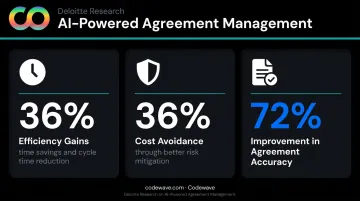
The numbers back this up. Deloitte's research on AI-powered agreement management found:
- 36% efficiency gains through time savings and cycle time reduction
- 36% cost avoidance through better risk mitigation
- 72% improvement in agreement accuracy
Gartner predicts that by 2027, 50% of organizations will support supplier contract negotiations using AI-enabled contract risk analysis and editing tools. For most procurement teams, that's within the current planning horizon.
RFP and Sourcing Automation
Writing an RFP from scratch takes time—gathering requirements, drafting specifications, formatting for different supplier types, and ensuring compliance with sourcing policies. GenAI compresses that cycle by days, sometimes weeks.
Procurement teams input their requirements in natural language. The AI drafts the RFP structure, populates standard sections, suggests evaluation criteria, and can score supplier responses against those criteria once submissions come in.
Deloitte found that 19% of early GenAI adopters were already automating RFI/RFP/RFQ generation—making it one of the faster-growing sourcing applications. The quality improvement is just as important as the time saving: AI-generated RFPs are more consistent, more complete, and less likely to create ambiguity that leads to supplier clarification rounds.
Supplier Risk Management
Supply disruptions are the top risk in procurement today—cited by 42% of procurement leaders in Gartner's 2024 survey. The problem with traditional risk monitoring is that it's backward-looking: you find out a supplier is in trouble after the problem has already affected your supply chain.
Generative AI shifts that dynamic forward. It monitors real-time signals across financial health databases, news feeds, regulatory filings, geopolitical developments, and ESG data—covering hundreds of suppliers at once—and surfaces early warnings before disruptions materialize.
The key differentiator is synthesizing unstructured data. A news article about a supplier's factory fire, a regulatory filing indicating financial stress, and a social media signal about labor unrest can all feed a single coherent risk assessment. No rules-based system can do that.
Invoice Processing and AP Automation
Accounts payable is one of the highest-friction areas in procurement. IOFM reports that only 5% of PO-to-invoice matches are 100% accurate on the first attempt, and more than a third of organizations deal with duplicate payment rates above 1%.
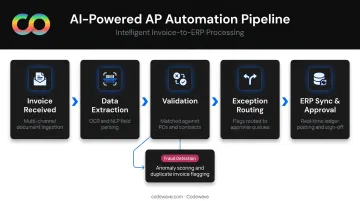
AI-powered AP automation—combining OCR, NLP, and generative AI—extracts invoice data from any format, validates it against POs and contracts, routes exceptions, and syncs approved invoices directly to ERP systems. Codewave's AP automation platform does exactly this, using transformer-based NLP and graph neural networks to handle new vendor formats without manual template configuration.
The result: faster processing cycles, fewer exceptions, and fraud detection that flags mismatches before they hit the general ledger.
Procurement Intake and Orchestration
An emerging but high-impact use case: AI-powered intake management. Instead of navigating procurement portals or submitting formal requisitions, employees type what they need in plain language. The AI interprets the request, maps it to the right category, preferred suppliers, and approval workflow—reducing maverick spend without creating process friction.
When the easiest route is also the approved one, compliance rates follow. Organizations piloting AI intake report measurable drops in off-contract spend within the first quarter of deployment.
Key Benefits of Generative AI in Procurement
Efficiency and Productivity
KPMG's simulations found that GenAI has the capacity to automate 50–80% of current procurement work—document creation, data entry, spend categorization, contract review, and more. The Hackett Group found AI-driven procurement tools delivering up to 10% improvements in productivity, quality, and cost savings, with some advanced implementations exceeding 25%.
The practical effect: procurement teams spend less time on administrative tasks and more time on supplier strategy, negotiations, and cross-functional collaboration.
Cost Reduction and Spend Optimization
GenAI drives cost savings across several fronts at once:
- Better spend visibility catches tail spend, duplicate vendors, and off-contract purchases
- Smarter supplier selection through AI-scored sourcing events
- Faster contract cycle times reduce the cost of contracting itself
- Exception reduction in AP cuts the labor cost of error resolution
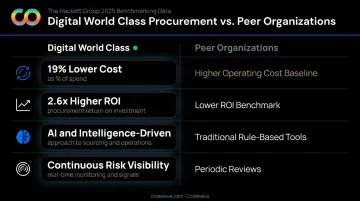
Digital World Class procurement teams—those using AI and intelligence-driven approaches—operate at 19% lower cost as a percentage of spend and achieve 2.6x higher ROI than peers, per The Hackett Group's 2025 benchmarking data.
Risk Management and Compliance
Instead of quarterly supplier reviews or manual contract audits, AI systems watch for risk signals around the clock. Contract compliance risks, regulatory changes, supplier financial stress, and payment anomalies are all surfaced faster—and with fewer false positives. That shift from periodic to continuous visibility is where AI materially reduces exposure.
Faster, Smarter Decision-Making
Deloitte's 2024 Global CPO GenAI survey found that enhanced analytics and decision-making was the #1 value driver organizations believe GenAI will unlock—ranking above direct cost savings. That reflects where CPOs see the real leverage: not in automation alone, but in better judgment at every decision point.
Stronger Supplier Relationships
When AI handles the transactional work—performance tracking, communication logging, invoice resolution—procurement teams have more capacity for the conversations that build strategic partnerships. AI also provides the data foundation for those conversations: objective performance benchmarks, spend trend analysis, and market comparisons that give procurement teams a defensible, fact-based position at the table.
Challenges of Implementing Generative AI in Procurement
Data Quality and Readiness
Gartner identifies fragmented, low-quality data as one of the primary obstacles to GenAI adoption in procurement. Deloitte's 2024 CPO survey confirmed it: data quality ranked as the second-largest internal barrier to AI success.
Inconsistent spend taxonomies, incomplete supplier records, and siloed ERP systems undermine AI accuracy at every layer. The trap is waiting for perfect data before starting—that moment never arrives. The better approach: identify the 2–3 data domains most critical to your priority use cases, clean those first, and let AI assist with ongoing data quality improvement.
Integration Complexity and Change Resistance
Most procurement functions run across legacy ERP systems, point solutions for sourcing and CLM, and manual processes stitched together with spreadsheets. Integrating AI into that environment is technically complex—and rarely a clean lift-and-shift.
The organizational challenge is often harder to solve. Procurement professionals may distrust AI outputs, fear displacement, or resist changing workflows that have always worked. Cross-functional governance and deliberate change management—not just a technology rollout—determine whether adoption actually sticks.
Skills Gaps and Governance
BCG research found that only 6% of C-suite respondents had begun upskilling their workforce in any meaningful way, while 62% cited talent and skills shortages as their primary barrier to scaling AI. That gap shows up directly in procurement: teams may lack the AI literacy to challenge, interpret, or effectively oversee AI outputs.
Governance needs to run in parallel with technology deployment—not after it. Three questions need answers before go-live:
- Which data can be exposed to AI systems?
- Who validates outputs before they influence decisions?
- Who owns accountability when AI-driven recommendations are wrong?
How to Implement Generative AI in Procurement
Step 1: Start with Problems, Not Tools
Anchor every GenAI initiative in a specific, measurable business outcome. "Reduce contract review time by 50%" is a workable objective. "Explore AI in procurement" is not.
Identify 2–3 high-impact, low-risk use cases to prove value quickly. Spend analytics and contract summarization consistently emerge as recommended starting points—both deliver visible results fast and don't require deep system integration to pilot.
Step 2: Build Your Data and Integration Foundation
Before committing to any AI tool, address these three foundations:
- Assess data quality across key procurement systems and prioritize cleanup in the domains your priority use cases actually need
- Plan API integrations between AI tools and existing platforms—ERP, CLM, spend analytics
- Compress your timeline by running discovery, design, and early development in parallel rather than sequentially
Codewave's QuantumAgile™ methodology is designed around this parallel approach, enabling teams to move from concept to validated outcomes in days rather than months.
Step 3: Establish Governance and Cross-Functional Alignment
Form a cross-functional AI governance committee that includes procurement, IT, legal, and finance. Define clear policies on:
- What data can be exposed to AI systems
- How AI outputs will be validated before action
- Who owns accountability for AI-driven decisions
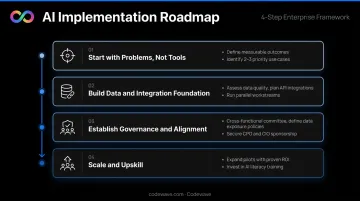
Secure executive sponsorship from both the CPO and CIO. Without it, AI initiatives stall at pilot.
Step 4: Scale What Works, Upskill Your Team
After a pilot delivers measurable ROI, build a roadmap for scaling across the procurement function. Track adoption metrics alongside business outcomes—both matter.
Invest in AI literacy training so procurement professionals understand how to use, challenge, and oversee AI outputs. The goal is teams who can work effectively with AI—using it as a partner in decisions without depending on data science expertise.
Frequently Asked Questions
What is generative AI in procurement?
Generative AI uses large language models to read unstructured data—contracts, invoices, supplier emails, market reports—and generate summaries, documents, and recommendations. Unlike traditional automation that follows fixed rules, it understands context and nuance, which makes it useful at every stage of procurement.
How is generative AI different from traditional procurement automation?
Traditional automation processes structured data using predefined logic (if-then rules). Generative AI handles unstructured data, generates new content, and reasons contextually—it can summarize a 60-page contract, draft an RFP from a paragraph of requirements, or synthesize supplier risk signals from dozens of news sources simultaneously.
What are the most impactful use cases for generative AI in procurement?
The consistently top-ranked use cases are spend analytics and classification, contract lifecycle management, RFP/sourcing automation, supplier risk monitoring, and invoice processing. These align with where procurement data is most unstructured and where manual effort is highest.
Will generative AI replace procurement professionals?
No. GenAI automates the transactional and administrative work—document review, data entry, spend categorization—freeing procurement teams to focus on strategic sourcing, supplier relationships, and oversight of AI outputs. The role shifts toward higher-value judgment work, not elimination.
What is the ROI of generative AI in procurement?
Deloitte found that Digital Masters achieved an average 3.2x return on GenAI investment. Early-stage adopters typically see 10% productivity gains, with advanced implementations exceeding 25%. ROI comes from automation (time savings), augmentation (better decisions), and advisory (strategic insights).
What are the biggest barriers to implementing generative AI in procurement?
The top three barriers are data quality and readiness, integration complexity with legacy systems, and organizational change resistance. All three are manageable through phased rollouts, cross-functional governance, and targeted AI literacy programs for procurement staff.