Introduction
A major port shuts down for 72 hours. A tier-two supplier files for bankruptcy. A sudden cold snap disrupts regional freight networks. Any one of these events can cascade into tens of millions in losses before a single human decision-maker even opens their inbox.
Supply chain leaders aren't short on intelligence — they're overwhelmed by signal volume, and disruptions move faster than sequential decision workflows can respond. McKinsey reports that disruptions lasting one month or longer occur every 3.7 years on average, with cumulative losses reaching up to 45% of one year's profit over a decade.
Traditional automation handles routine scenarios well, but it collapses the moment conditions shift outside predefined rules. Agentic AI takes a fundamentally different approach — sensing conditions in real time, reasoning across data sources, and acting without waiting for a human to approve each step.
This article covers what agentic AI actually is, how it changes the resilience equation, where it delivers the highest impact, and what a responsible implementation path looks like.
Key Takeaways
- Agentic AI turns supply chains from reactive systems into continuously self-correcting operations
- The sense–plan–act–learn loop enables continuous adaptation
- Highest-value use cases: demand forecasting, dynamic procurement, logistics optimization, predictive maintenance
- Deployment succeeds when data infrastructure, agent orchestration, and human escalation protocols are in place from the start
- Start with high-frequency, data-rich processes for the fastest ROI and quickest trust-building
Why Traditional Supply Chains Break Under Pressure
Most supply chain processes were designed around human cognitive limits — sequential handoffs, periodic reviews, manual exception handling. That design made sense when disruptions were rare and data volumes were manageable. Neither condition holds today.
The Reactive Trap
When something goes wrong, traditional systems force teams into firefighting mode. Rule-based automation handles routine scenarios reasonably well — a standard replenishment trigger, a predefined carrier preference. But the moment an unexpected variable enters the picture (a geopolitical shift, a sudden demand spike, a supplier showing early stress signals), those rules no longer apply.
The architecture of traditional supply chain management is reactive by design: each disruption must be detected, escalated, decided on, and acted upon in sequence. That's a structural problem, not a people one. Every handoff adds latency, and in volatile conditions, that latency is expensive.
The Visibility Gap Makes It Worse
A 2022 McKinsey supply chain survey found 45% of respondents had no upstream visibility beyond tier-one suppliers — meaning most organizations are making decisions with an incomplete picture of their own supply base. When a tier-two supplier fails, the first sign is often a missed shipment, not an early warning signal.
The financial stakes make this harder to ignore. McKinsey estimates AI can create $1.2T–$2T in annual value across supply chain management and manufacturing — a figure that reflects how much reactive, visibility-limited operations are costing enterprises right now.
What Makes Agentic AI Different: The Shift from Automation to Autonomy
Rule-based automation executes what it's told. Generative AI responds when asked. Agentic AI does neither — it identifies goals, plans multi-step actions, executes across connected systems, and learns from outcomes without waiting for direction.
The operational difference is structural, not incremental:
| Model | How It Works | Key Limitation |
|---|---|---|
| Traditional Automation | Executes predefined rules | Brittle outside known parameters |
| Generative AI | Responds to human prompts | Waits to be asked |
| Agentic AI | Independently plans, acts, and learns | Requires clear guardrails and governance |
The Sense–Plan–Act–Learn Loop
This loop is the operational engine of every agentic system:
- Sense: Continuously read live signals — inventory levels, supplier feeds, IoT sensor data, weather, market trends
- Plan: Evaluate scenarios against business objectives and operational constraints
- Act: Execute decisions in connected systems (ERP, WMS, TMS) within defined guardrails
- Learn: Refine models based on real outcomes, compounding accuracy with every decision cycle
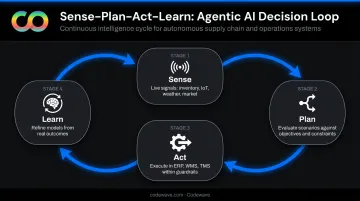
Consider a concrete example: a supplier shows early signs of lead-time degradation. A traditional system waits for a human alert. An agentic system detects the signal, evaluates backup suppliers, calculates cost and service-level trade-offs, reroutes procurement, and adjusts production schedules — autonomously, within defined guardrails — before the delay reaches your operations.
Human-in-the-Loop by Design
Agentic AI doesn't eliminate human judgment. It restructures it. Agents handle high-volume, routine decisions autonomously. Novel situations, high-stakes calls, or actions near policy boundaries get escalated to human reviewers — with full audit trails for every action taken.
The shift is from reactive execution to strategic oversight. Human time gets spent where human judgment actually matters.
The Market Is Moving Quickly
Gartner predicts that by 2030, 50% of cross-functional supply chain management solutions will use intelligent agents to autonomously execute decisions — up from less than 5% today. SCM software with agentic AI features is forecast to grow from under $2B in 2025 to $53B by 2030. Every deployment cycle an organization runs today builds the agent memory, data pipelines, and governance scaffolding that competitors will spend years catching up to.
Where Agentic AI Builds Resilience: High-Impact Use Cases
Four domains consistently deliver the highest resilience ROI. These are the areas to prioritize — and the starting points that generate proof fast.
Demand Forecasting and Inventory Optimization
Static, quarterly forecasting can't keep pace with real-world demand volatility. Agentic systems replace it with continuously updated models that ingest:
- Real-time sales trends and point-of-sale data
- IoT data from warehouses and distribution centers
- Weather patterns, seasonality, and external event signals
- Social media sentiment and search trend data
The result: autonomous rebalancing of stock and replenishment triggers before demand materializes rather than after stockouts occur.
McKinsey reports that AI-driven forecasting reduces forecast errors by 20%–50% and can translate into up to a 65% reduction in lost sales and product unavailability. Autonomous supply chain planning reduces inventory levels by 10%–20% while maintaining required service levels.
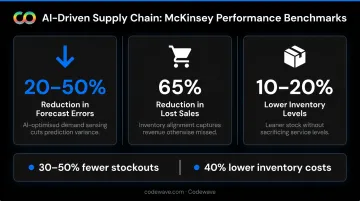
Codewave's implementations using Prophet and XGBoost models — integrated with Snowflake-backed data pipelines — have achieved 30–50% fewer stockouts and 40% lower inventory costs in retail environments.
Dynamic Procurement and Sourcing
Procurement agents don't clock out. They continuously:
- Monitor supplier financial health, lead times, and performance metrics
- Flag geopolitical risk signals and capacity constraints
- Evaluate alternative sourcing options against cost and service-level parameters
- Autonomously adjust sourcing strategies within approved policies
McKinsey estimates agentic AI could increase procurement efficiency by 25%–40% by shifting transactional work from human teams to agents. With 82% of supply chains affected by new tariffs in 2025, and supplier diversification now a top priority for 86% of supply chain leaders, always-on procurement intelligence has become a core operational requirement — not an enhancement layer built on top of existing processes.
Logistics and Transportation Optimization
Logistics optimization is traditionally exception management: something goes wrong, someone fixes it. Agentic logistics shifts it toward continuous optimization.
Logistics agents process real-time GPS, carrier capacity, weather, and traffic data to:
- Dynamically reroute shipments before delays occur
- Select optimal carriers based on live availability and cost
- Proactively resolve disruptions rather than reacting to them
- Reduce empty miles and fuel waste across fleet operations
Codewave's logistics implementations — integrating IoT telemetry, real-time traffic data, and dynamic routing — have achieved 25% reductions in delivery costs and a 30% increase in fleet utilization for logistics clients.
Predictive Maintenance and Shop Floor Continuity
Unplanned downtime costs Fortune Global 500 industrial companies approximately $1.5T annually — roughly 11% of their annual turnover, according to Siemens Senseye research.
Predictive maintenance agents address this by:
- Analyzing IoT sensor data and equipment logs continuously
- Detecting early failure signals before performance degrades visibly
- Scheduling maintenance proactively, during planned production windows
- Rebalancing production plans based on equipment availability
Codewave's predictive maintenance implementations — including an aviation case study — have achieved 40% reduction in aircraft downtime and 95% forecast accuracy for equipment failure prediction.
The Technology Foundation Agentic AI Depends On
Agent intelligence is only as good as the data it operates on. Most implementations break down not at the agent logic layer, but at the data layer beneath it.
The Data Fabric Requirement
Agentic AI needs unified, real-time access to every relevant data source: ERP, WMS, TMS, IoT feeds, and external market signals. Siloed or stale data produces poor autonomous decisions regardless of how sophisticated the agent logic is.
IDC's 2024 supply chain survey found that 48% of respondents cited legacy systems and integration barriers as the primary impediment to AI in supply chain operations. The data fabric — a unified architecture that standardizes access across these sources — is the foundational layer that makes agentic AI viable.
Codewave's data infrastructure stack addresses this directly: Apache Kafka for real-time event streaming, Snowflake for unified data warehousing across raw/staging/curated layers, and Apache Airflow for automated ETL workflows. Across implementations, this stack has delivered 3x faster data processing and a 60% improvement in data accessibility.
Agent Orchestration and Governance
In multi-agent supply chain environments, individual agents handling procurement, logistics, and inventory must coordinate — not compete. Without a governance layer, agents can act at cross-purposes, creating inefficiencies or escalating risk.
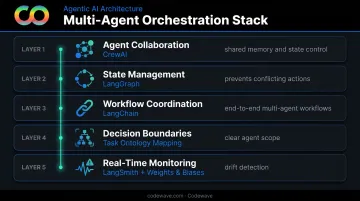
Codewave's multi-agent orchestration approach combines several coordination layers:
- CrewAI enables agent collaboration through shared memory and state control
- LangGraph manages state machines to prevent conflicting agent actions
- LangChain coordinates multi-agent workflows end-to-end
- Task ontology mapping defines clear decision boundaries before any agent goes live
- Real-time monitoring via LangSmith and Weights & Biases catches drift before it compounds
Every autonomous action is logged with full audit trails — prompts, outputs, data sources, decision paths, confidence scores, and timestamps — making every agent decision traceable and reviewable.
Integration Without Replacement
Agentic AI layers onto existing systems via APIs and middleware rather than replacing them. Codewave's enterprise application development practice explicitly builds systems that integrate with existing ERP data — pulling from current infrastructure, not displacing it. REST APIs, event-driven messaging, and IoT connectors bridge agent intelligence with action in existing systems.
As integration scope expands across more systems and agents, governance requirements scale with it — making compliance architecture a design decision, not an afterthought.
Governance and Security as Baseline Requirements
Every autonomous action must be logged, auditable, and bounded by policy. Codewave's governance framework includes:
- Human oversight for payments, compliance decisions, and high-stakes supply chain triggers
- Pydantic-based input validation before any action executes
- Guardrails and manual override flows at every decision boundary
- Alignment with NIST AI RMF, EU AI Act, ISO 42001, and GDPR
Retrofitting governance after deployment creates audit gaps, slows rollback when agents misbehave, and typically requires rearchitecting the decision boundary layer from scratch — a cost most organizations absorb only after an incident forces the issue.
How to Start Your Agentic AI Journey in Supply Chain
Start Where Data Is Cleanest and Decision Volume Is Highest
Demand forecasting, shipment routing, and purchase order approvals are ideal first use cases. They share three characteristics that drive early success:
- High decision frequency (measurable impact accumulates quickly)
- Clean, structured data (agent performance is not constrained by data quality issues)
- Clear success metrics (ROI is visible and attributable)
Early pilots should prioritize speed of evidence over depth of deployment. The goal isn't perfection — it's generating proof fast enough to build organizational confidence in autonomous decision-making.
Test Against Real Disruption Scenarios Before Going Live
Before agents enter live decision workflows, test them against the scenarios that matter most:
- Supplier failures and sudden de-listing events
- Demand spikes driven by weather, promotions, or external shocks
- Carrier capacity constraints and route disruptions
Compare agent decisions to historical human decisions. Use the delta to refine agent logic and — critically — to demonstrate to internal stakeholders that the system handles edge cases sensibly. This is how organizational trust gets built.
Scale Deliberately, Not Quickly
A responsible scaling path looks like this:
- Deploy in lower-risk, high-volume workflows first — routine replenishment, standard carrier selection, PO approvals within defined parameters
- Maintain human oversight at defined thresholds — escalation triggers for novel situations, high-value decisions, or confidence scores below acceptable levels
- Monitor performance continuously — track decision accuracy, escalation rates, and business outcomes weekly
- Expand autonomy as trust and data accumulate — based on demonstrated performance, not a predetermined calendar
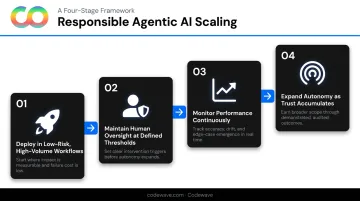
Governance failures in agentic deployments almost always trace back to expanding scope before the system has earned it. Narrow scope, proven value, and staged expansion aren't constraints — they're how organizations reach full automation without costly reversals.
Frequently Asked Questions
What is agentic AI in supply chain management?
Agentic AI refers to systems capable of autonomous goal-setting, multi-step planning, and execution across connected platforms — without requiring constant human direction. In supply chain contexts, this means agents that independently manage demand forecasting, procurement decisions, and logistics routing based on live data signals.
How is agentic AI different from traditional supply chain automation?
Traditional automation follows fixed rules and fails when conditions shift outside predefined parameters. Agentic AI adapts dynamically through its sense–plan–act–learn loop, handling novel scenarios and improving with every decision cycle — making it resilient to the unexpected, not just efficient in routine conditions.
What are the most valuable use cases of agentic AI for supply chain resilience?
The four highest-impact domains are demand forecasting, dynamic procurement, logistics optimization, and predictive maintenance. Start wherever data is cleanest and decision volume is highest — that combination delivers measurable ROI fastest.
Does implementing agentic AI require replacing existing ERP or TMS systems?
No. Agentic AI is designed to layer onto existing systems via APIs and middleware, orchestrating decisions across platforms rather than replacing them. Codewave's enterprise integration approach explicitly builds on top of existing ERP and logistics infrastructure without requiring system replacement.
How do companies maintain human oversight with autonomous supply chain agents?
Agents handle high-volume routine decisions autonomously while escalating novel, high-stakes, or policy-boundary decisions to human reviewers. Every action is logged with full audit trails — decision paths, confidence scores, timestamps — so human teams retain complete visibility into what agents are doing and why.
What data infrastructure is needed before deploying agentic AI in supply chains?
Organizations need unified, real-time data access across ERP, WMS, TMS, and IoT systems — a data fabric architecture. Consistent data definitions, clear data ownership, and solid data quality in your highest-priority process are the essential prerequisites before deployment.