Introduction
Global food demand is projected to rise 35%–56% between 2010 and 2050, yet arable land per person keeps shrinking and agriculture already consumes 72% of all global freshwater withdrawals. Meanwhile, FAO estimates that pests and diseases alone destroy up to 40% of crops annually — a $220 billion problem that manual field scouting can't solve at scale.
Computer vision (CV) addresses this directly. It enables machines to process images and video in real time, giving farm operators continuous, automated visibility into fields, livestock, and produce — at a scale and speed no field crew can match.
This guide breaks down the key applications, measurable benefits, implementation steps, and practical challenges of CV in agriculture — so agri-tech decision makers can identify where it delivers the fastest return.
Key Takeaways
- Pests and disease destroy up to 40% of global crops annually — CV enables early detection before damage spreads
- John Deere's See & Spray achieved 59% average herbicide savings across 1M+ U.S. acres using real-time object detection
- On specialty crop farms, labor runs 38–42% of production costs — CV automation addresses these highest-cost tasks directly
- Yield estimation via CV hits 91–95% accuracy for apple counting, while sorting systems catch defects at 99%+ rates
- Start with one high-priority use case — farm-wide rollouts without a proven pilot rarely succeed
What Is Computer Vision in Agriculture?
Computer vision is a branch of AI that trains machines to extract meaning from images and video. In practice, algorithms — convolutional neural networks (CNNs), object detection models, or semantic segmentation architectures — analyze visual data and return actionable outputs: "this leaf shows early blight," "this is a weed, not a crop row," "this fruit is ready to harvest."
How CV Fits the Broader Smart Farming Stack
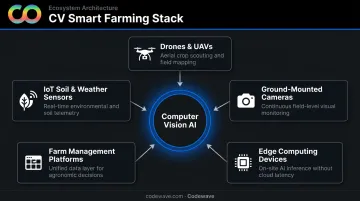
CV doesn't operate in isolation. It sits at the center of a sensor-rich ecosystem:
- Drones and UAVs capture multispectral aerial imagery across entire fields
- Ground-mounted cameras monitor crop rows, livestock pens, and processing lines
- IoT soil and weather sensors provide environmental context that sharpens CV predictions
- Edge computing devices run inference locally, reducing latency and cloud dependency
- Farm management platforms turn CV outputs into operator alerts or automated actions
Why This Shift Matters
Traditional farm monitoring is periodic, manual, and error-prone. A field scout covers a fraction of a large farm's acreage per visit. Disease or pest damage can spread for days before anyone notices.
CV-powered monitoring changes that equation. Running continuously across thousands of acres, it catches disease outbreaks, pest intrusions, and stress signals when targeted intervention is still possible — not after the damage has already spread.
Top Applications of Computer Vision in Smart Farming
Computer vision covers a broad range of applications in agriculture — each targeting a specific, high-cost problem that traditional methods handle poorly or can't address at scale.
Crop Disease and Pest Detection
CV models analyze drone or satellite imagery to identify early signs of disease, nutrient deficiency, or pest damage — often at the individual leaf level — before visible spread across a field. Instead of blanket fungicide application across an entire crop, farmers can direct treatment precisely to affected zones.
Commercial platforms like Taranis already deploy this at scale across multiple crops and geographies. Research systems have demonstrated detection accuracies above 98% on controlled datasets, though performance drops in low-light or poor-image-quality conditions — which makes field validation essential before procurement decisions.
Weed Detection and Precision Herbicide Spraying
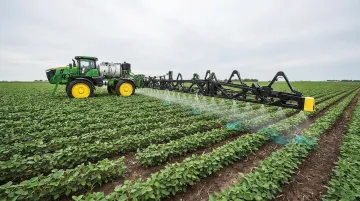
Object detection algorithms distinguish crop plants from invasive weeds in real time, guiding robotic sprayers or drones to apply herbicide only where weeds are actually present.
The commercial evidence here is compelling. John Deere's See & Spray technology achieved 59% average herbicide savings across corn, soybean, and cotton fields on more than 1 million U.S. acres in 2024 — equivalent to approximately 8 million gallons of herbicide mix avoided. The system scans over 2,100 square feet per second at speeds up to 15 mph.
Beyond cost savings, reduced chemical application lowers runoff risk and supports farms pursuing USDA sustainable agriculture goals — including the Biden-era target of cutting agricultural emissions and chemical inputs as part of broader conservation program expansion.
Yield Prediction and Estimation
CV algorithms analyze canopy coverage, fruit counts, and plant growth stages — combined with soil and weather data — to generate pre-harvest yield forecasts. Accurate forecasting improves supply chain planning, labor scheduling, and buyer negotiations.
Published results show real commercial viability:
- Apple-counting systems using YOLOv3 and DeepSORT tracking reached 91–95% accuracy
- Pumpkin counting via drone video achieved 93.9% accuracy
- One orchard system operating across 140+ hectares in Spain and France reported 90–95% precision
Occlusion (fruit hidden by foliage) remains the primary accuracy challenge — orange counting dropped to 79% in one study due to overlapping canopy. Crop-specific piloting is essential before assuming generalized accuracy.
Automated Harvesting
CV-equipped robotic harvesters assess crop maturity — ripeness, color, size — in real time, triggering precision mechanical grasping. This reduces waste from over- or under-ripe harvesting and lowers dependence on seasonal labor, which represents up to 38% of production costs on fruit and tree-nut farms.
Current field performance is promising but not yet uniform:
- Field-tested apple robot: 80.8% success on reachable fruit; 61.59% full-process success (including localization and grasping)
- 2025 study results: 85% field success, approximately 9 seconds per fruit picked and deposited
When evaluating robotic harvesting vendors, request complete workflow metrics rather than detection accuracy alone.
Livestock Health Monitoring
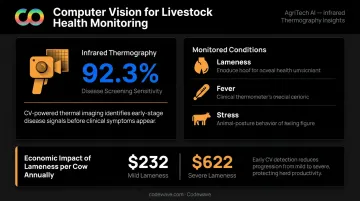
Thermal imaging cameras and video analytics track individual animal behavior, movement, and body temperature — flagging lameness, fever, or stress before clinical signs become obvious. Lameness alone costs an estimated $232 per mildly affected cow and $622 per severely affected cow annually, including milk loss and reproductive effects.
Infrared thermography algorithms have demonstrated 92.3% sensitivity for disease screening, though specificity varies with environment and temperature thresholds. CV systems work best as a triage layer, screening for abnormal animals before veterinary confirmation.
Post-Harvest Quality Grading and Sorting
CV systems on processing lines evaluate produce by color, size, shape, and surface defects at speeds no human grader can match. Machine vision apple graders have measured diameter within ±1.5 mm of manual sorting. TOMRA reports customer results above 99% defect removal at recommended settings for its optical sorting line.
FAO estimates 13.2% of food is lost between harvest and retail. Consistent, objective grading directly protects yield value and ensures product quality that buyers and traders can depend on.
Key Benefits of Computer Vision for Agricultural Operations
Operational Efficiency and Labor Savings
Labor is one of the largest cost centers in agriculture. CV automates the most repetitive, time-intensive tasks — visual crop scouting, manual sorting, animal observation, fruit counting — freeing farm staff for higher-value work.
The pressure is real: labor represented 42% of greenhouse and nursery expenses and 40% of fruit and tree-nut production costs in the U.S. in 2022. H-2A temporary agricultural worker certifications climbed from 48,000 in FY2005 to 385,000 in FY2024 — a clear signal of how difficult reliable seasonal labor has become to source.
Precision Resource Use
CV-driven precision application targets inputs only where they're needed:
- Herbicides: 59% reduction demonstrated commercially by See & Spray
- Nitrogen fertilizer: A 2025 deep learning wheat applicator reported 37.53% nitrogen savings versus blanket application, with no significant yield difference
- Water: Precision irrigation systems triggered by visual and sensor data reduce over-application without yield penalty
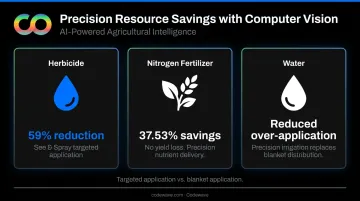
Shifting from blanket to targeted application cuts input costs and reduces chemical runoff. That efficiency gain only compounds when farms pair it with real-time data to drive the decisions behind each application.
Enhanced Decision-Making with Real-Time Data
Instead of waiting for weekly field scout reports, farm operators receive continuous visual intelligence: disease alerts as symptoms emerge, yield forecasts weeks before harvest, livestock anomalies flagged the same day they appear.
Faster information means faster, better-calibrated responses — and in agriculture, conditions can shift dramatically within a single week.
Sustainability and Regulatory Alignment
Reduced chemical use, optimized water consumption, and better land stewardship help farms align with tightening environmental standards. Products with ESG-related claims grew 28% cumulatively versus 20% for products without such claims between 2017 and mid-2022 — a signal that sustainable sourcing is becoming a commercial differentiator, not just a regulatory obligation.
How to Implement Computer Vision in Your Farming Operations
Step 1: Define Your Highest-Priority Use Case
Don't try to deploy CV everywhere at once. Start with the single area where visual data gaps are creating the most financial loss — undetected disease spreading through a high-value crop, a labor bottleneck in post-harvest sorting, or inconsistent weed control burning through herbicide budget.
A focused first use case produces faster ROI, generates the training data you need for future expansion, and builds operator confidence from the start.
Step 2: Assemble the Right Hardware Stack
Hardware choice should follow your use case, not the other way around. Typical components include:
- High-resolution field cameras or multispectral drone sensors for canopy and crop analysis
- Thermal cameras for livestock health and irrigation stress monitoring
- Ground-level cameras for sorting and grading lines
- Edge computing devices for local inference where connectivity is unreliable
- IoT soil and weather sensors to enrich CV predictions with environmental context
Step 3: Partner with an Experienced AI Development Team
Most agricultural businesses don't have in-house deep learning expertise, and building that capability from scratch rarely makes sense. The right partner brings pre-validated model architectures, experience with agricultural datasets, and the ability to train models on data relevant to your specific crop, region, and farm environment.
Our AI development practice spans 15+ industries and uses an outcome-based engagement model (ImpactIndex™) that ties delivery to measurable results rather than hours logged. Our ZeroDX™ approach connects you directly with the engineers building your solution — no account manager relay — which matters when you're iterating on model accuracy against real field conditions.
Step 4: Train, Validate, and Scale Iteratively
Successful CV adoption requires more than good algorithms:
- Pilot on a contained area — one field block, one processing line, one livestock pen
- Validate model accuracy against real outcomes, not just held-out test images
- Train farm operators to interpret outputs and act on alerts confidently
- Scale progressively as accuracy and operator trust are confirmed
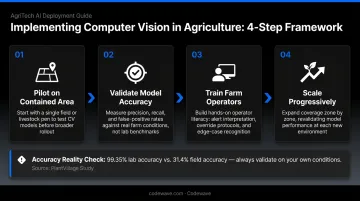
Field generalization is a genuine risk. PlantVillage disease detection models scored 99.35% on controlled test images but only 31.4% on external field images. Always validate on your own crop and conditions before scaling.
Challenges of Adopting Computer Vision in Agriculture
High Upfront Investment
Cameras, drone fleets, edge hardware, software integration, and ongoing model maintenance represent significant capital — particularly for small and mid-size farms. Several pathways help offset these costs:
- USDA NRCS Conservation Innovation Grants fund conservation technology development and adoption
- EQIP cost-share assistance covers practices that reduce environmental impact
- SaaS-based pricing models from CV platform vendors lower the barrier to entry for farms not ready for full capital deployment
Data Quality and Model Training
CV models perform only as well as the data they're trained on. Farms in new geographies, with uncommon crops, or under unusual growing conditions may need to invest in custom dataset collection and annotation before models reach reliable field accuracy. The right dataset volume depends on crop variety, image variability, and acceptable error tolerance — there's no universal threshold that applies across all deployments.
Connectivity and Skills Gaps
Beyond data quality, infrastructure is the next barrier. Only 48% of rural residents globally used the internet in 2024, compared to 83% in urban areas. Real-time CV at scale requires data infrastructure that many farms don't yet have. Edge computing — running inference directly on local devices rather than in the cloud — is the most practical workaround for intermittent connectivity. A 2024 field study demonstrated weed recognition and site-specific spraying using edge architecture, achieving local inference without cloud dependency.
The Future of Smart Farming with Computer Vision
Three trajectories will define the next generation of agricultural CV:
Multimodal AI Integration
Future systems will combine visual data with weather time-series, soil chemistry, and even genetic data to generate richer recommendations. The question shifts from "what do I see?" to "what should I do?" — with a single AI system processing multiple data streams simultaneously.
Autonomous Farm Robotics
As CV models become more reliable across varying field conditions, fully autonomous robots will handle end-to-end tasks: planting, spraying, and harvesting without human oversight. The agricultural robots market, valued at $14.74 billion in 2024, is projected to reach $48.06 billion by 2030.
Wider Accessibility
Falling hardware costs, satellite internet expansion, and cloud-hosted CV platforms will bring smart farming to smaller operations and developing regions. Smallholder farms — which produce roughly 70% of the world's food — stand to gain the most from these cost reductions.
Frequently Asked Questions
What is computer vision in agriculture?
Computer vision in agriculture uses cameras, drones, and AI algorithms to automatically analyze visual data from fields, crops, and livestock. It enables real-time monitoring and automation of tasks like disease detection, yield estimation, and quality grading — replacing periodic manual inspection with continuous, scalable intelligence.
What are the most common applications of computer vision in smart farming?
The main use cases are crop disease and pest detection, weed identification and precision spraying, yield prediction, automated harvesting, livestock health monitoring, and post-harvest quality grading and sorting.
How do drones enable computer vision in agriculture?
Drones equipped with high-resolution and multispectral cameras capture aerial imagery across large field areas quickly and cost-effectively. CV algorithms then analyze those images to detect crop stress, pest pressure, nutrient deficiencies, or weed infestations. What takes days to survey on foot can be completed in hours from the air.
What are the biggest challenges of implementing computer vision in agriculture?
The three main barriers are high initial hardware and software costs, the need for large volumes of quality training data specific to your crop and region, and rural connectivity and workforce skills gaps that complicate deployment and day-to-day operation.
How does computer vision support sustainable farming practices?
CV precision applications reduce herbicide, pesticide, water, and fertilizer overuse by targeting inputs only where needed — demonstrated by 59% herbicide savings and 37% fertilizer reductions in commercial deployments. Lower chemical application reduces runoff and helps farms meet regulatory sustainability standards.
How much does it cost to implement computer vision in agriculture?
Costs vary widely based on farm size, use case complexity, hardware choices, and integration requirements — there's no one-size-fits-all number. The best approach is to start with a scoped pilot project and consult an AI development partner like Codewave for an estimate scoped to your specific farm, use case, and expected outcomes.