Introduction
For centuries, farming operated on a simple premise: human judgment, experience, and labor drove every planting, irrigation, and harvest decision. Today, that foundation is shifting. By 2050, the world will need to produce approximately 70% more food to feed 9.7 billion people, while agricultural land per capita has declined 20% since 2000 and water scarcity threatens 3.2 billion people living in agricultural areas.
Traditional precision farming tools gave farmers data — soil moisture readings, weather forecasts, disease alerts — but stopped short of acting on it. Farmers still had to interpret disconnected information streams, make decisions manually, and coordinate actions across isolated systems.
AI agents close that loop. They perceive environmental inputs continuously, make autonomous decisions based on learned patterns and predefined goals, and execute coordinated actions across the farm without waiting for human input at every step. This article breaks down how multi-agent systems work in practice, where they're already delivering results, and what it takes to implement them at scale.
Key Takeaways
- AI agents autonomously handle multiple farming tasks at once, coordinating decisions across soil, weather, and crop systems in real time
- Real deployments deliver measurable gains: up to 46-50% water savings, 8% fertilizer reduction, and 5% yield improvements documented across operations
- The biggest barrier to scale isn't technology—it's rural connectivity infrastructure, data quality, and integration with existing farm systems
- Multi-agent architectures use a supervisory layer to combine inputs from specialized agents and push unified actions to the field
What Are AI Agents in Agriculture — and Why Now?
AI agents are autonomous software systems that perceive environmental inputs — sensor data, imagery, weather feeds — and execute actions without human intervention. Unlike rule-based automation that follows fixed decision trees, AI agents use continuous feedback loops and reasoning-driven task decomposition to adapt to changing conditions. When soil moisture drops, they don't just send an alert: they activate irrigation systems, factor in predicted rainfall from a connected weather agent, and log the decision for future learning.
This is a structural shift beyond the static if-then automation common in healthcare logistics and supply chain management. Farms generate massive volumes of real-time data from distributed sensors — yet traditional approaches left farmers manually synthesizing that information across disconnected tools. Agent-based systems close that gap.
Single Agent vs. Multi-Agent Systems
A single AI agent handles one specialized task in isolation — a soil moisture tool that tracks water levels and sends alerts, for example. A multi-agent system deploys multiple specialized agents that communicate, delegate tasks, and coordinate decisions across the farm. It's the difference between a specialist consultant (single agent) and a coordinated expert team (multi-agent) — where a soil agent, weather agent, and crop health agent all feed insights to a supervisory orchestrator that issues unified instructions.
Why Adoption Is Accelerating Now
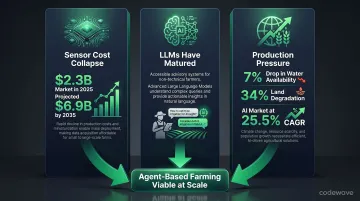
Three forces have converged to make agent-based agriculture viable at scale:
- Sensor costs have collapsed. The global agriculture sensor market reached $2.3 billion in 2025 and is projected to hit $6.9 billion by 2035. Sensors that once cost thousands now cost tens of dollars, enabling dense field coverage.
- LLMs have matured. Foundation models translate complex sensor outputs into actionable guidance in local languages — putting advisory systems within reach of farmers without data science expertise.
- Production pressure is mounting. Renewable water availability per person has dropped 7% in a decade, and 34% of agricultural land is now affected by soil degradation. The window for incremental efficiency gains is closing — the AI in agriculture market reflects this urgency, growing from $1.91 billion in 2023 to a projected $9.55 billion by 2030 at 25.5% CAGR.
How Multi-Agent Systems Enable Precision Farming at Scale
Architecture: Specialized Agents + Orchestration Layer
A production multi-agent farming system follows a layered architecture:
Field Agents (Sensing Layer):
- Soil Agent: Monitors nitrogen, phosphorus, potassium (NPK), moisture, pH, and salinity in real time
- Weather Agent: Tracks temperature and humidity, then forecasts short-horizon conditions to anticipate crop stress
- Crop Health Agent: Processes drone and camera imagery using computer vision to detect disease, pests, and growth anomalies at the plant level
- Pest Control Agent: Analyzes infestation patterns and coordinates targeted pesticide deployment
- Irrigation Agent: Manages water delivery based on soil conditions and crop demand
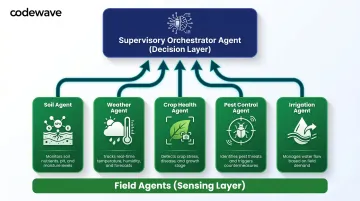
Supervisory/Orchestrator Agent (Decision Layer):
The orchestrator synthesizes inputs from multiple field agents, resolves conflicting signals (for example, the soil agent flags low moisture while the weather agent forecasts heavy rain within 6 hours), and generates context-aware recommendations or triggers automated actions. This is autonomous reasoning — LLM capabilities interpreting multi-stream data and issuing coordinated instructions across the entire system.
The layered design mirrors enterprise software architecture applied to physical farmland. It scales across thousands of acres or multiple farm sites without requiring proportional increases in human oversight.
Sensing Layer: What Agents Observe
Each agent class captures a distinct data stream. Together, they give the orchestrator a complete operational picture that no single sensor type could provide alone:
1. Soil Agents: Continuously monitor nutrient levels (NPK), moisture, pH, and salinity. Variable-rate application systems then use this data to apply fertilizer precisely where needed — not uniformly across the entire field.
2. Weather/Climate Agents: Track temperature and humidity while generating short-horizon forecasts. These anticipate crop stress windows or disease-favorable conditions before they develop, giving the orchestrator time to act rather than react.