Against that backdrop, AI-powered chatbots have moved from novelty to necessity. The real question isn't whether institutions should deploy them — it's whether they're using them in ways that produce measurable outcomes. This article breaks down exactly that.
Key Takeaways
- Educational chatbots drive measurable gains in retention, cost reduction, and student engagement
- Georgia State's Pounce chatbot cut summer melt from 19% to 9% through personalized enrollment support
- Northwestern's Canvas chatbot reached 92% containment, resolving most inquiries without staff involvement
- Deployment as a standalone widget — not integrated into existing workflows — is the most common reason chatbots fail
- Ongoing content governance and performance review are what separate successful deployments from stalled ones
What Are Chatbots in Education?
Educational chatbots are AI-driven conversational tools that interact with students, faculty, or administrators to answer questions, deliver content, provide feedback, and handle routine tasks automatically.
They operate across a range of institutional touchpoints:
- LMS platforms — Canvas (50% North American market share), Brightspace, Blackboard, and Moodle
- University websites and admissions portals — answering prospective student questions around the clock
- Student support services — financial aid, enrollment steps, registration deadlines
- IT helpdesks — navigating platform issues and technical questions
Chatbots don't replace advisors or instructors — they extend institutional support to the hours and moments when staff aren't available. An advisor can handle dozens of conversations a week; a well-deployed chatbot handles thousands without fatigue or delay, at a scale no human team can match.
Key Advantages of Chatbots in Education
The advantages below focus on operational impact — outcomes institutions actually track. Each one is most powerful when the chatbot is embedded into existing systems rather than bolted on as an afterthought.
Personalized, Round-the-Clock Learning Support
Office hours end. Confusion doesn't.
A student stuck on a concept at 11 p.m. the night before an exam has no human support option at most institutions. A chatbot changes that. Students get answers when they need them — across time zones, across schedules, regardless of whether they're on campus or fully remote.
What makes this more than just availability is personalization. Educational chatbots analyze prior interactions and learning patterns to tailor responses. A student who's consistently struggling with foundational concepts gets pointed toward remedial material. An advanced learner gets extension questions. The chatbot adapts rather than delivering the same generic response to everyone.
The outcome data is concrete. Georgia State University's Pounce chatbot reduced summer melt from 19% to 9% by sending personalized enrollment reminders and answering financial aid questions — reaching students who historically fell through the cracks between acceptance and first day of class.
KPIs this moves:
- Student retention rates
- Course completion rates
- Student satisfaction scores
- Support response time
This advantage carries the most weight in online-first or hybrid programs, large introductory courses with historically high drop rates, and institutions serving non-traditional students — working adults, international students, first-generation college-goers — who can't easily drop by an advisor's office.
Institutional Efficiency and Cost Reduction
Most routine student inquiries follow the same script. What's the enrollment deadline? How do I access the LMS? Where do I submit my FAFSA documents? These questions don't require an advisor — they require an accurate, fast answer.
Chatbots handle this volume without human intervention, freeing staff for the conversations that genuinely require them. An advisor's 30-minute meeting shouldn't be spent explaining how to navigate a student portal. EAB research found that advisors wanted to spend 50% less time on transactional tasks like course selection logistics — time they'd rather spend on actual advising.
Northwestern University's Canvas chatbot illustrates what effective deflection looks like in practice. By 2023, the chatbot had reached 92% absolute containment and 86% IT containment — meaning the overwhelming majority of queries were resolved without any staff involvement. In one year alone, the chatbot fulfilled 124 prep-site requests while IT staff handled just 9 of the same type.
KPIs this moves:
- Cost per support interaction
- Tickets resolved without escalation
- Staff hours redirected to high-value work
- Time-to-resolution for student queries
The impact is sharpest during peak periods — enrollment season, FAFSA deadlines, start of term — when inquiry volume spikes faster than staffing can respond.
Stronger Student Engagement and Measurable Learning Outcomes
Static content delivery doesn't keep students engaged. A chatbot makes the learning experience interactive: dynamic feedback, quizzes, scenario simulations, and proactive nudges at moments when students are most likely to disengage.
The Georgia State data on course-level engagement is particularly telling. In a trial of 500 American Government students, those who received chatbot nudges were 16% more likely to earn a B or higher. In a Macroeconomics section, chatbot-supported students were 38% less likely to drop the course. For first-generation students, the effect was even larger — final grades running 11 points higher than the control group.
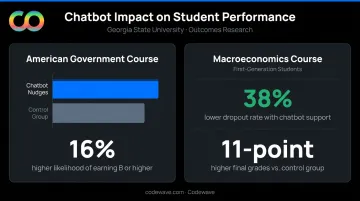
Those numbers translate directly to persistence — the metric most institutions care about most.
Beyond outcomes, every chatbot interaction is logged. Administrators gain visibility into exactly where students are struggling — at scale, in real time. That data feeds back into course design, resource allocation, and proactive intervention in ways that human support staff simply can't capture at volume.
KPIs this moves:
- Assignment submission rates
- Course grade distributions
- Session-to-session retention
- Frequency of student-initiated support interactions
Engagement chatbots deliver the highest return in large introductory courses with high attrition, programs with significant online components, and institutions where the advising-to-student ratio makes proactive outreach impractical.
What Happens When Chatbots Are Missing
The cost of missing chatbot support rarely shows up in a single report — it spreads across disengagement, staff overload, and blind spots in institutional data.
When a student can't get an answer at 2 a.m., they don't send a follow-up email — they disengage. Missed deadlines, unresolved confusion, and growing frustration rarely show up in support logs because the student stopped reaching out. By the time an advisor notices, the student may already be on their way out.
Meanwhile, staff absorb the cost. An Inside Higher Ed survey of 3,004 undergraduates found only 55% had been advised on required coursework for graduation — a gap that reflects not indifference but capacity constraints. Advisors buried in repetitive queries have less time for the conversations that require genuine human judgment.
That capacity crunch also creates a data blind spot. Without interaction logs, institutions lose visibility into where students are actually struggling. If 300 students ask the same financial aid question in week two of the semester, that's a clear signal worth acting on — but only if a system is there to capture it.
Each of these consequences compounds the others:
- Students disengage when support isn't available outside business hours
- Advisors get buried in repetitive queries, reducing time for high-stakes conversations
- Institutions fly blind without interaction data to identify systemic friction points
How to Get the Most Value from Chatbots in Education
Deployment location determines impact. A chatbot embedded directly into Canvas, a student portal, or a financial aid page encounters students where they already are. A widget buried on a homepage doesn't.
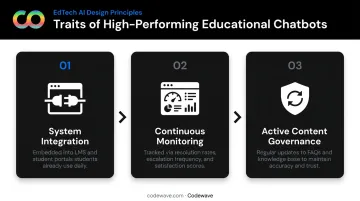
The highest-performing implementations share a few common traits:
- Embedded into daily systems students already use, not bolted on as a standalone tool
- Monitored consistently through resolution rates, escalation frequency, and satisfaction scores to catch gaps early
- Maintained with active content governance — outdated FAQs and siloed information erode student trust faster than most institutions expect
Northwestern's experience is instructive: the Canvas chatbot maintained 80–90% IT containment consistently because the team kept improving it. That level of performance doesn't happen at launch and stay there — it requires ongoing attention.
For institutions building or refining a chatbot implementation, technical architecture matters as much as content. Approaches like RAG (retrieval-augmented generation) ground responses in verified institutional knowledge rather than generic model outputs — which is critical for accuracy in student-facing interactions.
That distinction matters especially in higher ed, where a wrong answer about financial aid deadlines or enrollment requirements carries real consequences.
Conclusion
Well-deployed chatbots deliver measurable outcomes: faster answers, fewer dropped students, reduced staff burden, and clearer institutional visibility into where support breaks down.
These gains — in personalization, operational efficiency, and student engagement — build on each other over time. That compounding only happens when the chatbot is well-integrated, kept current, and tied to the institution's actual goals rather than deployed as a checkbox initiative.
Treat chatbot deployment as an ongoing process, not a one-time launch. Institutions that monitor performance, refine content, and expand use cases thoughtfully are the ones that see durable returns — in retention rates, operating costs, and the overall student experience.
Frequently Asked Questions
What AI is best for education?
The best AI depends on the use case. Purpose-built tools trained on educational content and integrated with LMS platforms consistently outperform general-purpose AI for academic support. Duolingo Max (GPT-4 powered) and course-specific chatbots like Pounce are strong examples of contextually accurate, outcome-oriented implementations.
What is an example of a chatbot in education?
Georgia State University's Pounce chatbot is one of the most cited. It reduced summer melt from 19% to 9% by sending personalized enrollment reminders and answering financial aid questions — a measurable institutional outcome.
How do chatbots help students learn?
Chatbots support learning through instant feedback, personalized content delivery, 24/7 availability, and practice simulations. Students get consistent support between sessions, not just during scheduled instruction.
Can chatbots replace teachers in the classroom?
No. Chatbots handle routine, repetitive support tasks so teachers can focus on complex instruction, mentorship, and the social-emotional dimensions of learning. Judgment calls, emotional support, and nuanced feedback on student growth remain firmly in the teacher's domain.
What are the limitations of chatbots in education?
Key limitations include lack of deep contextual understanding, inability to handle emotionally complex queries, risk of reinforcing misinformation if poorly trained, and potential for over-reliance that reduces critical thinking. All require ongoing human oversight to manage effectively.
How are chatbots used as teaching tools?
Educators use chatbots for skills practice simulations, anonymous feedback collection, flashcard-style memorization, and course FAQ support. The strongest implementations target specific pedagogical goals with measurable learning outcomes, rather than open-ended general Q&A.