The industry is catching up. A 2024 Lighthouse survey of 1,278 hospitality professionals found that 63% of companies now use AI in some capacity for revenue management, and 71% said data complexity had increased significantly over the prior five years. Meanwhile, a 2025 RoomPriceGenie analysis of 567 properties reported 19% average revenue growth after switching to automated dynamic pricing.
This article covers how AI hotel pricing systems actually work, the concrete benefits hotels are seeing, practical use cases, common adoption pitfalls, and how to build the right foundation to get started.
Key Takeaways
- AI pricing systems analyze competitor rates, occupancy patterns, local events, and booking behavior in real time, then adjust room rates automatically
- Key benefits: improved RevPAR, higher forecasting accuracy, reduced manual monitoring, and more targeted guest offers
- Main challenges: data quality gaps, staff resistance, and integration complexity — none of them insurmountable
- AI doesn't replace revenue managers; it handles routine pricing decisions so teams can focus on higher-value work
What Is AI-Powered Hotel Pricing and Revenue Management?
Traditional hotel pricing works in tiers: a weekday rate, a weekend rate, a peak-season rate. Predictable in structure — and predictably wrong in practice.
Static pricing fails in both directions. During a demand surge — a conference announces, a concert sells out nearby — rooms sell at yesterday's rate while competitors respond within hours. During slow periods, the same fixed pricing leaves rooms vacant rather than filling them at a modest discount that still covers operating costs.
AI-powered revenue management systems replace this static logic with machine learning models that set and adjust rates dynamically based on current market conditions. But dynamic pricing is only one part of the equation — modern systems are built to optimize across every revenue lever a hotel controls.
Beyond Room Rates
"Revenue optimization" covers more ground than just pricing a room:
- Occupancy management — balancing fill rate against rate integrity
- Channel distribution — controlling which inventory appears where and at what price
- Length-of-stay strategies — pricing to attract stays that maximize total revenue per available night
- Ancillary revenue — dining, spa, event space, packages
AI ties these levers together. A system that only optimizes room rates while ignoring ancillary revenue and channel mix is leaving money on the table.
Core Inputs AI Systems Evaluate
| Data Category | Examples |
|---|---|
| Internal | PMS booking history, room type performance, lead time patterns, guest segmentation |
| Competitive | Competitor rate shops, OTA inventory signals, GDS search volumes |
| External | Local event calendars, weather forecasts, flight search trends |
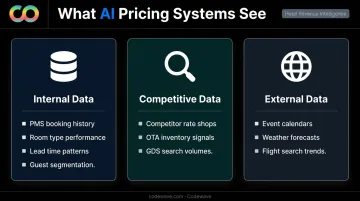
The quality and timeliness of this data — not the complexity of the algorithm alone — determines how accurate the output is.
How AI Hotel Pricing Systems Actually Work
The data collection layer is where AI pricing begins. Systems pull from internal sources (PMS reservation history, booking lead times, room type demand curves) and external sources (OTA search volumes, competitor rate shops, event databases). Without clean, consistent feeds from all of these, the model is working blind.
Machine Learning and Pattern Recognition
Rules-based automation follows preset conditions: if occupancy hits 80%, raise rates by 20%. That's a trigger, not AI.
True ML models learn which combinations of signals reliably predict demand shifts. A competitor adding a minimum-stay restriction while search volume climbs is a different signal than search volume climbing alone. The model assigns weighting to these leading indicators and refines them with each new booking outcome.
A 2024 Tourism Management study using booking data from three European hotels found that a PCA-based interpretable ML approach outperformed classical pickup and clustering-based forecasting methods across all tested properties and horizons — not by applying smarter rules, but by recognizing patterns human analysts couldn't track at scale.
Reinforcement learning goes a step beyond pattern recognition. RL-based systems simulate pricing scenarios and learn from outcomes in real time, self-optimizing without manual rule updates. A 2023 field experiment published in the Journal of Operations Management across five Shanghai hotels found that an RL approach increased RevPAR by 11.80%, occupancy by 5.15%, and ADR by 5.93% compared to a synthetic control group of 271 hotels.
Real-Time Pricing Automation
When demand signals change, automated pricing engines push rate updates simultaneously across all channels — OTAs, direct booking engines, GDS. A revenue manager updating rates manually might do this once or twice a day; an AI system makes hundreds of micro-adjustments in that same window.
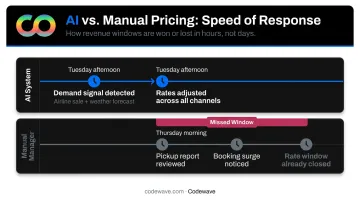
The speed gap is decisive. When a coastal hotel's AI detects a flash airline sale and a clear-weather forecast update on Tuesday afternoon, rates adjust immediately. A human manager reviewing pickup reports Thursday morning notices the booking surge — but the window to capture that demand at premium rates has already closed.
That gap between signal detection and rate response is where significant revenue is won or lost.
Key Benefits of AI for Hotel Revenue Optimization
Dynamic Pricing and RevPAR Growth
AI prevents two specific revenue leaks:
- Underpricing during demand spikes — rooms sell at rates set before demand materialized
- Vacancies during slow periods — static pricing drives guests to competitors who are offering modest discounts
RoomPriceGenie's analysis of 567 properties across 9 countries reported 19% average revenue growth, driven by a 4% ADR increase and a 14% occupancy increase after implementing automated dynamic pricing. Individual property results vary considerably — a 63-room boutique hotel in Lucerne saw a 33.67% RevPAR increase in its first year using Duetto — but the direction is consistent.
Forecasting Accuracy and Staffing Benefits
Better demand forecasts don't just improve pricing; they improve staffing decisions, food and beverage purchasing, and resource allocation across the property.
ML-based forecasting outperforms classical additive pickup models by identifying non-obvious demand combinations. That said, no model is universally superior — a 2025 academic study found that while LSTM achieved a lower MAPE than Prophet on occupancy forecasting, it produced a negative R-squared score, meaning ARIMA still outperformed it on explained variance.
The takeaway: model selection matters. Blind trust in any single approach is a risk worth taking seriously.
Time Savings for Revenue Managers
The Lighthouse 2024 survey found 49% of revenue managers cite lack of time as their primary data-related challenge, and 83% expect AI to generate meaningful time savings. That expectation has some grounding in practice.
The Local House, an 18-room boutique hotel in Miami, reduced pricing-related work from 2 hours per week to 30 minutes after implementing Atomize, while ADR grew 37% over 18 months. That's not a job elimination — it's capacity freed for guest experience design, strategy, and the decisions that require human judgment.
Channel Revenue Optimization
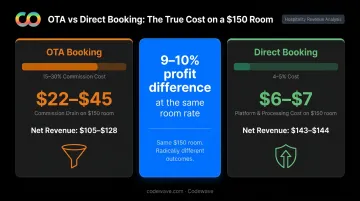
Not all bookings are equally profitable. OTA bookings typically cost 15–30% of booking value in commission; direct bookings run 4–5% after marketing and payment processing. On a $150 room, that gap is roughly $22–$45 versus $6–$7 per booking. That's a 9–10% profit difference at the same room rate, according to HospitalityNet's 2026 analysis.
AI channel optimization helps hotels act on that gap by:
- Restricting OTA inventory when direct demand is strong
- Surfacing direct booking incentives at the right moment
- Rebalancing distribution to maximize net revenue, not just gross bookings
Personalized Pricing and Package Offers
AI segments guests by booking behavior, stay history, and preferences to surface targeted offers at the right moment:
- Early booking discounts for guests who historically plan far ahead
- Length-of-stay incentives for guests with flexible travel dates
- Packages (dining credits, spa add-ons) for segments with high ancillary spend
Done well, personalization converts one-time visitors into repeat guests — a segment that typically costs 5x less to retain than to acquire.
Practical Use Cases: How Hotels Are Using AI Pricing Today
Event-Based Pricing
A major sporting event or conference is announced in a city. Hotels with AI systems layered over local event calendars detect the booking signal — rising search volume, compressed availability — weeks before traditional demand models catch it. Rates adjust proactively.
Hotels still pricing manually catch the surge after it's already visible in their pickup reports. By then, the most price-sensitive demand has already booked at yesterday's rate.
Low-Demand Optimization
On slow nights, AI identifies demand leakage: guests who would book at a modest discount but are being lost to competitors offering better value. The system recommends targeted promotional pricing or packages specifically to fill rooms that would otherwise stay vacant.
This is distinct from indiscriminate rate-cutting. The system targets discounts at the right segments and channels while maintaining rate integrity on the bookings where demand supports full price.
Total Revenue Management
Filling rooms is only part of the picture. More advanced AI systems expand beyond room pricing to optimize ancillary revenue streams, including:
- Dining reservations and F&B packages
- Spa bookings and wellness experiences
- Event space utilization
- In-stay upsells and personalized offers
Total RevPAR (TRevPAR) — total revenue including ancillary income divided by available rooms — gives a more complete picture of property performance than room RevPAR alone. According to HSMAI's revenue metrics research, 77.4% of practitioners still rely primarily on RevPAR, meaning the majority of hotels are measuring (and optimizing) only a fraction of their actual revenue opportunity.
Room pricing is the most visible lever — but for most properties, it's not the largest one.
Challenges Hotels Face When Adopting AI Pricing
Data Quality and Integration Gaps
AI recommendations are only as accurate as the data feeding the model. Hotels with fragmented systems — a PMS that doesn't sync properly with the channel manager, historical data buried in spreadsheets, inconsistent rate parity across channels — will generate recommendations that are confidently wrong.
The Lighthouse survey identified 42% of revenue teams citing data silos as a primary barrier, and 39% reporting a lack of trust in their own data. Before evaluating any AI pricing tool, the real question is whether your data infrastructure can support it.
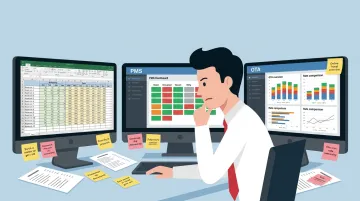
The first investment is in clean, connected data — not software.
Staff Adoption and Trust in AI Recommendations
Revenue managers who've built careers on instinct and market knowledge can resist following recommendations from a model they can't interrogate. HSMAI's guidance suggests an 80/20 ratio — accepting roughly 80% of AI recommendations while overriding 20% — as a reasonable operating benchmark.
Consistently overriding more than that signals the model needs reconfiguration — not confirmation that the human is always right.
Building trust requires phased implementation, transparent model explanations, and visible performance evidence over time. Teams don't need to trust AI on day one; they need enough runway to observe outcomes and adjust their threshold accordingly.
Balancing Automation with Brand Integrity
Aggressive dynamic pricing — rates spiking too high during peak demand or dropping too low to fill rooms — can damage brand perception and alienate loyal guests. A business traveler who sees wildly inconsistent rates on repeat visits forms a specific impression of the brand.
Pricing guardrails give AI room to operate efficiently without drifting outside ranges that protect brand positioning. A well-configured setup typically includes:
- Floor and ceiling rates tied to demand thresholds
- Alert parameters that flag unusual recommendations before they publish
- Periodic human review of outlier pricing events
In this model, oversight doesn't disappear — it shifts from approving individual rates to monitoring the system that sets them.
How to Get Started with AI-Powered Hotel Pricing
Before selecting any tool, audit your current data foundation. AI pricing systems require real-time data flows. If your PMS updates every few hours, your channel manager syncs on a delay, and your historical data is sitting in Excel, you're not ready to benefit from AI pricing — yet. Closing those integration gaps is the prerequisite.
Build vs. Buy — Choosing the Right Approach
Off-the-shelf AI pricing tools are the right starting point for most hotels. The market has matured across several tiers:
- Independent hotels (under 50 rooms): RoomPriceGenie, Atomize, Pricepoint — faster to deploy, lower configuration overhead
- Mid-sized properties (50–300 rooms): Duetto, Cloudbeds RMS, Lighthouse Pricing
- Enterprise chains (500+ rooms): IDeaS, Duetto enterprise — deep multi-property logic, more configuration required
Key evaluation criteria:
- Range of data integrations (PMS, OTA, GDS, channel manager)
- ML model transparency — can the system explain why it made a recommendation?
- Pricing guardrail controls
- Multi-property support if applicable
Custom AI development makes sense when off-the-shelf tools can't accommodate your data ecosystem. If your competitive advantage lies in how your pricing model weights proprietary signals — guest lifetime value from a loyalty database, demand patterns unique to your property mix — a generic RMS works against you.
Codewave has built custom AI solutions for 400+ businesses, including travel and hospitality clients, with integrations across PMS platforms (Opera, Mews, Maestro), channel managers (SiteMinder, Cloudbeds, eZee Centrix), and GDS connections (Amadeus, Sabre, Travelport). For hotel groups with complex multi-property logic or proprietary data requirements, that integration depth becomes the differentiator.
Implementation approach — regardless of build or buy:
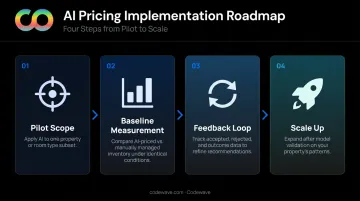
- Apply AI pricing to one property or a subset of room types first — narrower scope means faster learning cycles
- Measure AI-priced inventory against manually managed inventory under identical conditions to establish a clean baseline
- Track which recommendations were accepted, rejected, and what the outcomes were to tighten the feedback loop
- Expand once the model has learned from your specific property's patterns — validation before scale
Custom AI engagements at Codewave typically run three to six months from discovery through deployment, with data assessment and integration scoping taking the first two to four weeks.
Frequently Asked Questions
What data does an AI hotel pricing system use to set room rates?
AI pricing systems draw from two data streams. Internal data includes PMS booking history, occupancy patterns, room type performance, and booking lead times. External data covers competitor rates, OTA search volumes, local event calendars, and weather signals. Together, these sources build a multi-variable demand picture that static pricing models can't replicate.
How much can AI actually improve hotel revenue compared to manual pricing?
Vendor studies report a range of outcomes — RoomPriceGenie's 567-property analysis found 19% average revenue growth, while individual property case studies show RevPAR gains from 11% to over 30%. Results depend heavily on property type, baseline data quality, and how fully the system is implemented.
Will AI replace hotel revenue managers?
No. AI handles continuous rate monitoring and routine pricing micro-decisions — tasks that currently consume most of a revenue manager's day. That frees revenue managers to focus on strategy, guest experience design, and judgment calls that require market context no algorithm can fully replicate.
Can independent and small hotels benefit from AI pricing?
Often more than large chains. Independent hotels typically lack dedicated revenue management staff, so automation delivers outsized impact per property. Several tools are purpose-built for smaller properties, and RMS pricing tiers have dropped significantly in recent years.
What guardrails should hotels set when using AI dynamic pricing?
Set minimum price floors (protecting brand integrity and covering costs), maximum price ceilings (preventing rate spikes that alienate guests), and alert thresholds for recommendations that fall outside normal parameters. Guardrails let AI operate efficiently without requiring human review of every decision.
What is the difference between rules-based pricing automation and true AI pricing?
Rules-based systems execute preset conditions ("if occupancy exceeds 80%, raise rates by 20%"). True AI/ML systems learn from outcome data — which signal combinations actually preceded demand shifts — and continuously refine their weightings without manual rule updates. The result is a system that gets more accurate over time rather than one that stays static.