Introduction
Agriculture is under pressure from multiple directions simultaneously. The UN projects the global population will reach 9.7 billion by 2050, while cropland per person has already shrunk roughly 20% since 2001 — from 0.24 to 0.19 hectares. Add anthropogenic climate change, which has reduced global agricultural total factor productivity by an estimated 21% since 1961, and traditional farming methods simply can't keep pace.
IoT is changing how farms respond to these pressures. Connected sensors, actuators, drones, and monitoring systems give farmers visibility across the entire operation in real time — something unthinkable a generation ago.
Farmers can now monitor soil conditions from a tablet, get alerts before equipment fails, and automate irrigation without walking a single field.
This article covers what IoT in smart agriculture means, the six most impactful use cases operating on farms today, the technologies behind them, and the real challenges you'll face when implementing them.
Key Takeaways
- IoT connects farm sensors, equipment, and data systems to enable real-time, automated decisions across the entire agricultural cycle
- Precision soil monitoring, smart irrigation, and equipment maintenance offer the clearest near-term ROI for most operations
- Grand View Research values the agriculture IoT market at $28.65B in 2024, projected to reach $54.38B by 2030
- Rural connectivity gaps and data complexity remain the two biggest adoption barriers
- Phased implementation starting with one high-ROI use case is the most practical path for mid-sized operations
What Is IoT in Smart Agriculture?
IoT in smart agriculture is a network of connected physical devices — sensors, drones, actuators, GPS trackers, and monitoring systems — embedded across farm environments to collect, transmit, and act on real-time data about soil, crops, livestock, weather, and equipment.
The Smart Farming Cycle
The practical value of agricultural IoT comes from a four-stage loop that replaces reactive, manual farming with continuous, data-led operations:
- Observe — Ground sensors, weather stations, and drones collect field data continuously
- Diagnose — Cloud platforms and AI models process raw readings into meaningful signals
- Decide — Insights trigger automated responses or surface recommendations to farm operators
- Act — Irrigation activates, maintenance alerts fire, or feeding schedules adjust automatically
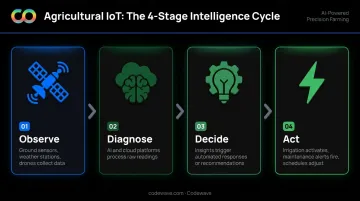
This cycle runs 24/7 across every monitored asset on the farm — without manual inspection at each step.
Market Scale
Grand View Research values the agriculture IoT market at $28.65B in 2024, projecting 10.5% CAGR through 2030 to reach $54.38B. MarketsandMarkets, using a narrower component boundary, tracks $8.86B in 2025 growing to $12.61B by 2030 at 7.3% CAGR. The difference comes down to what each firm includes — but the direction is the same: adoption is accelerating, and the use cases driving that growth are worth examining closely.
Key Use Cases of IoT in Smart Agriculture
Precision Farming and Soil Monitoring
Soil sensors deployed across field zones continuously measure moisture, nutrient content, pH, and temperature. Instead of applying fertilizer or water uniformly across an entire field, farmers see exactly which zones are deficient and apply inputs only where conditions actually require it.
The cost case is documented. USDA data shows GPS soil mapping associated with savings above $13 per acre on US corn farms, with variable-rate technology (VRT) combined with soil mapping reaching $21 per acre in associated savings — roughly 3.7% of total production costs. These figures are from 2010 survey data, so treat them as directional rather than current benchmarks. Targeted application wastes less and costs less.
Key outcomes from precision soil monitoring:
- Reduced fertilizer and pesticide overuse in well-resourced zones
- Early identification of nutrient deficiencies before they affect yield
- Zone-specific crop management strategies across large, variable fields
- Better documentation for regulatory compliance and sustainability reporting
Smart Irrigation and Water Management
Smart irrigation connects soil moisture sensors directly to irrigation controls. When readings drop below a defined threshold , accounting for current weather data and forecasted rainfall, the system activates watering. When conditions are adequate, it shuts off. No manual scheduling, no fixed timers running regardless of actual field conditions.
A 2023 field study published in Agricultural Water Management evaluated an IoT-based irrigation system in Taiwan rice paddies. Compared to conventional irrigation strategies, the system delivered 2.9%–6.5% water savings in dry seasons and 8.8%–19.3% in wet seasons without any significant effect on rice yield or agronomic traits. These are peer-reviewed, field-measured results, not vendor claims.
Water scarcity is one of agriculture's most constrained long-term inputs. Precision irrigation doesn't just cut costs ; it extends the viability of farming operations in drought-prone regions.
Crop Health Monitoring and Yield Prediction
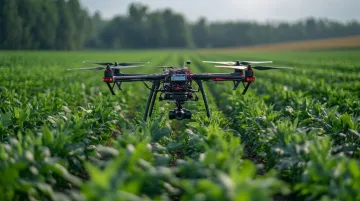
IoT sensors combined with drone-mounted imaging and AI analytics give farmers continuous visibility into crop health across every field zone. The system detects:
- Early signs of disease or fungal infection before visual symptoms spread
- Pest infestations concentrated in specific areas
- Growth anomalies that signal nutrient stress or water issues
- Canopy coverage and biomass changes over the growing season
Early detection matters because intervention cost increases exponentially once a problem spreads. Treating 5% of a field for a contained pest infestation is far cheaper than treating 60% after it propagates unchecked.
The same sensor infrastructure feeds yield prediction models. Historical crop data combined with real-time field conditions allows AI models to forecast harvest volume weeks before collection. Farmers use these forecasts to plan logistics, negotiate contracts, and reduce post-harvest waste from misaligned supply chain timing.
Livestock Management and Health Tracking
IoT wearables (collar sensors, ear tags, rumen boluses) attached to individual animals track location, body temperature, heart rate, and activity levels continuously. When any reading deviates from established baselines, the system alerts the farm operator.
This matters most for three scenarios:
- Early illness detection — temperature and activity changes often precede visible symptoms by 24–48 hours
- Reproductive cycle monitoring — behavioral changes signal estrus windows that are easy to miss in large herds
- Injury and distress alerts — unusual movement patterns flag problems before they become severe
A 2025 Journal of Dairy Science study modeled returns from rumen bolus monitoring in Holstein herds. In poor-health herds, estimated net returns ranged from +€23 to +€119 per cow-year. Results varied considerably by herd health baseline and labor cost assumptions. In already-healthy herds, some simulation scenarios showed negative returns.
The economics depend on your specific operation. A farm already running tight health protocols will see smaller gains than one with higher baseline illness rates.
The management benefit beyond the economics: farmers running large herds can monitor hundreds of animals simultaneously without physical inspection rounds.
Smart Greenhouses and Controlled Environment Agriculture
IoT-enabled greenhouses use sensor networks and automated actuators to maintain optimal growing conditions without constant manual adjustment. Monitored and controlled variables include:
- Temperature and humidity
- CO₂ concentration
- Light intensity and photoperiod
- Irrigation and nutrient delivery
When CO₂ drops below target levels, the system adjusts ventilation. When temperature rises unexpectedly, cooling activates automatically. Growers set the parameters and the IoT layer enforces them continuously.
The practical benefit is year-round production at consistent quality, regardless of external weather. Higher yields per square foot and reduced energy consumption compared to manually managed greenhouse environments make the ROI case relatively straightforward for commercial producers.
Farm Equipment Monitoring and Predictive Maintenance
Sensors attached to tractors, irrigation systems, harvesters, and grain storage equipment monitor performance metrics (vibration, temperature, pressure, fuel efficiency) and flag anomalies before they become failures.
The cross-industry benchmark from the DOE's Operations and Maintenance Best Practices Guide puts predictive maintenance programs at:
- 25%–30% lower maintenance costs
- 35%–45% less unplanned downtime
- Up to 10x ROI compared to reactive maintenance approaches
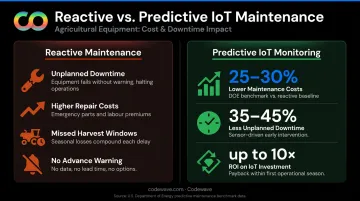
This data is industrial, not agriculture-specific — treat it as a planning benchmark rather than a farm guarantee.
One important caution from a 2021 McKinsey analysis: a predictive maintenance algorithm that predicted about one-quarter of breakdowns with 85% accuracy generated a 10% false-positive rate , producing roughly 1,000 unnecessary interventions per year and eliminating more than $1M in expected annual savings.
Accuracy thresholds and alert calibration matter as much as the technology itself. For farm operations where a harvester breakdown during peak season can cost tens of thousands in losses and missed windows, predictive maintenance carries strong financial justification — provided implementation is done carefully.
Technologies That Power Smart Agriculture IoT
Hardware Layer
The physical foundation includes:
- Ground sensors — soil moisture, temperature, pH, weather stations
- Drone-mounted sensors — multispectral and thermal imaging for aerial crop analysis
- GPS trackers — equipment location, livestock movement
- LPWAN modules — LoRaWAN and NB-IoT for long-range, low-power data transmission across large farm areas
LoRaWAN operates on unlicensed 915 MHz spectrum in North America, covering several kilometers per gateway with sensor battery life exceeding 10 years in typical deployments. NB-IoT relies on managed cellular infrastructure — specified at a 164 dB maximum coupling loss — making it a better fit for farms with existing cellular coverage.
Neither protocol has a universal range figure. Propagation conditions vary significantly across farm topographies, so deployment planning matters as much as protocol selection.
Software and Data Layer
Cloud platforms aggregate sensor feeds from distributed devices. AI and machine learning models process the data to generate:
- Anomaly alerts when readings fall outside normal ranges
- Predictive models for yield forecasting and equipment failure
- Decision recommendations surfaced through dashboards and mobile apps
Codewave's IoT development capabilities span this full stack — integrating EdgeX Foundry and MQTT for sensor data ingestion, connecting to cloud platforms including AWS IoT Core and Azure IoT Hub, and deploying real-time analytics dashboards backed by tools like Prometheus and Datadog. For agri-businesses working through the challenge of turning raw sensor data into operational decisions, having a single team handle ingestion, processing, and visualization removes the integration gaps where most projects stall.
The AI Convergence
The tools described above are accelerating a broader shift: from reactive monitoring toward predictive and increasingly autonomous systems. Self-adjusting irrigation, automated livestock feeding triggered by behavioral data, and autonomous field equipment are no longer conceptual — they're in various stages of commercial deployment. The practical implication is that operators spend less time interpreting alerts and more time acting on decisions the system has already validated.
Challenges of Implementing IoT in Agriculture
Connectivity Gaps
USDA data from 2025 shows 85% of US farms have internet access, with 55% using broadband and 74% using cellular data. Those access figures don't measure field-level coverage reliability — a sensor in a barn or remote pasture may exist well outside reliable signal range even on farms technically counted as "connected."
LPWAN technologies address this partially. LoRaWAN's low-power, wide-area design is specifically suited for farm-scale deployments where traditional cellular coverage is inconsistent.
Data Complexity
IoT deployments generate continuous, high-volume data streams from multiple device types. Without proper cloud infrastructure, data architecture, and analytics layers, that volume produces noise rather than usable insight.
This is where technology partners make a concrete difference. Codewave addresses agricultural data complexity by building unified data layers that centralize feeds from soil sensors, weather stations, and equipment monitors into a single platform, with predictive analytics applied on top to turn raw readings into farm decisions teams can act on.
Codewave's documented outcomes across data-intensive engagements include 3x faster data processing and ~3 weeks saved per month in manual data work — results that translate directly to farm management efficiency.
Upfront Cost and Scalability
Hardware, installation, cloud infrastructure, and ongoing platform maintenance represent real capital expenditure — particularly for small and mid-sized operations.
A phased approach manages adoption risk:
- Start with one high-ROI use case — irrigation automation or equipment monitoring typically deliver measurable returns fastest
- Validate the infrastructure — confirm connectivity, data quality, and platform performance before expanding
- Scale based on results — add use cases once the first deployment demonstrates clear operational value
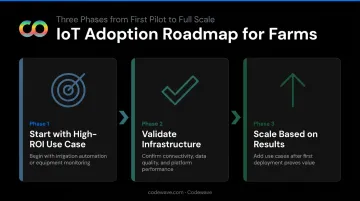
Codewave structures technology engagements the same way: identify the highest-ROI opportunity first, deploy production-ready solutions fast, then scale what's proven.
Frequently Asked Questions
What is IoT in smart agriculture?
IoT in smart agriculture refers to networks of connected sensors, devices, and software deployed across farm environments to collect real-time data on crops, soil, livestock, and equipment. Farmers use this data to make faster decisions and automate key processes — from irrigation to equipment maintenance.
What is an example of smart agriculture?
A smart irrigation system that reads soil moisture sensor data and checks weather forecasts to automatically trigger or shut off watering — rather than running on a fixed schedule. The result is less water waste and no manual intervention required.
How does IoT improve crop yields?
Continuous monitoring of soil health, crop growth, and environmental conditions lets farmers catch problems — pest infestations, disease, nutrient deficiencies — before losses spread. Inputs get applied precisely where needed, not uniformly across entire fields.
What sensors are commonly used in smart agriculture?
The main categories are soil moisture and pH sensors, weather stations, drone-mounted multispectral imaging sensors, livestock wearables (ear tags, collar sensors, rumen boluses), and equipment performance monitors tracking vibration, temperature, and pressure.
What are the biggest challenges of IoT adoption in agriculture?
Rural connectivity gaps, data integration complexity, and upfront hardware costs are the three most common obstacles. Phased rollouts and working with experienced implementation partners significantly reduce all three.