Introduction
Healthcare organizations are drowning in data while struggling to act on it. The average health system juggles fragmented EHR systems, mounting administrative overhead, and intense pressure to improve patient outcomes—yet Gartner predicts that organizations will abandon 60% of AI projects unsupported by AI-ready data through 2026. In healthcare, where the stakes are clinical rather than just financial, that failure rate is unacceptable.
Specialized healthcare AI consulting addresses that gap by going beyond architecture diagrams. The real constraints—HIPAA compliance, EHR integration, FDA classification for clinical tools, and clinician adoption—require a different kind of partner than general tech consulting provides.
This guide covers what healthcare AI consulting is, where it delivers the strongest ROI, the barriers that derail most implementations, and how to choose a partner who can actually execute.
Key Takeaways:
- Revenue cycle automation delivers ROI in 3–6 months—start here
- Ambient documentation cuts physician burnout and reclaims clinical capacity
- Data fragmentation, regulatory complexity, and change management kill most rollouts
- Phased deployments succeed; big-bang rollouts create expensive pilots
- Outcome-based consulting models outperform hourly retainers for clinical AI
What Is Healthcare AI Consulting and Why Does It Matter Now?
Healthcare AI consulting is a specialized advisory and implementation discipline that helps providers, payers, and health systems design, deploy, and optimize AI across clinical and operational workflows. Unlike general IT consulting, it requires deep grounding in HIPAA compliance, HL7/FHIR interoperability standards, clinical workflow design, and FDA medical device classification.
General AI firms rarely bring this combination. That gap is why healthcare-specific consulting exists as its own discipline.
Three Categories of Healthcare AI
Understanding scope helps organizations prioritize:
- Administrative and operational AI — Revenue cycle automation, prior authorization, coding, reporting, supply chain optimization
- Patient-facing AI — NLP-powered EHR portals, appointment scheduling chatbots, symptom checkers, remote monitoring tools
- Clinician-facing AI — Diagnostic imaging analysis, clinical decision support, ambient documentation, predictive risk alerts
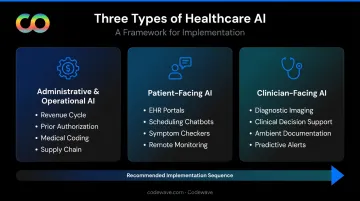
Most organizations should sequence these in the order listed: administrative AI first (lower regulatory risk, faster ROI), then patient-facing, then clinician-facing tools that touch direct care decisions.
Why the Urgency Is Real
The global AI in healthcare market is projected to reach $187.7 billion by 2030, growing at a 38.5% CAGR from 2024 to 2030. McKinsey reported healthcare AI venture funding rose nearly 20% between 2023 and 2024, with AI-focused startups capturing 69% of all digital health funding in Q2 2025. Organizations without a structured AI consulting approach are entering this market without a roadmap — and the cost of a failed deployment in a clinical environment goes well beyond sunk budget.
High-Impact Use Cases: Where Healthcare AI Consulting Delivers Results
Revenue Cycle and Administrative Automation
Revenue cycle is the right starting point for most organizations—and not just because the ROI is fast.
Administrative expenses account for $600 billion to $1 trillion annually in US healthcare. Much of that is addressable through AI-driven automation of claims processing, prior authorization, denial management, and coding.
The results from deployed systems are concrete. R1 RCM's AI-powered denial management achieved a 90% average denials overturn rate and recovered $40 million for one unnamed multi-department hospital in a single year. Waystar reported organizations using AI-powered revenue cycle software saw a 27% improvement in denial prevention and 36% workforce efficiency improvement.
Why this use case first:
- Avoids FDA clinical device classification
- Operates outside exam rooms, reducing clinician resistance
- Delivers measurable financial ROI within 3–6 months
- Builds organizational confidence in AI before higher-stakes clinical deployments
Codewave's revenue cycle automation stack combines intelligent document processing with transformer-based NLP, RPA via UiPath and Automation Anywhere, and FHIR/HL7-compliant medical coding automation—covering the full claims lifecycle from intake to adjudication.
Clinical Documentation and Physician Burnout
Physician burnout costs US healthcare an estimated $4.6 billion annually in turnover and reduced clinical hours. A significant driver: time spent on post-visit documentation rather than patient care.
Ambient AI documentation tools are changing this. A large California health system saved nearly 16,000 documentation hours over 15 months using ambient listening technology. A 2025 multicenter study found burnout among ambient AI scribe users dropped from 51.9% to 38.8% within 30 days.

Less burnout means more appointments per provider per day, and better revenue capture without adding staff. That combination makes clinical documentation one of the fastest paths from AI deployment to measurable operational improvement.
Diagnostic Imaging and Predictive Analytics
AI-assisted imaging is among the most clinically impactful applications—and the one requiring the most careful sequencing before deployment.
A peer-reviewed Nature study found AI reduced mammography false negatives by 9.4% in the US and false positives by 5.7%. In breast ultrasound, AI-assisted radiologists reduced false-positive rates by 37.3% and unnecessary biopsy requests by 27.8% while maintaining sensitivity.
Deploying clinical imaging AI without FDA oversight planning, clinical validation protocols, and radiology workflow integration is a compliance risk, not just a technical one. Experienced consultants sequence this work after administrative AI has established organizational trust and data infrastructure.
Personalized and Preventive Care
AI synthesizing EHR history, wearable streams, and lifestyle variables enables a shift from reactive to proactive care. One peer-reviewed study found AI-based clinical decision support reduced readmission rates from 11.4% to 8.1%—a roughly 25% relative reduction.
At the population level, predictive models flag high-risk patients for proactive care management interventions, reducing preventable hospital admissions and improving chronic disease outcomes. Organizations that reach this stage are typically running AI across administrative, clinical, and population health functions simultaneously—which is where consulting sequencing decisions made early in the program determine how much of that potential actually gets realized.
Key Benefits of AI Consulting for Healthcare Organizations
Reduces false negatives through models trained, validated, and clinically integrated before deployment — not after. The mammography accuracy gains referenced above reflect what happens when validation is built into the process from day one.
Targets the highest-impact automation opportunities first, rather than deploying technology for its own sake. Codewave's documented outcomes across engagements include a 40% increase in productivity, 25% cost reduction, and 90% fewer data errors.
Cuts patient no-shows and wait times directly. A JMIR 2025 study found real-time analytics reduced no-show appointments by 50.7% and trimmed waiting time by 5.7 minutes — gains driven by AI-powered scheduling, symptom checkers, and personalized follow-up workflows.
Compresses drug development timelines from years to months. One AI-developed compound moved from target identification to preclinical candidate in under 18 months; traditional discovery typically requires 10–15 years. AI also accelerates clinical trial protocol development and site selection by surfacing patterns human review would miss.
Scales patient services without proportional headcount increases. Codewave builds on auto-scaling infrastructure designed to handle 100 or 100,000 concurrent users on the same architecture — a practical advantage for health systems growing capacity under resource constraints.
Barriers to Healthcare AI Adoption (and How to Overcome Them)
Data Fragmentation and Quality
About 80% of medical data remains unstructured and untapped after creation—scattered across legacy EHR systems, imaging archives, lab platforms, and wearable devices in incompatible formats. Even where interoperability exists, ONC data shows only 42% of clinicians routinely use outside clinical information while treating patients, despite 71% having routine electronic access to it.
Experienced consultants address this before any model development begins: data audits to assess quality and completeness, FHIR-compliant integration layers to unify disparate sources, and governance frameworks to prevent stale or untagged data from reaching models.
Regulatory and Compliance Complexity
HHS OCR has processed $144.8 million in HIPAA settlements and civil money penalties as of late 2024. For clinical-decision AI, FDA's Software as a Medical Device (SaMD) framework adds another compliance layer entirely—with the December 2024 final guidance on Predetermined Change Control Plans adding new documentation requirements.
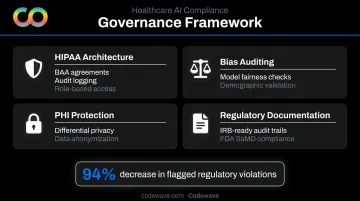
Most internal IT teams are not equipped to navigate this alone. Consultants experienced in healthcare bring structured approaches to BAA agreements, bias audits, and model explainability documentation, built into the architecture from the start rather than added under audit pressure.
Codewave's governance framework covers bias auditing, HIPAA-compliant architecture, differential privacy for PHI protection, and IRB-ready audit documentation. Across deployments, clients have seen a 94% decrease in flagged regulatory violations.
Clinical Adoption and Change Management
Technology failure is rarely why healthcare AI projects stall. The AMA's 2026 survey found 92% of physicians want more AI education and training—a signal that willingness exists, but implementation support is lacking. Even physicians who see clear care advantages don't automatically adopt AI outputs embedded in their workflows. Closing that gap is where consulting makes the difference.
Effective engagement includes workflow shadowing before design begins, clinical champion identification within departments, phased rollout with feedback loops, and post-go-live training. Skipping these steps is the most common reason technically sound systems fail to generate clinical value.
Infrastructure Readiness and EHR Integration Complexity
Integrating AI tools with live Epic or Cerner environments involves HL7/FHIR data standards, SMART on FHIR authentication, real-time synchronization requirements, and uptime reliability that clinical workflows depend on. These are not generic API integration problems. They require middleware expertise and EHR-specific integration patterns that most general AI firms simply don't have.
Codewave builds .NET-based platforms with HL7/FHIR integrations as a foundational capability, with validation layers that catch data quality issues before they reach core systems.
A Practical Roadmap for Healthcare AI Implementation
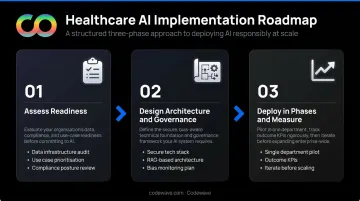
Step 1 – Assess readiness and prioritize use cases. Before a single model is built, conduct a maturity assessment covering data infrastructure quality, EHR integration depth, compliance posture, and organizational culture toward AI. Use case prioritization should sequence low-risk, high-ROI applications—revenue cycle automation, documentation tools—before higher-complexity clinical AI. Organizations that skip this step almost always overbuild for their current readiness level.
Step 2 – Design architecture and governance. Production-ready healthcare AI requires a secure technical stack: role-based access controls, audit logging, vendor BAAs, and a bias monitoring plan from day one. RAG-based architectures are particularly valuable in clinical contexts. By grounding AI responses in verified clinical data retrieved at inference time — patient records, lab results, approved institutional datasets — they reduce hallucination risk compared to models that rely solely on training data.
Codewave implements validation layers that compare AI-generated clinical summaries against source records, blocking outputs that contain information not present in the original documentation.
Step 3 – Deploy in phases and measure outcomes. Start with a single department or use case. Measure results. Iterate before scaling. In healthcare AI, this phased approach isn't cautious — it's the only path with a real track record of reaching production.
Codewave's QuantumAgile™ methodology is built for exactly this: moving from validated idea to production outcome in days rather than months, with outcome-tied KPIs defined during discovery and tracked transparently throughout. It directly addresses "pilot forever" syndrome, where organizations run perpetual proof-of-concept cycles without ever committing to full deployment.
How to Choose the Right Healthcare AI Consulting Partner
Look for Healthcare-Specific Credentials
General AI experience does not transfer cleanly to healthcare. Test for it directly:
- "Walk me through how you'd prepare our AI system for a HIPAA audit—specifically, what documentation you'd produce and what technical controls you'd verify."
- "Describe your most complex EHR integration—what platform, what data standards, and what broke along the way."
- "How have you structured a bias audit for a clinical decision support tool?"
Vague answers to these questions indicate general AI experience dressed in healthcare language. Look for specifics: named EHR platforms, documented FHIR integration patterns, and real compliance scenarios they've navigated.
Evaluate Their Implementation Model
Time-and-materials retainers create misaligned incentives: the consultant earns more when projects run longer, regardless of outcomes. Outcome-based engagement models tie partner compensation to measurable clinical and operational results.
Codewave's ImpactIndex™ model is built on this principle—clients pay for measurable results, not hours logged. When economic incentives align with your outcomes, partners prioritize faster deployment and real performance gains over billable scope expansion.
Verify Post-Deployment Support
Healthcare AI is not a one-time implementation. Clinical protocols evolve, patient demographics shift, regulatory requirements update, and AI models drift—often all at once.
Ask any prospective partner:
- How do you monitor model performance post-launch?
- What triggers a retraining cycle, and what's your response timeline?
- How do you handle compliance updates when FDA guidance changes?
Codewave's post-deployment model covers:
- Continuous performance monitoring with defined retraining triggers
- Model and rule updates as data patterns evolve
- HIPAA compliance advisory across access logs, consent flows, and third-party integrations
Frequently Asked Questions
What is an AI agent in healthcare?
An AI agent in healthcare is an autonomous software system that perceives inputs—patient data, EHR records, voice—reasons across multiple steps, and takes actions without requiring a human prompt at each step. Practical examples include scheduling follow-up appointments, verifying insurance eligibility, or generating post-visit documentation automatically.
What is healthcare AI consulting?
Healthcare AI consulting is a specialized advisory and implementation service that helps providers, payers, and health systems plan, deploy, and optimize AI solutions tailored to clinical workflows, compliance requirements, and patient care goals. It differs from general IT consulting through deep expertise in HIPAA, HL7/FHIR, and FDA regulatory frameworks.
What are the biggest barriers to AI adoption in healthcare?
The top three are fragmented data and legacy EHR systems (making clean AI-ready data pipelines difficult to build), regulatory complexity spanning HIPAA, FDA, and state-level privacy laws, and clinical change management—getting clinicians to trust and use AI outputs in real workflows. Organizations that underestimate any one of these barriers typically see pilots stall before reaching production.
How long does a healthcare AI consulting engagement typically take?
Revenue cycle automation typically shows measurable ROI within 3–6 months. Clinical decision support systems—requiring clinical validation, regulatory review, and workflow integration—typically take 12–18 months from strategy through validated production deployment. Scope and EHR complexity are the primary timeline variables.
How do I measure ROI from healthcare AI consulting?
Track ROI across three dimensions:
- Financial: claim denial rates, days in AR, documentation time
- Clinical: diagnostic accuracy, readmission rates
- Operational: staff hours saved, patient throughput
A credible consulting partner defines these baselines before implementation begins—not after results are needed.