Introduction
Most companies today claim to be "building with AI." The gap between adding AI features to an existing product and building one where AI is the engine is real — and it's producing sharply different competitive outcomes.
McKinsey's 2025 State of AI survey found that 88% of organizations regularly use AI in at least one function, yet nearly two-thirds remain in experimentation or piloting, and only 39% report enterprise-level business impact. That disconnect has a name: most of those organizations are building AI-enhanced products, not AI-native ones.
Product teams and founders often don't realize they're in AI-enhanced territory until the product underperforms, the moat fails to form, or the improvement loops don't close. By then, the architectural decisions are expensive to reverse.
This post covers what AI-native actually means and how to build it deliberately — including the four pillars that separate durable products from impressive demos, the development lifecycle, team structure, and the most common pitfalls.
Key Takeaways:
- AI-native means AI is the core value mechanism — remove it and the product collapses
- Four pillars define durable builds: probabilistic architecture, data infrastructure, feedback loops, and domain intelligence
- Most AI failures stem from treating AI as a feature to ship rather than a system to build
- The real moat is proprietary data and compounding feedback loops, not the models themselves
What "AI-Native" Really Means (And What It Doesn't)
An AI-native product is designed from the ground up with AI as the primary value-creation mechanism — not a feature bolted on after launch, but the structural core around which architecture, UX, data flows, and business model are built.
The Remove-It Test
Here's a simple diagnostic: strip the AI out. What happens?
- AI-enhanced product: It still basically works. Maybe slower, less accurate, less convenient — but functional. The AI was improving an existing workflow.
- AI-native product: It ceases to be useful, or becomes a fundamentally different product entirely.
Think of parking sensors versus autonomous parking. Parking sensors help a human driver — remove them and the driver still parks. Autonomous parking is the system. Remove the AI and there's no product left.
Stitch Fix is a useful real-world illustration. Their algorithms don't just recommend clothing — they rank inventory, score items through collaborative filtering and NLP, and use client feedback to improve future selections. Their own systems tour makes clear: the AI and the styling service are the same thing. One cannot exist without the other.
What AI-Native Doesn't Mean
Common misconceptions worth clearing up:
- Using the latest models isn't required — architecture dependence is what counts
- A chat interface is neither necessary nor sufficient
- Generative AI is one pattern among many; it's not a prerequisite
- AI doesn't have to be present at launch — but the product must be built to fail without it
It means the product's behavior, improvement, and value delivery are structurally dependent on AI — at the architecture level, not the feature level.
A Temporal Label
AI-native is a meaningful distinction now, in this early adoption phase — just as "cloud-native" or "mobile-native" were useful distinctions until those paradigms became assumed baseline. CNCF's 2024 survey found 89% cloud-native adoption in production environments. That label has largely lost its differentiation value. AI-native will follow the same trajectory — but for now, the distinction matters enormously for how you build.
That architectural shift has an organizational counterpart. AI-native also means AI is inside the decision loop and the roadmap process, not siloed in a separate "AI team" while the rest of the org runs the old playbook.
AI-Native vs. AI-Enhanced: Spotting the Real Difference
The clearest behavioral signal: does the product improve automatically with use, or does it require manual feature releases to get better?
AI-native products get smarter as data accumulates. AI-enhanced products get better when engineers ship updates.
Signals in Practice
| Dimension | AI-Enhanced | AI-Native |
|---|---|---|
| System behavior | Deterministic: same input, same output | Probabilistic — outputs vary and improve over time |
| Development focus | Application logic, feature delivery | Models, data pipelines, workflows |
| How it improves | Feature releases by engineering team | Data accumulation and model updates |
| What "testing" means | Confirming expected behavior | Evaluating accuracy, relevance, consistency, latency |
| Remove AI and… | Product degrades | Product collapses |
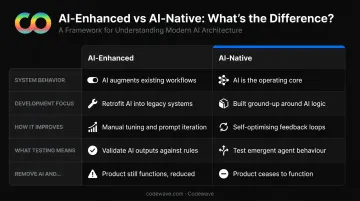
These distinctions play out differently depending on the industry. A few concrete examples show what that looks like in practice.
Industry Examples
Fintech: An AI-enhanced claims processing tool uses ML to flag anomalies — useful, but the claims workflow still runs without it. An AI-native underwriting product like Upstart's lending model is different: the AI is the credit decision engine, evaluating default and prepayment probabilities for each borrower. Remove the model and there's no underwriting product.
Healthcare: Epic using generative AI to draft patient message responses saves nurses roughly 30 seconds per message — that's AI enhancement. IDx-DR, an FDA-cleared retinal diagnostic software, is AI-native: it achieved 87.4% sensitivity and 89.5% specificity in clinical trials, and the entire diagnostic workflow is built around the adaptive algorithm. There's no "manual version" of the product.
Retail: Shopify Magic generating product descriptions from input details is AI-enhanced — the store exists and functions without it. An AI-native personalization platform where recommendation, inventory, logistics, and pricing decisions are all model-driven is structurally different.
Can You Evolve from Enhanced to Native?
Yes — but it requires genuine architectural rethinking, not feature additions. Adobe and Microsoft Office both moved from on-premises to cloud-native by rebuilding core workflows, not just adding cloud storage. The same logic applies to AI: moving toward AI-native means rearchitecting how the product works at its core — not layering new AI features onto an existing foundation.
The Four Pillars of Building AI-Native Products
Truly AI-native products are differentiated across four interdependent pillars. Depth across all four is what separates durable products from impressive demos.
Pillar 1: Architecture Built for Probabilistic Outputs
Traditional software architecture assumes determinism — the same input reliably produces the same output. AI-native architecture has to accommodate the opposite.
This means building:
- Orchestration layers that coordinate models, tools, and retrieval systems
- Dynamic model routing that directs prompts to the right model based on task type, cost, and latency (AWS Bedrock and Microsoft Foundry both offer production-grade implementations of this)
- Feedback mechanisms wired into the system's core — not added as an afterthought
- Explainability built in from the start, so the system can connect inputs to outputs in ways users can interrogate
The NIST AI Risk Management Framework identifies opacity, limited explainability, and lack of transparency as core reliability risks in AI systems. These aren't edge cases. They're the default failure modes when architecture doesn't address them deliberately.
Pillar 2: Data as Infrastructure, Not Input
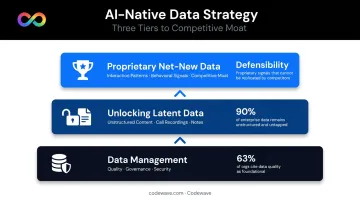
In AI-native builds, data strategy is product strategy. There are three layers:
Data management — quality, governance, security. Gartner found that 63% of organizations lack or are unsure they have the right data management practices for AI, and predicts 60% of AI projects unsupported by AI-ready data will be abandoned through 2026.
Unlocking latent data — the unstructured content sitting in drives, call recordings, notes, and documents. Analysts estimate 90% of enterprise data is unstructured. AI-native products surface and structure what was previously inaccessible.
Creating net-new proprietary data — interaction patterns, behavioral signals, multi-modal engagement data that didn't exist before the product launched. This third layer is where the competitive moat forms. It's what a16z means when they argue that defensibility comes from context: workflow knowledge, customer-specific data, and domain expertise embedded in the system — not the model itself.
Pillar 3: Feedback Loops as a Core Product Feature
AI-native products treat user feedback as a training signal, not a satisfaction metric. That distinction changes how the entire product is designed.
Every interaction becomes an opportunity to improve model performance. The design challenge is collecting useful signals without disrupting the experience:
- Implicit signals: Engagement patterns, hover behavior, copy-paste frequency, session duration, retry rates
- Explicit signals: Ratings, corrections, flags — but used sparingly so they don't create friction
- Outcome signals: Did the user take the action the product suggested? Did the prediction hold?
Amazon's search team demonstrated this in production: clicks within a query session were used as implicit feedback to infer hidden intent and rerank subsequent results. No explicit rating required. That's a feedback loop as product infrastructure.
That feedback infrastructure is what enables the "living system" quality AI-enhanced products can't replicate: the product improves continuously, between feature releases, without manual intervention.
Pillar 4: Domain Intelligence Embedded in the Product
The application layer is where domain expertise creates differentiation. General-purpose models are broad by design. AI-native products in specialized verticals require models built for depth — trained on domain-specific data and workflows, not just general web knowledge.
In practice, that looks like:
- Fine-tune models on domain-specific datasets to improve task accuracy
- Encode expert user behavior into workflows, making specialized knowledge accessible at scale
- Layer global model capability with domain knowledge and organization-specific context for compounding differentiation
Gartner predicts that by 2027, organizations will use small, task-specific AI models at least 3x more than general-purpose LLMs. The vertical AI market — legal, healthcare, financial services — has already moved in this direction because domain intelligence is where the product value concentrates.
The AI-Native Product Development Lifecycle
AI-native products follow a different development lifecycle — iterative, data-driven, and nonlinear. Teams frequently revisit earlier stages as they learn how the AI behaves under real-world conditions.
The key stages:
- Problem discovery — workflow-first, not technology-first. What human decision or task does this replace or augment?
- Data and knowledge preparation — before any model work begins
- Model experimentation — structured experiments across model choices, prompt designs, retrieval strategies
- Prototyping and evaluation — measuring accuracy, relevance, consistency, latency, and user utility
- Deployment — with monitoring and escalation paths built in
- Continuous improvement — ongoing model updates driven by production signals
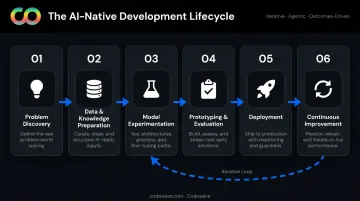
Experimentation is a first-class discipline here. Unlike deterministic software where testing confirms behavior, AI-native teams run experiments to discover what works before committing to a production approach. As Anthropic's engineering team notes, good evaluations are what allow teams to ship AI agents confidently rather than catching issues reactively after users encounter them.
That evaluation-first mindset is central to how Codewave approaches AI-native engagements. The QuantumAgile™ methodology structures development around short validation cycles — running parallel experiments, measuring against real performance signals, and committing only to what the data supports. In probabilistic systems, that discipline isn't optional; it's what separates shipped products from stalled pilots.
What AI-Native Teams Actually Look Like
AI-native teams are cross-functional, with AI ownership distributed across the team — not siloed in a specialist function.
Roles that need to be present:
- Product managers who define AI-driven experiences, not just feature lists
- AI/ML engineers focused on model behavior and performance
- Data engineers who build and maintain the knowledge infrastructure
- Domain experts who validate outputs against real-world standards
- UX designers who design human-AI interaction patterns — not just standard UI flows
The anti-pattern: most companies create an "AI team" and hand it a mandate while the rest of the org keeps running the old roadmap. The AI team ships demos. The rest of the org waits. Nothing gets to production.
AI-native orgs embed AI into the operating rhythm: discovery, decision-making, and delivery. AI capabilities are the product, not a side project with unclear ownership.
BCG's research found that 70% of AI transformation success comes from people, processes, and cultural change — not algorithms or technology.

Governance is non-negotiable. Every AI feature needs:
- An evaluation plan before shipping
- A monitoring plan after deployment
- A clear escalation path when AI outputs require human review
These guardrails are what keep AI-native products reliable as models drift and edge cases surface in production.
The Hardest Parts of Going AI-Native
The Four Core Challenges
- System reliability — probabilistic outputs require evaluation frameworks, not just QA checklists
- Data quality — Gartner found at least 50% of generative AI projects were abandoned after proof of concept, with poor data quality as the top failure driver
- User trust — people won't rely on AI outputs they can't interrogate or explain
- Deployment complexity — AI systems depend on multiple interconnected components that all need to perform reliably together
Start Narrow, Not Broad
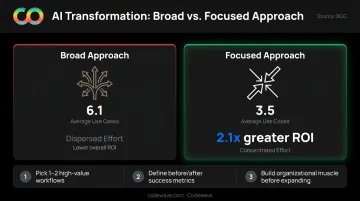
The most common AI transformation failure is trying to make every team AI-native at once. BCG's research shows AI leaders focus on 3.5 use cases on average, versus 6.1 for others — and expect 2.1x greater ROI as a result.
The practical path forward:
- Pick one or two workflows — internal or customer-facing — where AI delivers the clearest, most measurable value
- Define explicit before/after success metrics before you ship anything
- Use that wedge to build organizational muscle memory before expanding to adjacent use cases
The Governance Gap
As AI agents and automated workflows multiply, organizations often lose track of what the AI is doing, why, and who owns the outcome. This isn't a future problem — it surfaces the moment real users hit edge cases.
Responsible AI-native builds establish explicit risk boundaries from the start: privacy, safety, and reliability controls that are repeatable and documented. Retrofitting governance after deployment is far harder — and far costlier — than building it in from day one.
Frequently Asked Questions
What are AI-native products?
AI-native products are designed from the start around AI as the core value mechanism — not added as a feature. If you remove the AI, the product either stops functioning or becomes a fundamentally different product entirely.
What is the difference between AI-native and AI-powered products?
AI-powered means AI enhances an existing product — the core still works without it. AI-native means the entire product experience, architecture, and value delivery are structurally built around AI. Remove the AI, and there's no product left to degrade.
How do you build an AI-native product from scratch?
Start with a workflow problem, not a technology. Invest in data infrastructure early, design the system for probabilistic outputs, and build evaluation into the process before you build features. Experimentation comes before commitment.
Can an existing product be made AI-native?
Yes, but it requires genuine architectural rethinking — not feature additions. Companies like Adobe and Microsoft have done this by rebuilding core workflows around AI.
What makes an AI-native product defensible against competitors?
The moat comes from embedded workflows that compound: proprietary data captured through interactions, models continuously tuned on that data, and feedback loops that make the system smarter with every use. Competitors can replicate features. They cannot replicate years of compounding data advantage baked into your model.
What is the most common mistake when building AI-native products?
Treating AI as a feature to ship rather than a system to maintain. The result: demos that never reach production, models that drift without monitoring, and evaluation gaps that surface only when real users hit failures at scale.