Introduction
AI consulting has moved from a niche investment to a mainstream business priority—yet the pricing variance businesses encounter is wide. A simple pilot might start at $10,000, while enterprise-wide AI transformations can easily exceed $1 million. That range makes budgeting genuinely difficult — and separating real value from inflated fees even harder.
Most organizations run into the same three problems when evaluating AI consulting costs:
- Comparing proposals across pricing models — hourly rates, project fees, retainers, and outcome-based structures all measure value differently
- Underestimating total cost of ownership — budgeting for consulting fees while overlooking infrastructure, training, and ongoing maintenance
- Distinguishing expertise from overhead — a premium price tag doesn't always mean better results
This guide breaks down AI consulting pricing models, the real cost components, what drives costs up or down, and how to measure ROI so you budget for outcomes—not just effort.
Key Takeaways
- AI consulting costs $100–$600/hour, $2,000–$30,000/month on retainer, or $10,000–$5M+ for project-based engagements — scope and firm type drive the range
- Price drivers include engagement model, consultant seniority, project complexity, and whether you need strategy, implementation, or ongoing support
- Startups and SMBs exploring AI typically invest $10,000–$200,000; enterprise transformations cost significantly more
- Higher spend is justified by implementation complexity and ROI potential — not by a firm's reputation alone
- Most organizations underestimate first-year AI costs by 30–50% by overlooking maintenance, infrastructure, and team training
How Much Does AI Consulting Cost? (Pricing Overview)
AI consulting has no fixed price. Costs vary widely by engagement model, firm type, consultant seniority, and project scope. Misunderstanding this range leads to underbudgeting, hiring mismatched consultants, or stalling mid-project when unexpected costs emerge.
Pricing by Engagement Model
Hourly / Time-and-Materials
Hourly rates vary by experience tier:
- Junior consultants (0-3 years): $100–$150/hour
- Mid-level consultants (3-7 years): $150–$250/hour
- Senior consultants (7-12 years): $250–$400/hour
- Elite/specialized consultants (12+ years): $400–$600+/hour
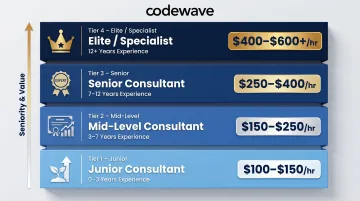
(Source: Leanware)
This model works best during exploratory phases when scope is uncertain—strategy workshops, feasibility studies, or early discovery. The key downside: budget unpredictability. Scope creep can push costs well beyond initial estimates.
Project-Based / Fixed Fee
Fixed-price engagements require clear upfront scoping and work best for well-defined deliverables:
- AI readiness/strategy assessment: $50,000–$500,000 depending on firm tier
- Mid-tier pilot or POC: $7,500–$800,000
- Enterprise AI transformation: $1 million–$5 million+
(Source: AffixedAI)
Fixed pricing offers cost predictability but requires disciplined scoping. Scope changes mid-project often trigger additional fees or change orders.
Retainer / Ongoing Advisory
Retainers suit organizations that need continuous AI guidance post-implementation:
| Retainer Tier | Monthly Cost | Hours/Month |
|---|---|---|
| Essential advisory | $2,000–$5,000 | 5–10 |
| Standard support | $5,000–$15,000 | 10–25 |
| Comprehensive partnership | $15,000–$30,000 | 25–40 |
(Source: Leanware)
Enterprise retainers with Big 4 firms can reach $50,000–$150,000/month for dedicated teams.
Outcome-Based / Value-Based Pricing
A growing segment of AI consultants tie fees to measurable business results—cost savings, productivity gains, or revenue growth. Fees are typically structured as a percentage of achieved outcomes or as reduced day rates, often 50% lower upfront, with upside tied to successful delivery. Codewave's ImpactIndex™ model applies this structure directly: fees are benchmarked against real business outcomes rather than hours logged, which shifts the consulting firm's incentives toward your results.
(Source: Slideworks)
Pricing by Firm Type
Boutique/Specialized Firms
- Hourly rates: $150–$350/hour
- Project range: $50,000–$200,000 for comprehensive AI transformation
- Best for: Mid-market companies seeking focused expertise and faster time-to-value
Boutique firms typically cost 50–70% less than enterprise consultancies for comparable scope and deliver 40% faster time-to-value.
(Source: AI Smart Ventures)
Big 4 / Global Consultancies
- Hourly rates: $300–$600/hour on average; senior partners command $1,100–$1,200/hour
- Project minimums: Often start at $250,000
- Best for: Enterprise-grade transformations requiring global delivery, brand assurance, and deep regulatory expertise
Big 4 fees average 3–5x higher than boutique alternatives, driven by overhead including office space, sales cycles, and staffing pyramids.
(Sources: Slideworks, AI Smart Ventures)
Independent / Fractional AI Consultants
Independent consultants operate outside both tiers above, offering flexible access to senior AI expertise without the overhead of a large firm.
- Cost range: Variable; fractional Chief AI Officer equivalents cost $300,000–$500,000+ annually at full-time equivalent rates
- Best for: Organizations exploring AI without committing to full-time executive hires
When evaluating independents, ask for case studies in your industry and clarity on how they handle implementation hand-off — many advise but don't build.
(Source: TheHovi)
Key Factors That Affect AI Consulting Pricing
AI consulting pricing depends on technical, organizational, and strategic variables. Understanding these prevents sticker shock and helps businesses scope projects realistically.
Project Complexity and Scope
Complexity drives hours, team size, and total cost:
- Data readiness: Projects requiring extensive data cleaning or integration cost more than those with prepared datasets
- Number of integrations: Connecting AI systems to CRMs, ERPs, or legacy platforms adds complexity
- Custom vs. off-the-shelf: Building a custom machine learning model costs more than implementing pre-trained APIs
Example:
- Simple chatbot integration using a pre-built API: $10,000–$50,000
- Multi-system ML build requiring custom model development, data pipeline creation, and enterprise integration: $150,000–$500,000+
(Source: SoftTeco)
Consultant Seniority and Specialization
Senior AI strategists and domain specialists—generative AI experts, healthcare AI architects, NLP engineers—command rates far above generalist consultants. Elite specialists bill at $400–$600+/hour, a 3–4x premium over junior generalists at $100–$150/hour.
The premium reflects:
- Proven track records solving complex problems
- Domain-specific regulatory knowledge (HIPAA, GDPR, fintech compliance)
- Ability to design architectures that scale
(Source: Leanware)
Engagement Duration and Delivery Model
Short-term pilots differ from long-term transformation programs in total cost. A 3-month proof-of-concept might cost $50,000–$100,000, while an 18-month enterprise-wide rollout can reach $1 million+.
Offshore and blended delivery models cut implementation costs — sometimes by 40–60%:
| Region | Hourly Rate | Effective Cost/1,000 hrs | Rework Rate |
|---|---|---|---|
| US (West Coast) | $200–$280 | $210,000 | 5–10% |
| Eastern Europe | $70–$100 | $82,000 | 10–15% |
| Asia | $40–$60 | $50,000* | 20–35% |
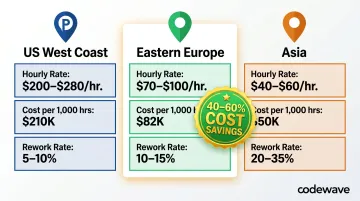
Eastern Europe offers 40–60% cost savings with manageable rework rates. Asia's lower hourly rates are offset by higher rework and turnover costs.
*Asia effective cost reflects base hourly billing only; rework and turnover adjustments vary by project.
(Source: Interexy)
Industry and Compliance Requirements
Highly regulated industries—healthcare, fintech, insurance—add cost through compliance architecture, audit requirements, and security reviews:
- Healthcare: AI validation increases compliance costs by 20–40%
- Per-model compliance overhead: 10–25% extra cost
- Initial compliance setup: 15–20% added to total project costs
Companies underestimate compliance costs by up to 30%.
(Source: SQ Magazine)
Strategic vs. Implementation Work
AI strategy consulting—roadmaps, feasibility assessments, vendor selection—typically commands a premium over pure implementation work. McKinsey and BCG senior partners bill at $1,100–$1,200/hour for strategy engagements, while implementation-level analysts bill at $327–$498/hour.
Most projects involve both phases, each priced differently. Strategy work is the fastest-growing AI consulting segment at 26.51% CAGR.
(Source: Slideworks)
Full Cost Breakdown: What You Are Really Paying For
The consulting engagement fee is only one part of the total cost of ownership. Organizations that budget only for the initial fee frequently encounter post-deployment costs that match or exceed the implementation spend. The breakdown below covers every major cost category — one-time and recurring.
Initial Assessment and Strategy Phase (One-Time)
What it covers:
- Feasibility analysis
- AI readiness audit
- Use case prioritization
- Roadmap and phased implementation plan
Typical cost: $50,000–$500,000 depending on firm tier and scope
Skipping this phase is one of the most common reasons AI projects fail. It validates assumptions, assesses data readiness, and surfaces which use cases will actually deliver ROI — before a single dollar goes into development.
Implementation and Build (One-Time)
What it covers:
- Data preparation and pipeline creation
- Model development or API integration
- Testing and validation
- Deployment and integration
Cost range: $10,000–$5 million+ depending on complexity
Integration complexity is where budgets most frequently overrun. Connecting AI systems to legacy infrastructure, ensuring data quality, and managing change across teams require significant effort.
Post-Implementation Maintenance and Model Updates (Recurring)
AI systems require ongoing tuning as business conditions and data change. Models drift over time—accuracy degrades without continuous monitoring and retraining.
Typical annual maintenance cost: 10–15% of total implementation spend
(Source: Marc Bara/Medium)
Infrastructure and Tooling (Recurring)
Cloud compute costs, API usage fees, and platform subscriptions run in the background—often omitted from initial proposals but compounding quickly as usage grows:
- Monthly cloud costs: $20–$5,000+ depending on usage
- Monthly data storage: $10–$3,000+
- Annual infrastructure total: $10,000–$100,000+
(Source: SoftTeco)
Internal Costs: Training and Change Management (One-Time + Recurring)
Employee training, adoption programs, and internal change management are essential for ROI realization. Organizations that skip this phase see AI tools go unused.
Budget range: 15–25% of total project cost
AI leaders invest 2–3x more in training and change management than laggards—and achieve 5–15% cost efficiency improvements versus 1–3% for laggards.
(Sources: Marc Bara/Medium, PwC)
Low-Cost vs. High-Cost AI Consulting — What's the Difference?
Price tier matters less than fit. What separates budget and premium AI consulting isn't the dollar amount — it's the scope they're built to handle, the risk they absorb, and whether the ROI justifies the investment.
Here's how the two tiers compare across the dimensions that actually matter:
| Factor | Budget-Tier Consulting | Premium Consulting |
|---|---|---|
| Typical providers | Independents, offshore-only teams | Boutique specialists, established firms |
| Use case fit | Narrow, well-defined projects | Complex, multi-system engagements |
| Time to production | 2–12 weeks (boutique) | 8–23 months (Big 4) |
| Documentation | Shorter handoffs, thinner docs | Comprehensive technical docs |
| Post-delivery support | Limited | Extended, structured |
| Dependency risk | Lower with fixed-fee models | Higher with hourly billing |
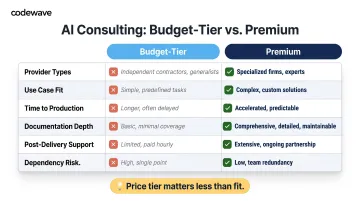
Source: AffixedAI
What Premium Pricing Actually Buys
Beyond delivery speed, premium engagements differ in what they leave behind. Lower-cost consultants often wrap up with minimal handoff — thin documentation, limited knowledge transfer, and little post-delivery access. That's fine for a contained, well-scoped build.
For complex or high-stakes implementations, the gap widens. Premium engagements typically include:
- Comprehensive technical documentation
- Structured knowledge transfer sessions
- Extended post-delivery support windows
- Senior-level involvement throughout (not just at kickoff)
The Dependency Trap to Watch For
Billing model shapes long-term outcomes as much as price tier does. Hourly arrangements at large firms can quietly extend timelines and deepen reliance on external consultants — the engagement never quite ends.
Outcome-based or fixed-fee models with built-in knowledge transfer do the opposite: they're structured to leave your team capable of running what was built. That distinction is worth factoring into any vendor comparison, regardless of where a firm sits on the price spectrum.
How to Estimate the Right AI Consulting Budget
Your AI consulting budget should fund a scope broad enough to generate measurable outcomes within a realistic timeframe — not simply the lowest number you can justify to stakeholders.
Start with the Use Case, Not the Price Tag
Defining a specific, high-value AI use case first produces a more accurate budget estimate than starting with a number and working backwards.
How to prioritize use cases by ROI potential:
- Identify high-repetition tasks where automation saves significant time
- Target processes with measurable cost drivers (labor hours, error rates, processing delays)
- Focus on use cases where small accuracy improvements yield large financial impact
Example:
- Automating invoice processing cuts processing time by 50% and reduces errors by 90%
- Building a demand forecasting model reduces inventory carrying costs by 25%
Codewave clients working on similar use cases report 50% faster invoice processing, 99% reduced fraud risk, and 25% cost reduction — concrete benchmarks worth pressure-testing against your own operations.
Factor in Total Cost of Ownership, Not Just Fees
Organizations typically underestimate total first-year AI investment by 30–50% when they ignore maintenance, infrastructure, and training.
Simple TCO calculation:
| Cost Component | Year 1 | Ongoing (Annual) |
|---|---|---|
| Consulting fees | $150,000 | — |
| Infrastructure (cloud, APIs) | $20,000 | $30,000 |
| Training & change management | $30,000 | $10,000 |
| Maintenance & model updates | — | $22,500 |
| Total | $200,000 | $62,500 |
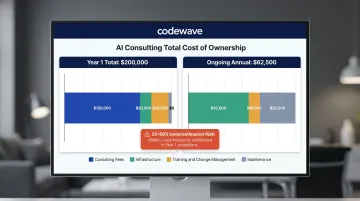
According to a Hidden Economics of AI analysis on Medium, real enterprise AI implementation costs are often 3–5x the advertised price once data preparation, configuration, and change management are factored in. That gap is exactly what proper TCO planning closes.
When scoped correctly, those investments pay off. Codewave clients report outcomes including 40% productivity improvement, 3X faster data processing, and 60% improvement in data accessibility.
Plan for ROI Timeline Realistically
Most AI consulting investments reach break-even within 18–30 months. According to Deloitte, basic automation projects show ROI in under 3 years for 45% of organizations, while advanced multi-agent systems take longer — 60% of organizations expect ROI beyond the 3-year mark.
Budget in phases:
- Discovery + pilot (3–6 months): Validate ROI with a smaller proof-of-concept
- Scale (12–24 months): Expand to additional use cases or departments after proving value
Common Mistakes to Avoid
- Focusing only on upfront consulting fees while ignoring maintenance, infrastructure, and training costs
- Choosing the cheapest option without evaluating track record, methodology, or domain experience
- Skipping the assessment or feasibility phase — cutting this step to save money typically causes expensive rework or failed implementations downstream
- Over-specifying initial features that aren't needed to validate the core use case — adds cost and delays before you've confirmed value
Frequently Asked Questions
What is the average cost of an AI agent?
Simple API-based agents like chatbots cost $10,000–$50,000 to implement. Autonomous multi-step agents with custom models can exceed $200,000. Ongoing API and compute costs add $1,500–$10,000/month depending on usage.
Is AI consulting worth it?
AI consulting delivers real returns when the use case is clearly defined, the scope is realistic, and ROI is tracked. Studies show 84% of organizations that implement AI strategically report positive ROI. The biggest variable is whether the business is operationally ready to absorb the change.
What is the most common AI consulting pricing model?
Time-and-materials (hourly or daily billing) is the most common model, preferred for its flexibility. Project-based and retainer models are increasingly preferred for larger or ongoing engagements because they offer better cost predictability.
What hidden costs should I watch out for in AI consulting?
The most overlooked costs are system integration work, data preparation, employee training, cloud/API fees, and annual model maintenance. These can add 30–50% on top of the initial consulting fee if not planned for upfront.
How long does it take to see ROI from AI consulting?
Most implementations show measurable efficiency gains within 6–12 months, with full break-even occurring within 18–30 months. Narrowly scoped, high-repetition use cases—like invoice processing or customer support automation—typically hit ROI faster.
When should I choose a retainer vs. a project-based AI consulting model?
Project-based pricing suits one-time, well-defined builds—integrations, model deployments, or pilot implementations. Retainers make more sense when AI is embedded in ongoing operations and requires continuous optimization, monitoring, or strategic advisory support.