Introduction
Global AI spending is set to hit $2.52 trillion in 2026—a 44% year-over-year surge—as organizations across industries race to find partners who can deliver strategy, not just software. Yet despite this appetite, most businesses struggle with the same challenge: turning AI investments into results that show up in revenue, efficiency, or risk reduction.
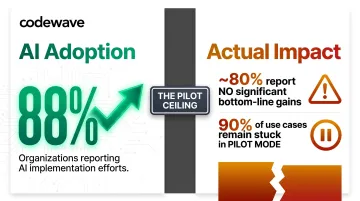
88% of organizations now use AI in at least one business function, yet nearly two-thirds remain stuck in pilot mode — unable to scale enterprise-wide. That gap usually comes down to the consulting partner. Firms that treat AI as a strategy exercise leave clients with slide decks; firms that treat it as an implementation problem leave clients with tools nobody uses. The right partner does both.
This article evaluates the best AI strategy consulting companies for 2026, covering global firms, specialized practices, and boutique consultancies. For each, we explain the strengths, ideal client profile, and how to assess fit against your industry, maturity level, and goals.
Key Takeaways
- AI strategy consulting firms turn ambition into execution — identifying high-value use cases and delivering measurable results
- The best partners move clients from proof-of-concept to production without stalling in the pilot phase
- Key selection criteria: industry experience, deployment speed, technical depth, outcome-based pricing, and post-launch support
- This list covers global strategy houses, specialized AI practices, and outcome-driven boutiques for different organizational needs
- Codewave stands out for its ImpactIndex™ outcome-based model and proven results across 400+ businesses in 15+ industries
What Is AI Strategy Consulting and Why Does It Matter in 2026?
AI strategy consulting helps organizations identify where AI creates the most value, build actionable roadmaps, and implement solutions that integrate into existing operations with measurable business outcomes.
The global AI consulting services market reached approximately $14.08 billion in 2026, growing at a projected 27.3% CAGR through 2035. This growth reflects four converging pressures:
- Rapid generative AI adoption across enterprise functions
- Maturing agentic systems that require architectural oversight
- Rising regulatory requirements around AI governance
- Pressure to move from pilots to production-scale deployment
Enterprise generative AI spending alone hit $37 billion in 2025—a 3.2x year-over-year increase.
Yet adoption doesn't equal impact. Nearly 80% of companies using generative AI report no significant bottom-line gains, and approximately 90% of vertical use cases remain stuck in pilot mode. The firms listed below have a track record of moving organizations past that pilot ceiling into deployments that show up in revenue, efficiency, and risk metrics.
Best AI Strategy Consulting Companies for 2026
These firms were evaluated on depth of AI expertise, cross-industry track record, ability to move from pilot to production, and evidence of measurable client outcomes—not just completed projects.
Codewave
Codewave is an award-winning AI and data consultancy that has worked with 400+ businesses across 15+ industries including fintech, healthcare, retail, insurance, energy, transportation, agriculture, and education. The firm focuses on translating data into competitive advantage through outcome-driven AI solutions that prioritize measurable results over billable hours.
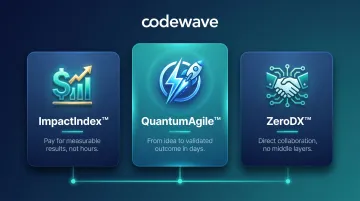
Three proprietary frameworks define how Codewave delivers:
- ImpactIndex™ — Clients pay for measurable results, not project hours, ensuring solutions are built to launch, perform, and drive real business value
- QuantumAgile™ — Moves from ideas to validated outcomes in days by simulating multiple futures and shipping what works before full-scale rollout
- ZeroDX™ — Removes middle management layers so the people you talk to are the ones who build, delivering direct collaboration and faster execution
Proven results include 3X faster data processing, 40% productivity increases, 90% fewer data errors, and a 70-80% client retention rate across engagements.
| Key AI Services | AI strategy roadmapping, data pipeline automation, predictive analytics, AI-powered product development, intelligent process automation across fintech, healthcare, retail, energy, and transportation |
| Engagement Model | Outcome-based (ImpactIndex™)—clients pay for measurable business results, not project hours; phased delivery via QuantumAgile™ ensures rapid validation before full-scale rollout |
| Best For | Mid-to-enterprise businesses across 15+ industries seeking outcome-driven AI strategy with direct collaboration, fast execution, and proven ROI metrics |
McKinsey QuantumBlack
McKinsey QuantumBlack is McKinsey & Company's dedicated AI and advanced analytics practice, serving global enterprises that need AI embedded at the strategic and organizational level—not just in isolated workflows. Originally born in Formula 1 data analytics, QuantumBlack has grown into McKinsey's global AI practice focused on hybrid intelligence that combines data precision with human creativity.
The firm's defining focus is building internal AI capabilities within client organizations rather than creating dependency. QuantumBlack's "Rewired" framework covers six core capabilities: strategic roadmapping, talent, operating model, technology, data, and adoption/scaling.
Organizational transformation runs alongside technical deployment—because AI success requires leadership alignment, cultural change, and sustained capability building, not just a working model.
QuantumBlack helped ING Bank build a generative AI chatbot in just 7 weeks that assisted 20% more customers post-launch, with plans to scale across 10 markets and 37 million customers. For a large bank, they deployed AI agent squads to modernize a legacy core system of 400 software components, reducing time and effort by more than 50% in early adopter teams.
| Key AI Services | AI strategy and governance, advanced analytics, generative AI integration, responsible AI frameworks, capability building and organizational transformation |
| Notable Clients / Industries | Financial services (ING Bank), healthcare, retail, energy, telecom; emphasis on large-scale enterprise transformations |
| Best For | Large enterprises pursuing org-wide AI transformation where leadership alignment, cultural change, and long-term capability building are as important as technical deployment |
Accenture AI
Accenture AI is a global professional services giant whose AI practice spans strategy, implementation, and workforce enablement, serving clients across financial services, healthcare, consumer goods, and communications with an extensive ecosystem of cloud, AI platform, and startup partnerships. Accenture committed $3 billion to generative AI and grew its AI workforce from 40,000 to 77,000 in two years.
Accenture's clearest differentiator is its ability to combine enterprise-scale resources with a dedicated generative AI and LLM consulting practice. The firm's Responsible AI framework is built on 8 principles—Accountability, Governance, Human Impact, Fairness, Explainability, Transparency, Accuracy, and Safety—developed in collaboration with the World Economic Forum. Accenture focuses on embedding AI across entire business functions rather than delivering point solutions, with an emphasis on AI-led processes that modernize operations end-to-end.
Research from Accenture shows companies with AI-led processes achieve 2.5x higher revenue growth, 2.4x greater productivity, and 3.3x greater success at scaling generative AI use cases. In fiscal year 2025, Accenture tripled its advanced AI revenue year-over-year to $2.7 billion and delivered more than 6,000 advanced AI projects.
| Key AI Services | Enterprise AI strategy and roadmap, generative AI and LLM integration, data readiness, responsible AI governance, workforce AI enablement, scaling AI for productivity |
| Notable Clients / Industries | Financial services, healthcare, consumer goods, communications; research-backed outcomes across 12 countries and 15 industries |
| Best For | Large, complex organizations needing multi-year AI programs integrated into broader digital transformation, with regulatory compliance and global scalability as priorities |
BCG X
BCG X (formerly BCG Gamma) is Boston Consulting Group's advanced analytics and AI unit, blending strategic business consulting with deep data science and machine learning expertise across financial services, retail, healthcare, and industrial sectors. BCG X is positioned as BCG's "tech build and design division" and a global force multiplier helping Fortune 500 clients achieve what only 8-10% of companies manage: scaling AI and digital transformations.
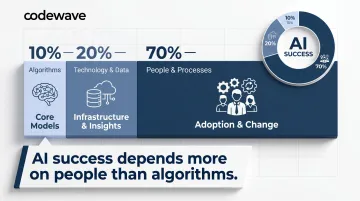
BCG X's approach is built around a collaborative build-alongside-the-client model, prioritizing rapid prototyping over traditional consulting timelines. The firm's 10-20-70 framework (10% algorithms, 20% technology and data, 70% people and processes) reflects a core conviction: AI success depends more on change management and upskilling than on algorithms alone.
Its DRI framework—Deploy, Reshape, Invent—guides organizations through three stages: deploying GenAI tools for 10-15% productivity gains, reshaping critical functions, and ultimately inventing new business models using proprietary data and AI.
BCG X teams work hand-in-hand with client teams to move from strategy to MVPs and scaled transformations, delivering tangible results in less than 12 months. The firm is also a leader in responsible AI frameworks and AI governance.
| Key AI Services | AI strategy and governance, generative AI and autonomous agents, responsible AI frameworks, process redesign, advanced analytics, minimum viable AI solution development |
| Notable Clients / Industries | Financial services, manufacturing, healthcare, insurance, consumer goods; emphasis on business model transformation |
| Best For | Enterprises pursuing business model transformation where AI strategy needs to be anchored to commercial outcomes and organization-wide change management |
Deloitte AI & Analytics
Deloitte AI & Analytics is a global professional services firm whose AI practice prioritizes governance-led transformation, helping organizations in financial services, healthcare, energy, and consumer sectors identify high-value AI use cases and deploy them within rigorous compliance and risk frameworks.
Deloitte's Trustworthy AI framework manages AI risk, bias, and transparency across 7 dimensions: Private, Transparent and Explainable, Fair and Impartial, Responsible, Accountable, Robust and Reliable, and Safe and Secure. The firm's strength in analytics modernization and intelligent automation is complemented by deep integration of AI within audit, tax, and regulatory advisory services—making it especially relevant for compliance-heavy industries.
Only 1 in 5 companies (20%) has a mature governance model for autonomous AI agents, and Deloitte helps organizations build these frameworks while ensuring readiness in infrastructure, data, risk, and talent. The firm publishes the AI Dossier, a collection of 80+ high-impact AI use cases organized by industry, function, and AI type including agentic AI.
| Key AI Services | AI strategy and use case identification, generative AI adoption, Trustworthy AI governance framework, analytics modernization, ML model design, intelligent automation |
| Notable Clients / Industries | Financial services, life sciences, healthcare, energy; emphasis on regulatory compliance and governance-led transformation |
| Best For | Enterprises where regulatory compliance, governance, and risk management are the primary constraints on AI adoption—particularly in financial services and healthcare |
IBM Consulting (Watsonx)
IBM Consulting is a technology-led AI consultancy powered by the Watsonx platform, combining decades of enterprise IT experience with a modern AI ecosystem designed for hybrid cloud environments. The firm serves financial services, healthcare, government, and manufacturing clients globally, with particular strength in mission-critical, compliance-sensitive deployments.
The Watsonx.governance platform is IBM Consulting's most distinctive technical asset, with built-in tools for AI explainability, bias detection, and lifecycle governance. This enables organizations to monitor fairness, quality, and drift in ML models; detect bias; explain predictions; flag performance issues; and automate compliance by translating regulatory requirements into enforceable policies. Watsonx.governance supports both IBM and third-party models including OpenAI and Amazon SageMaker, and earned the #1 ranking for user experience.
For enterprises running infrastructure built over decades, IBM's proven track record in modernizing legacy systems without disrupting core operations sets it apart from newer AI-native consultancies. As "Client Zero," IBM deployed Watsonx across its own operations and unlocked $4.5 billion in productivity gains, achieving a 58% reduction in processing time for third-party data clearance. In April 2026, 11 IBM solutions including the full Watsonx portfolio received FedRAMP authorization, enabling federal agencies to deploy advanced AI capabilities on AWS GovCloud.
| Key AI Services | Enterprise AI strategy, Watsonx platform deployment, generative AI for regulated environments, data governance, bias detection, hybrid cloud and legacy system modernization |
| Notable Clients / Industries | Financial services, government (FedRAMP authorized), healthcare, manufacturing; IBM's own operations (Client Zero case study) |
| Best For | Large enterprises in regulated industries that prioritize AI reliability, security, auditability, and the ability to scale AI across hybrid infrastructure environments |
How We Chose These AI Strategy Consulting Firms
These firms were evaluated on their ability to move AI from strategy to production, depth of industry-specific expertise, evidence of measurable outcomes (not just completed projects), and the quality of their engagement models. Organizations often choose firms based on brand recognition alone — a mismatch with their actual AI maturity stage and industry needs.
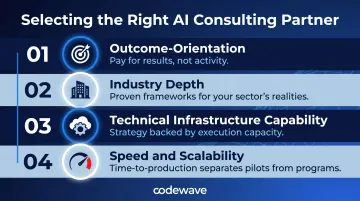
Four core evaluation factors tied to business outcomes guided this selection:
Outcome-orientation: Firms that commit to measurable results — not just deliverables — structure engagements differently. Codewave's ImpactIndex™ model ties payment to outcomes; traditional consultancies often bill on time-and-materials. That distinction determines whether you pay for activity or results.
Industry depth: Proven frameworks for your sector's regulatory and operational realities matter more than general AI expertise. Deloitte and IBM excel in compliance-heavy industries; BCG X and McKinsey focus on business model transformation across sectors.
Technical infrastructure capability: Strategy without execution capacity is a gap. IBM's Watsonx platform addresses hybrid cloud and legacy modernization; Accenture offers deep cloud partnerships; Codewave provides end-to-end MLOps and data engineering — not just strategic recommendations.
Speed and scalability: Time-to-production separates pilots from real programs. McKinsey QuantumBlack delivered ING's chatbot in 7 weeks; Codewave's QuantumAgile™ framework moves from idea to validated outcome in days.
This list spans global consultancies and outcome-based boutiques deliberately. The right firm for a regulated healthcare enterprise looks nothing like the right firm for a fintech scaling a pilot — which is why firm type, not just firm name, belongs in your evaluation criteria.
Conclusion
The AI strategy consulting landscape in 2026 is diverse, and the right partner isn't always the biggest name—it's the one that matches your organization's specific goals, data maturity, industry requirements, and desired pace of transformation.
Assess whether a firm offers ongoing performance accountability, knowledge transfer to internal teams, and scalable infrastructure—not just a polished roadmap document. A strategy deck has no value until it ships, performs, and moves the metrics that matter.
If those criteria matter to your organization, Codewave's ImpactIndex™ model is built around exactly that: clients pay for measurable results, not deliverables. AI that doesn't perform doesn't get paid for. Start a conversation at codewave.com.
Frequently Asked Questions
What does an AI strategy consulting company do?
AI strategy consulting firms help organizations identify high-value AI use cases, build implementation roadmaps, and oversee deployment—bridging the gap between AI's potential and real operational outcomes. They combine strategic planning with technical execution to ensure AI initiatives deliver measurable ROI.
Is there a demand for AI consultants?
Yes, and it's accelerating. AI Services spending is forecast at $588.6 billion in 2026—up 34% year-over-year. Most organizations lack in-house expertise to design, govern, and scale AI responsibly, making external consulting essential as generative AI and agentic systems go mainstream.
What is the 30% rule in AI?
There is no single authoritative definition. The term appears informally across contexts—budget allocation to data quality, task automation thresholds, creative work caps—with no consistent meaning. No major analyst firm or academic institution has established it as a standard framework.
How do I choose the right AI strategy consulting firm?
Prioritize industry-specific experience, a proven track record from pilot to production, and transparent engagement models (outcome-based vs. time-and-materials). Match the firm to your AI maturity—global consultancies handle large-scale transformation, while boutique firms move faster at the deployment stage.
What is the difference between AI consulting and AI implementation?
AI consulting focuses on strategy, use case prioritization, and roadmap design, while AI implementation covers the technical build, integration, and deployment. The best firms—like those listed here—do both end-to-end, ensuring strategies are executable and implementations are grounded in clear business goals.