Introduction
Manual workflows drain productivity across modern enterprises at alarming rates. 94% of workers perform repetitive, time-consuming tasks that could be automated, creating costly bottlenecks in healthcare claims processing, fintech compliance reporting, and logistics coordination.
AI consulting firms are transforming this landscape by delivering intelligent automation that goes far beyond rule-based bots. Using machine learning, natural language processing, and agentic AI, these firms build systems that handle dynamic, complex workflows: routing invoices based on vendor history, flagging compliance anomalies in real-time, or onboarding customers with personalized decision trees.
The numbers back the shift: the AI automation market hit $129.92 billion in 2025 and is projected to reach $1,144.83 billion by 2033, growing at a 31.4% compound annual rate. Intelligent Process Automation (IPA) alone commands a 33.8% revenue share in 2025.
Adoption is accelerating just as fast. 78% of organizations now use AI in at least one business function, up from 55% just two years ago. This guide breaks down the top AI consulting firms driving that change in 2026 — what they do well, which industries they serve, and how to evaluate the right fit for your workflows.
Key Takeaways
- AI consulting firms design and deploy intelligent automation that reduces manual effort, eliminates errors, and accelerates operations across industries
- The best partners integrate AI into existing ERP, CRM, and internal systems with measurable, documented ROI — not slide decks
- Key selection criteria: industry expertise, technical depth in RPA/IPA/GenAI, documented outcomes, and scalability
- Top 2026 firms include Codewave, IBM Consulting, Accenture, Infosys, and Automation Anywhere—each suited for different needs
- Choose based on your industry, operational complexity, speed requirements, and budget
What Is AI Consulting for Workflow Automation?
AI consulting for workflow automation helps businesses assess, design, build, and deploy AI-powered systems that replace manual, repetitive processes with intelligent, adaptive automation. The distinction from basic Robotic Process Automation (RPA) matters here. RPA executes fixed, rule-based tasks. AI adds decision-making through machine learning, enabling systems to analyze unstructured data, recognize patterns, and handle dynamic scenarios without human intervention.
Common workflows targeted for automation include:
- Invoice processing and accounts payable
- Document routing and classification
- Compliance monitoring and audit trails
- Customer onboarding and identity verification
- Data entry and validation
- Reporting and analytics pipelines
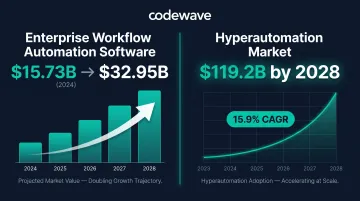
The market behind this shift is significant. The enterprise workflow automation software market is projected to grow from $15.73 billion in 2024 to $32.95 billion, while hyperautomation via process-agnostic software is expected to reach $119.2 billion by 2028 at a 15.9% annual growth rate.
That growth is driving demand for firms that can actually deliver, not just advise. The firms below were selected based on delivery capability, industry breadth, and documented client outcomes.
Best AI Consulting Firms for Workflow Automation in 2026
These firms were evaluated on reliability, technical depth, client outcomes, and ability to automate workflows across industries.
Codewave
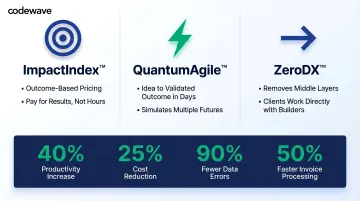
Codewave is an award-winning AI and data solutions company that has partnered with 400+ businesses across 15+ industries—including healthcare, fintech, retail, insurance, and transportation—delivering outcome-focused AI implementations through its proprietary ImpactIndex™, QuantumAgile™, and ZeroDX™ frameworks.
Each framework targets a different friction point in AI delivery:
- ImpactIndex™ — clients pay for measurable results, not hours billed
- QuantumAgile™ — moves projects from idea to validated outcome in days by simulating multiple futures
- ZeroDX™ — removes middle layers so clients work directly with the builders
Documented outcomes include 40% productivity increases, 25% cost reductions, 90% fewer data errors, and 50% faster invoice processing.
| Key Automation Services | AI-powered workflow design, data pipeline automation, predictive analytics, intelligent document processing, custom AI agent development |
|---|---|
| Best For | Mid-market to enterprise businesses in healthcare, fintech, retail, insurance, and energy seeking outcome-based, rapid AI deployment |
| Notable Differentiator | ImpactIndex™ outcome-based pricing — clients pay for measurable business results, not consulting hours |
IBM Consulting
IBM Consulting is a global enterprise AI leader that operationalizes AI automation through its WatsonX platform, helping large organizations integrate intelligent workflow automation into hybrid cloud environments with a strong emphasis on regulatory compliance and data governance.
IBM's depth shows in regulated industries — finance, healthcare, and government — where compliance, security, and legacy system integration are non-negotiable requirements. Its AI process automation practice combines RPA, data engineering, and AI orchestration to redesign workflows at scale.
Documented client outcomes include Pfizer achieving 20% cost avoidance on new projects and Sixt cutting problem detection and resolution time by 70%.
| Key Automation Services | Intelligent workflow automation, RPA integration, AI compliance monitoring, data platform modernization, enterprise AI strategy |
|---|---|
| Best For | Large enterprises with complex regulatory requirements, legacy infrastructure, and multi-year transformation budgets ($100K+ engagements) |
| Notable Differentiator | WatsonX platform with deep hybrid cloud integration and proven governance frameworks for regulated industries |
Accenture
Accenture is a global consulting firm that combines AI strategy, AiOps, IPA frameworks, and GenAI advisory to help enterprises scale intelligent automation across manufacturing, financial services, retail, and telecommunications.
Accenture's end-to-end delivery model spans process mining and automation design through GenAI integration and ongoing managed services. Banking operations clients have achieved 20–25% cost savings, with 80% of controls automated and a 70% reduction in time-to-yes for account opening. Their Triple-A framework (automation, analytics, AI) projects 21% revenue growth and 22% operations cost reduction from intelligent operations.
| Key Automation Services | Hyperautomation strategy, IPA framework development, GenAI-powered workflow design, AiOps, process mining |
|---|---|
| Best For | Mid-to-large enterprises in regulated or complex verticals seeking industry-specific AI automation with long-term managed support |
| Notable Differentiator | Deep GenAI advisory combined with AiOps capabilities that connect AI automation to real-time operational intelligence |
Infosys
Infosys is a global IT services leader whose AI-first platform, Infosys Topaz, combines 12,000+ pre-built AI assets, generative AI, and intelligent automation tools. The platform is built specifically to help large enterprises modernize legacy systems without disrupting core operations.
Infosys excels at integrating AI automation into complex, data-heavy environments, particularly for supply chain, ERP modernization, and financial services. Its global delivery network ensures consistent implementation across regions and time zones. A strategic collaboration with OpenAI announced in 2026 further accelerates enterprise GenAI capabilities through the Topaz Fabric platform.
| Key Automation Services | Legacy system AI integration, business process automation, AI-driven ERP optimization, data modernization, RPA/IPA deployment |
|---|---|
| Best For | Large global enterprises running legacy systems in finance, retail, manufacturing, and healthcare that need scalable AI integration without full stack replacement |
| Notable Differentiator | Infosys Topaz platform with 12,000+ pre-trained AI accelerators that reduce implementation time for enterprise automation projects |
Automation Anywhere
Automation Anywhere is an agentic process automation company that delivers AI-powered workflow automation through its cloud-native platform, helping businesses across financial services, healthcare, manufacturing, and logistics free employees from repetitive tasks using high-speed AI agents and co-pilots.
Its core focus is agentic AI: workflows that don't just follow rules but perceive, decide, and act. Standardized DevOps processes ensure rapid, clean deployment at scale. One global investment bank achieved a 92% reduction in processing time for new accounts, while vendor-reported benchmarks show 80% AP efficiency boosts and 90%+ straight-through processing in finance.
| Key Automation Services | Agentic AI workflow automation, AI co-pilot integration, process discovery, cloud automation workspace, service operations automation |
|---|---|
| Best For | Businesses of all sizes looking for a purpose-built workflow automation platform with fast deployment and pre-built automation across finance, healthcare, and logistics |
| Notable Differentiator | Agentic AI Studio enables businesses to build and deploy autonomous AI agents for multi-step workflows without deep ML engineering expertise |
How We Chose the Best AI Consulting Firms for Workflow Automation
A common mistake businesses make is selecting firms based on brand name alone rather than asking whether the firm can actually deliver working automation within a realistic timeline and budget — not just hand over a strategy document.
Core selection factors used:
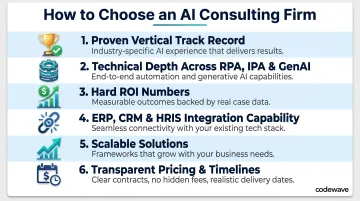
- Proven track record in your specific vertical, with documented outcomes (not just case study summaries)
- Technical depth across RPA, IPA, and GenAI — enough to handle both simple task automation and complex decision workflows
- Hard ROI numbers: cost savings, processing time reductions, error rate improvements
- Direct integration with your ERP, CRM, and HRIS without requiring a full stack replacement
- Solutions that scale as your processes evolve, not just fit your current state
- Pricing and timelines presented clearly upfront, not buried in the proposal fine print
Business size suitability was also weighted. Some firms are built for large enterprises with long implementation timelines and heavy compliance requirements. Others focus on mid-market and growth-stage companies that need faster deployment and tighter feedback loops.
That last point matters more than it might seem. Research shows approximately 95% of GenAI pilots fail to achieve rapid revenue acceleration, and more than 80% of organizations report no tangible enterprise-level EBIT impact from GenAI. When failure rates are that high, delivery track record — not proposal quality — is what separates firms worth hiring from ones worth avoiding.
Conclusion
Choosing the right AI consulting partner for workflow automation comes down to fit: their delivery model, technical stack, and engagement style need to align with your operational goals, timeline, and expected outcomes.
Before committing, vet any firm on these criteria:
- Request case studies from your specific industry with documented, measurable results
- Ask how they handle integration with your existing systems and tech stack
- Confirm scalability plans for as your workflows grow
- Verify whether they offer outcome-based pricing — not just hourly billing
- Ask for direct access to the technical team who will build your solution, not just account managers
For businesses that need automation delivering actual results, Codewave's ImpactIndex™ model ties every engagement to measurable outcomes — you pay for performance, not hours logged. With 400+ businesses across 15+ industries already running leaner, faster operations, see what that looks like for your workflows at codewave.com.
Frequently Asked Questions
How is AI used in process automation?
AI enables process automation to move beyond fixed rules—using machine learning to recognize patterns and NLP to process unstructured data. Decision models then handle dynamic scenarios like invoice routing, compliance checks, or customer onboarding without manual intervention.
What should I look for when choosing an AI consulting firm for workflow automation?
Look for industry-specific experience, technical capability across RPA/IPA/GenAI, proven client outcomes with measurable metrics, and whether they offer end-to-end delivery (not just strategy). Verify integration capability with your existing systems.
How long does it typically take to implement AI workflow automation?
Timelines vary—boutique and outcome-focused firms can deploy initial automations in weeks, while enterprise-scale implementations may take 6–18 months depending on scope. ROI payback ranges from 3–6 months for high-volume workflows to 6–12 months for cross-departmental processes, making early scoping critical.
Can AI consulting firms integrate automation with existing ERP and CRM tools?
Yes—reputable AI consulting firms connect automation with systems like SAP, Salesforce, Oracle, and custom internal tools via APIs and middleware, keeping data flowing across your stack without requiring a full replacement.
How much does AI workflow automation consulting typically cost?
Costs range widely—enterprise firms start at $100K+ for multi-month engagements, while outcome-based firms offer more accessible project pricing. Evaluate cost against documented ROI: finance and accounting automation averages 214% ROI over three years, not just deliverables on paper.
What industries benefit most from AI workflow automation?
Industries with high volumes of repetitive, data-heavy processes see the fastest ROI: financial services, healthcare, insurance, retail, logistics, and manufacturing. Tasks like claims processing, invoice handling, compliance reporting, and inventory management deliver measurable efficiency gains quickly.