Introduction
Retail has fundamentally changed. Customers now expect personalized, seamless, instant experiences across every channel—and retailers that can't deliver are losing ground fast. 71% of U.S. consumers abandon brands over disorganized interactions that force them to repeat information, yet 78% of businesses believe they already offer seamless omnichannel experiences—a dangerous perception gap that costs revenue daily.
The stakes are concrete: omnichannel shoppers spend 4% more in-store and 10% more online than single-channel customers, with 23% more repeat visits within six months. Meanwhile, digital-native competitors capture market share through AI-driven personalization, real-time inventory accuracy, and friction-free checkout experiences that legacy retailers struggle to match.
This guide breaks down the technologies, strategies, and measurable outcomes behind successful retail transformation—and how to build a roadmap that moves from ambition to execution without disrupting operations.
Key Takeaways
- The global retail digital transformation market will reach $535.94 billion by 2031, driven by AI, cloud, and omnichannel urgency
- 91% of retail IT leaders prioritize AI, yet only 8% have fully deployed it; the gap is execution, not intent
- Omnichannel customers spend 4-10% more and return 23% more often; personalization drives 40% revenue gains over non-personalizers
- 70% of Fortune 500 companies still run software over 20 years old, spending 60-80% of IT budgets maintaining legacy systems
- Successful transformation follows a phased path: data unification, pilot projects, then scaled deployment — typically 18-24 months to foundation, 2-3+ years to full omnichannel capability
What Retail Digital Transformation Really Means
Retail digital transformation is the integration of digital technologies, data systems, and new ways of working across every layer of retail operations—from customer experience to supply chain to inventory management. It's not just launching an app or upgrading a POS system; it's rewiring how retailers operate, compete, and generate value.
The market scale confirms urgency: The global digital transformation market in retail is valued at $317.34 billion in 2026 and projected to reach $535.94 billion by 2031 at an 11.05% CAGR. Cloud computing holds 36.72% market share by technology, while augmented and virtual reality grows at 13.52% CAGR—the fastest segment. Asia Pacific represents 34.72% of the global market.
What's Driving Urgency Right Now
Three forces are converging:
Customer expectations have shifted permanently. Personalization, omnichannel consistency, and convenience are now baseline requirements—not differentiators. 42% of consumers feel brands don't understand them as people, yet 46% of brands can't use customer data in real time.
That gap shows up in behavior. Customers research on mobile, compare online, buy in-store (or vice versa), and expect unified pricing, inventory visibility, and seamless handoffs across every channel.
Digital-native competitors have structural advantages legacy retailers lack. Amazon's advertising sales alone reached $46.9 billion in 2024. Retail media spend will hit $74 billion by 2026, representing 25% of all digital ad spend. Digital-first retailers control customer data, marketing value chains, and fulfillment networks—advantages built through years of data investment.
Rising costs leave no room for operational inefficiency. Labor costs, supply chain volatility, and price competition are compressing margins across retail. Automation, AI-driven forecasting, and inventory optimization have moved from innovation experiments to financial necessities.
The Scope of Transformation
Transformation touches three layers:
- Customer-facing operations: How people shop—personalized recommendations, mobile checkout, AR product visualization, click-and-collect, unified loyalty programs
- Internal operations: How retailers work—automated replenishment, AI demand forecasting, real-time inventory tracking, workforce scheduling, predictive maintenance
- Business models: How retailers generate value—retail media networks, subscription services, first-party data monetization, direct-to-consumer channels
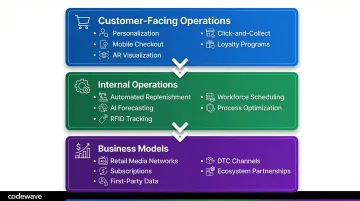
Each layer demands technology infrastructure, data integration, and real organizational change—which is why retailers that treat transformation as a technology procurement project consistently underdeliver on outcomes.
Key Technologies Reshaping Retail Operations
Artificial Intelligence and Machine Learning
AI drives personalization at scale, powering recommendation engines, demand forecasting, dynamic pricing, and inventory optimization. 91% of retail IT leaders prioritize AI as the top technology to implement by 2026, yet only 8% have fully deployed it across operations. Closing that execution gap is where transformation either stalls or accelerates.
Machine learning models analyze historical sales data, seasonality patterns, promotional impacts, and external signals (weather, events, economic indicators) to predict demand with 10-20% greater accuracy than traditional methods. That accuracy improvement translates directly to 2-3% revenue increases by reducing stockouts and overstock situations.
The downstream effects compound across the business:
- Freed-up working capital redirects toward growth investments
- Improved on-shelf availability lifts customer satisfaction scores
- More accurate procurement cuts expedited shipping costs
Retailers using segmented AI approaches — tailoring models to product categories, regions, or customer cohorts — achieve forecast accuracy improvements of 10 to 40 percent.
Generative AI alone is projected to create between $240 billion and $390 billion in economic value for retailers. The opportunity spans automated product description generation, hyper-personalized marketing copy, virtual shopping assistants, and synthetic data for pricing strategy tests — capabilities that extend what skilled teams can execute, not headcount reductions.
Cloud Computing and Modern Tech Architecture
Cloud infrastructure replaces rigid legacy systems with scalable, on-demand architecture. Retailers can deploy new services rapidly, integrate data across channels, and absorb demand spikes without downtime. 60% of retailers face 18-24 month modernization timelines, with integration costs running 40% higher than cloud-native deployments — but this investment is required before any broader transformation can take hold.
Why cloud is foundational:
- Elastic capacity: Scale compute resources up during Black Friday, down during slow periods — pay only for what you use
- Rapid deployment: Launch new services in days without procuring hardware or waiting on data center builds
- Global reach: Serve customers across regions with low latency through distributed cloud infrastructure
- Data centralization: Consolidate POS, e-commerce, inventory, CRM, and supply chain data in unified platforms accessible across the organization
The shift to microservices architecture is equally significant. Legacy monolithic systems require updating the entire application stack to change a single function — checkout, pricing, or promotions. Microservices break applications into independent components that communicate via APIs, so retailers can update one function without touching the rest.
Example: A retailer can deploy a new AI-powered recommendation engine to the product detail page without touching checkout, inventory management, or customer accounts. The modular architecture reduces deployment risk, accelerates innovation cycles, and enables integration with best-of-breed third-party services (payment processors, fraud detection, shipping providers) through API connections.
IoT, Big Data, and Emerging Technologies
IoT devices generate real-time operational intelligence. Smart shelves detect inventory levels and trigger automated replenishment alerts when stock drops below thresholds. In-store sensors track traffic patterns, identifying high-dwell zones and optimizing store layouts. Connected supply chain trackers monitor temperature, humidity, and location for perishable goods, reducing spoilage and ensuring compliance.
Global IoT devices will grow from 19.8 billion in 2025 to 40.6 billion by 2034, with retail-specific cellular IoT connections reaching 217.7 million by 2028. The proliferation of sensors and connected devices creates data volume that traditional systems can't process , making cloud infrastructure and AI necessary to extract any meaningful value from it.
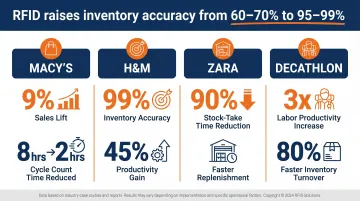
RFID delivers proven, rapid ROI. Radio-frequency identification tags raise inventory accuracy from baseline 60-70% to 95-99%, with retailers counting 50,000+ items in under 30 minutes versus hours of manual cycle counts. Macy's achieved a 9% sales lift in RFID-enabled categories, while H&M improved productivity by 45% and Zara reduced stock-take time by 90%, saving thousands of labor hours per store annually.
AR/VR bridges digital and physical retail. Virtual try-on reduces return rates and increases purchase confidence by letting customers visualize products in context before buying. Sephora's Virtual Artist reported 200% higher conversion rates than static browsing, with industry analyses citing a 35% increase in overall conversion rates and a 25% reduction in product returns for users who engaged with the AR tool. IKEA Place allows customers to place 3D furniture models in their homes using smartphone cameras, reducing the uncertainty that drives returns.
Strategic Pillars for a Successful Transformation
Building a Seamless Omnichannel Experience
Omnichannel integration is a strategic priority because customers now use multiple touchpoints in a single purchase journey. A Harvard Business Review study of 46,000 shoppers found that omnichannel customers spent 4% more in-store and 10% more online than single-channel shoppers, with customers using 4+ channels spending 9% more in-store. Within six months, omnichannel shoppers logged 23% more repeat shopping trips.
The business case is quantified: omnichannel shoppers have 1.7x higher lifetime value than single-channel shoppers. Nordstrom reported a 15% lift in customer lifetime value for shoppers using 3+ channels, while Best Buy shoppers using both app and kiosk spend 40% more per trip.
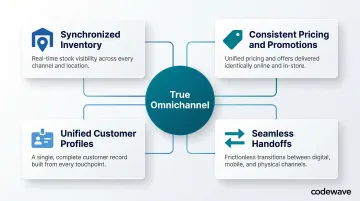
True omnichannel integration depends on four technical capabilities:
- Synchronized inventory: Real-time visibility into stock levels across warehouses, stores, and third-party fulfillment centers
- Consistent pricing and promotions: Unified pricing engines that prevent channel conflicts (online discounts not honored in-store)
- Unified customer profiles: Single view of customer identity, purchase history, preferences, and interactions across all touchpoints
- Seamless handoffs: Click-and-collect (BOPIS), mobile POS for checkout anywhere in-store, app-to-store product locators, ship-from-store fulfillment
Roughly 1 in 10 worldwide online orders are fulfilled via click-and-collect, demonstrating how customers now expect to research online and complete purchases through the most convenient channel—not the channel the retailer prefers.
Turning Data Into a Strategic Asset
Seamless omnichannel experiences generate enormous customer data — but most retailers aren't using it. 63% of companies collect customer data while only 15% use it to make growth decisions. That activation gap is the single largest missed opportunity in retail transformation.
The upside is substantial. Top retailers on the BCG Personalization Index can unlock an estimated $570 billion in incremental growth through first-party data. The retail sector accounts for 30% of the total personalization opportunity across all industries. Personalized promotions yield returns up to 3x higher than mass promotions, yet retailers invest less than 5% of promotional spending in personalization.
Closing that gap requires the right infrastructure:
- Unified customer data platform (CDP): Consolidate POS, e-commerce, loyalty, mobile app, and customer service data into single profiles
- Real-time decisioning engines: Trigger personalized offers, product recommendations, and content based on current behavior (not yesterday's batch processing)
- AI/ML models fed by clean data: Predictive analytics for churn risk, lifetime value scoring, next-best-action recommendations, and segment discovery
- Governance and privacy controls: GDPR/CCPA compliance, consent management, role-based access to customer data
To achieve "leader" status in personalization, large retailers invest $10-40 million annually in CDPs, marketing automation, AI models, and specialized personnel. The investment pays off: revenue growth for personalization leaders exceeds laggards by 10 percentage points annually.
Operational Efficiency Through Automation
The efficiency gains from data intelligence only compound when automation handles the underlying grunt work. Repetitive, error-prone tasks — inventory counting, price auditing, order processing, replenishment — are where automation delivers the clearest ROI. RFID deployment reduces manual cycle count tasks by 75-90%. Decathlon tripled labor productivity after RFID implementation, while automation can reduce supply chain operating costs by up to 30% through labor optimization and cycle time reduction.
Automation's real upside, though, is what it frees people to do. Companies spend an average of $9,100 annually per employee on software but only $1,200 per employee on training — a 7.6:1 imbalance that undermines the investment. A capability-first approach to AI collaboration yielded a 25% productivity gain at one North American services company by freeing up agent capacity and pairing workers with real-time data access.
Empowering store associates with smart devices — mobile POS for checkout anywhere, inventory lookup tools, customer history access — improves both service quality and job satisfaction. The retailers seeing the strongest results treat automation not as a headcount reduction strategy, but as a way to redeploy human judgment where it actually matters: on the floor, with the customer.
Measurable Outcomes Retailers Are Achieving
Customer Experience Outcomes
Personalization reduces churn, omnichannel consistency increases basket size, and faster checkout reduces walkouts. The KPIs that matter:
Customer satisfaction and loyalty:
- Retailers that personalize effectively see up to 40% higher revenue than those that don't
- Personalized product recommendations drive 10-20 percentage points of cross-sell for multi-category retailers
- Data-driven substitute recommendations cut cart abandonment rates by 50%
- A pharmacy retailer doubled customer engagement while halving outreach volume using a "next-best experience" engine
Conversion rate lift: Gibson Inc. achieved 120% growth in email revenue and doubled email engagement by implementing personalization strategies. Customers who interact with multiple channels convert at higher rates because friction is removed at every stage of the purchase journey.
Repeat purchase and lifetime value: Omnichannel shoppers demonstrate 23% more repeat visits within six months and 1.7x higher lifetime value. Keeping customers costs less than finding new ones — and these numbers show the gap is widening.
Operational and Financial Outcomes
Strong customer outcomes depend on operational infrastructure that can keep up. Codewave's client results across industries show what the right data and AI foundation delivers:
- 3X faster data processing
- 40% increase in productivity
- 90% fewer data errors
- 50% faster invoice processing
- 40% less reporting time
Retail-specific implementations follow the same pattern:
RFID case studies demonstrate measurable, multi-dimensional returns:
| Retailer | Accuracy Gain | Sales/Revenue Impact | Productivity Gain | Other Benefits |
|---|---|---|---|---|
| Walmart | 65% → 95%+ | ~5% sales increase | — | 10-15% out-of-stock reduction |
| Macy's | 18% stock discrepancy reduction | 9% sales lift | Cycle counts: 8hrs → 2hrs | 20% shrink reduction, 30% more store-fulfilled online orders |
| Lululemon | 98% accuracy | — | ROI payback <1 year | — |
| H&M | 99% accuracy | — | 45% improvement | — |
| Zara | — | — | 90% stock-take time reduction | Thousands of labor hours saved per store annually |
| Decathlon | — | — | Tripled labor productivity | 15% shrink reduction |

Financial outcomes: Automation cuts costs, better inventory management lifts revenue, and smarter pricing improves margins. The numbers are specific: Walmart trimmed cloud costs by 18% using edge nodes, Target improved forecasting accuracy by 30%, and Sam's Club reduced exit wait times to 3 seconds using computer vision.
Common Barriers and How to Overcome Them
Legacy Systems Create Data Silos and Block Agility
70% of Fortune 500 companies still operate software over two decades old, and organizations spend 60-80% of IT budgets maintaining legacy infrastructure. Monolithic POS, WMS, and ERP systems limit integration, prevent real-time data access, and make adding new capabilities expensive and risky.
Mitigation strategies:
- Audit existing workflows to maximize current system investments before replacing anything
- Adopt a central data platform to eliminate silos without full rip-and-replace—use APIs to extract data from legacy systems and feed unified platforms
- Gradually retire legacy modules as cloud-native alternatives prove ROI in pilot deployments
Integration costs for legacy systems run 40% higher than cloud-native deployments, but phased approaches reduce risk and spread investment over time.
Resistance to Change Slows Transformation
Employees fear job loss from automation; leadership hesitates to fund multi-year initiatives without guaranteed returns. These concerns are real — and ignoring them stalls even well-funded initiatives.
Effective change management means involving workers in tool design and rollout, communicating concrete benefits (time savings, reduced tedious work, better service capability), and pairing every technology deployment with comprehensive training.
Budget and Talent Constraints Limit Execution
60% of companies cite tech talent scarcity as a key transformation inhibitor, and only 16% of executives feel comfortable with available tech talent. Digital transformation requires both funding and specialized skills most retailers don't have in-house.
How to bridge both gaps:
- Phased investment: Pilot in one store or region before chain-wide rollout—prove ROI before committing full budget
- SaaS-based tools: Subscription pricing reduces upfront capital expense and includes vendor support and updates
- Partner with specialist providers: Firms operating on outcome-based models reduce risk and ensure transformation investments deliver business value rather than just technology deployment
Building Your Retail Transformation Roadmap
Phase 1 — Assess and Align (Months 1–3)
Before any technology investment, audit your current capabilities:
- Existing tech stack: Which systems are end-of-life? Where are the integration gaps?
- Data infrastructure: Is customer, inventory, and sales data accessible in real time — or siloed across disconnected systems?
- Key pain points: Where do customers experience friction? Where do internal processes break down?
Define measurable goals tied to business outcomes, not technology adoption: "Reduce out-of-stock incidents by 15%" beats "Deploy AI forecasting." Secure executive alignment by connecting transformation initiatives to revenue growth, cost reduction, or competitive positioning.
Start with the problem, not the solution. Too many retailers select technologies first, then search for use cases — a recipe for failed deployments and underutilized tools. Start with the problem, not the solution. Too many retailers select technologies first, then search for use cases — a recipe for failed deployments and underutilized tools. Once the problem set is clear, the right foundation work in Phase 2 becomes obvious.
Phase 2 — Foundation and Pilot (Months 4–18)
Build the data and technology foundation first:
- Cloud migration: Move workloads off legacy infrastructure onto scalable cloud environments
- Data unification: Consolidate disparate sources into a single platform — a data warehouse or CDP — so teams pull from one source of truth
- API integration: Link commerce, inventory, and CRM systems through APIs so data moves in real time rather than overnight batches
Then run small-scale pilot projects targeting high-impact, visible improvements. RFID deployment in a single store, AI-powered recommendations on one product category, mobile POS in a flagship location — each pilot should demonstrate measurable value within 3–6 months.
Quick wins build internal momentum and prove ROI before larger investments are committed. Pilots also surface integration complexity, training needs, and process redesign requirements in controlled environments where course corrections are far cheaper. Quick wins build internal momentum and prove ROI before larger investments are committed. Pilots also surface integration complexity, training needs, and process redesign requirements in controlled environments — where course corrections are far cheaper. When pilots consistently hit their targets, you have the proof needed to scale.
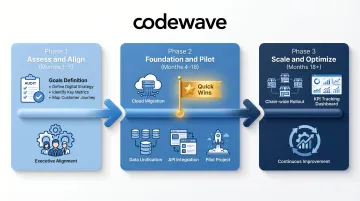
Phase 3 — Scale and Optimize (Months 18+)
Once pilots demonstrate measurable value, expand successful initiatives across the organization:
- Roll out proven technologies to additional stores, regions, or product categories
- Embed data-driven decision-making into daily operations through dashboards, alerts, and automated workflows
- Continuously track KPIs (conversion rates, inventory accuracy, customer satisfaction, cost per order) to identify optimization opportunities
Choosing the right implementation partner matters at this stage. When a technology firm is accountable for outcomes — revenue lift, cost reduction, error rates — rather than just project delivery, incentives align with your business goals. Codewave's ImpactIndex™ is built on this principle: clients pay for measurable results, not hours logged.
Full transformation typically takes 2–3+ years for large organizations, with foundational phases consuming 18–24 months. The retailers who treat this as a continuous operating model — not a discrete project — are the ones who maintain competitive distance as expectations and technology keep shifting.
Frequently Asked Questions
What are the benefits of digital transformation in retail?
The core benefits span customer experience, operations, and revenue:
- Personalization drives up to 40% revenue gains and increases repeat purchase rates
- Automation cuts operational costs and reduces manual errors across supply chain and fulfillment
- Smarter inventory management minimizes stockouts and overstock
- Omnichannel strategies generate 4-10% higher spending per customer than single-channel approaches
What are the 4 P's of digital transformation?
The 4 P's framework covers:
- People — building digital skills and a change-ready culture across the organization
- Process — redesigning workflows for digital-first operations
- Platform — modernizing infrastructure with cloud, APIs, and integrated data systems
- Performance — measuring outcomes against KPIs like revenue growth, cost reduction, and customer satisfaction
What are the biggest challenges of digital transformation in retail?
The most common barriers are:
- Legacy system integration that creates data silos and limits agility (70% of Fortune 500 companies still run software over 20 years old)
- Employee change resistance, particularly where job displacement is feared
- Digital talent scarcity — 60% of companies cite hiring as a key inhibitor
- Justifying upfront costs against long-term returns without clear short-term milestones
How do you measure the ROI of digital transformation in retail?
ROI combines hard metrics — revenue from digital channels, conversion lifts, inventory accuracy, and automation savings (up to 30% in supply chain) — with softer indicators like customer satisfaction and employee productivity. Key benchmarks include omnichannel customer lifetime value running 1.7x higher than single-channel and forecast accuracy improving 10-20% with AI-driven planning.
Where should a retailer start with digital transformation?
Start by identifying the highest-friction points in the customer journey or operations—where customers abandon carts, where inventory errors occur most, where manual processes consume excessive time. Define a specific and measurable business goal tied to that friction point, then pilot a targeted technology solution in limited scope (one store, one product category, one region) before scaling chain-wide.
How long does a retail digital transformation typically take?
Digital transformation is an ongoing process, not a single project. Foundational work — data infrastructure, cloud migration, system integration — takes 6-18 months for mid-sized retailers and up to 24 months for larger organizations. Full omnichannel and AI capabilities typically mature over 2-3+ years, depending on investment pace and legacy system complexity.