Introduction
Digital commerce is undergoing a fundamental transformation. AI agents are no longer just recommending products or comparing prices — they're initiating purchases, negotiating deals, and executing payments on behalf of users without requiring human confirmation at the point of transaction. This shift from traditional e-commerce to agentic commerce marks a new paradigm where autonomous AI agents search, decide, negotiate, and pay independently.
The scale of this opportunity is significant. Morgan Stanley projects that agentic commerce could capture $190–$385 billion in US e-commerce alone by 2030, while McKinsey estimates global agentic commerce could reach $3–5 trillion by the same year. Research cited by TSYS puts over 50% of all online purchases under agentic AI influence within the next several years.
TLDR:
- Agentic payments let AI agents autonomously execute transactions within pre-set limits without human approval at checkout
- Major payment networks (Visa, Mastercard, PayPal, Coinbase) launched dedicated infrastructure in 2025–2026
- Early use cases span B2B invoice automation, consumer shopping agents, payment routing optimization, and IoT commerce
- Data security is the top barrier: 80% of automated firms cite it as their primary concern around agentic payments
- Businesses should audit current systems and start with focused use cases before scaling agentic payment capabilities
What Are Agentic AI Payments?
Agentic AI payments are payments initiated and executed autonomously by an AI agent, operating within pre-authorized limits, without requiring human intervention at the point of transaction. Unlike autopay or scheduled payments — which automate when money moves — agentic payments empower AI to decide if, when, and how money moves based on real-time context and conditions.
Four Core Attributes
Agentic payments are defined by four characteristics:
- Evaluates conditions autonomously to determine whether a payment should be made — within predefined guardrails
- Operates under bounded financial authority: transaction caps, merchant restrictions, and spending rules constrain every action
- Runs on explicit rules or adaptive ML models that improve over time
- Executes in real time, triggered by inventory levels, contract milestones, price thresholds, or usage metrics
Evolution of the Payment Ecosystem
The traditional four-party payment model — cardholder, issuer, acquirer, merchant — grows significantly more complex when an AI agent enters the picture. Trust, identity verification, and credential management become central challenges the moment a non-human entity initiates a transaction.
Nekuda, a startup building agentic payment infrastructure, frames authorization — defining what an agent is permitted to do — as a fundamentally new problem. Every existing system assumes a human presses "Buy." When software takes control, that assumption breaks.
Key Protocols and Industry Infrastructure
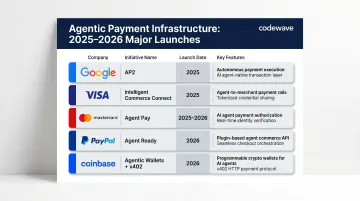
Between 2025 and 2026, major payment networks and technology platforms launched dedicated agentic payment infrastructure — a clear signal that the industry is building the rails, not just debating the concept:
| Company | Initiative | Announced | Key Features |
|---|---|---|---|
| Agent Payments Protocol (AP2) | Sep 2025 | Open, payment-agnostic protocol supporting card rails, ACH, and stablecoins; 60+ collaborating organizations | |
| Visa | Intelligent Commerce Connect | Apr 2026 | Network/protocol/vault-agnostic on-ramp; tokenized payments for approved AI agents |
| Mastercard | Agent Pay + Agentic Tokens | Apr 2025 | Merchant interfaces for trusted agents; tokenization specifically designed for agent-initiated transactions |
| PayPal | Agent Ready + Store Sync | Jan 2025–Jan 2026 | Native AI channel payments; catalog sync across AI platforms; fraud tools and purchase protection |
| Coinbase | Agentic Wallets + x402 Protocol | Feb 2026 | Autonomous spending/earning/trading; stablecoin-native with security guardrails |
Intent Mandates and Cart Mandates
Google's AP2 protocol introduces typed mandates — a structured mechanism consumers use to authorize agents at each stage of a transaction:
- Intent Mandate captures the user's high-level goal and constraints, such as budget limits or preferred merchants
- Cart Mandate locks specific items and prices the agent has selected, pending user confirmation
- Checkout Mandate authorizes final payment execution, with cryptographic proof linking the original intent to the completed transaction
Together, these mandates create non-repudiable authorization records at every step — giving consumers verifiable control over what their agents spend, and on what.
How Agentic Payments Work: The Mechanics Behind Autonomous Transactions
Step 1 — Agent Initialization
An AI agent is set up with a specific goal: pay invoices when delivery is confirmed, purchase an item within a budget, manage subscriptions, or rebalance treasury accounts. The agent is linked to a payment source — a bank account, digital wallet, or crypto wallet — and scoped with access limits, rules, and conditions that define its financial authority.
For example, an enterprise treasury agent might be authorized to transfer up to $50,000 between accounts when liquidity drops below a threshold, but require human approval for any transaction exceeding that amount.
Step 2 — Context Gathering and Decision-Making
The agent continuously monitors relevant data signals: account balances, pricing, contract status, usage metrics, ERP data, or market conditions. Using either rules-based logic (if condition X, then action Y) or machine learning models trained on historical patterns, the agent determines whether, when, and how a payment should be made.
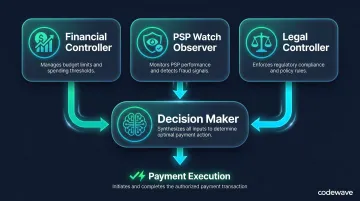
AWS describes a Cognitive Payments Director architecture where multiple specialized agents collaborate to select the best payment route in real time:
- Financial Controller evaluates available budgets and spending limits
- Legal Controller checks applicable regulatory requirements
- PSP Watch Observer monitors for fraud patterns in real time
- Decision Maker synthesizes all inputs and triggers the final payment action
Step 3 — Payment Execution
Once the decision threshold is met, the agent initiates the transaction using connected payment rails — ACH, card networks, real-time payment systems, or crypto APIs. The agent handles one-time payments, recurring subscriptions, or multi-party payouts without human confirmation.
For instance, a B2B procurement agent can trigger invoice payment the moment delivery is confirmed via EDI integration — no manual review required.
Step 4 — Logging, Auditing, and Compliance
Every agentic payment action is fully traceable. Built-in safeguards include:
- Audit trails capturing timestamps, data inputs, decision rationale, and transaction confirmations
- Compliance checks covering KYC/AML verification, sanctions screening, and regulatory reporting
- Human override controls allowing review, pause, or reversal when anomalies are detected
Accenture's internal finance automation delivered a 7% increase in auto-clearing and produced match results 77% faster by integrating audit trails directly into AI-driven invoice reconciliation workflows.
Staged Digital Wallets and the Trust Layer
Many agentic payment systems use smart wallets — also called agentic wallets — where the funding phase is separated from the payment phase. This staged architecture creates a security barrier critical when a non-human agent initiates the transaction.
Fime explains that smart wallets carry not only digital money (tokens, fiat, CBDCs) but also delegation logic: spend limits, merchant restrictions, and risk flags. That's why Visa and Mastercard are actively building frameworks that let agents hold and transfer payment credentials compliantly.
Startups such as Nekuda and Payman AI are building staged wallet frameworks designed to keep agent-initiated transactions verifiable and bounded. Their implementations typically include:
- Explicit transaction limits that cap what an agent can spend per session or merchant
- Transparent mandates passed through the payment stack so every party sees the agent's authorized scope
- Cryptographic authorization layers that confirm verifiable agent identity before funds move
Key Use Cases Across Industries
Consumer and E-Commerce
AI-powered shopping agents search, compare, and purchase products autonomously on behalf of consumers. Use cases include:
- Booking full vacation packages end-to-end (flights, hotels, activities)
- Sniping deals on marketplace items when price drops below a threshold
- Cancelling unused subscriptions and reallocating funds
- Completing recurring grocery orders based on household inventory levels
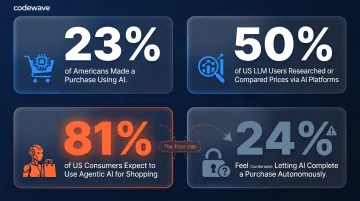
Morgan Stanley found that 23% of Americans had already made a purchase using AI in the month prior to their survey, and 50% of US LLM users used platforms to research or compare prices. While 81% of US consumers expect to use agentic AI tools for shopping, only 24% currently feel comfortable letting AI complete a purchase autonomously — highlighting the trust gap businesses must bridge.
B2B Finance and Treasury Automation
Enterprises use agentic payments for:
- Matching purchase orders, delivery receipts, and invoices, then triggering payment automatically when all conditions are met
- Monitoring liquidity thresholds and moving funds between accounts to optimize interest income or meet compliance requirements
- Releasing contract-based disbursements when project deliverables are verified
In practice, this level of automation delivers measurable results. Codewave's fintech engagements have produced 50% faster invoice processing and a 99% reduction in fraud risks — outcomes driven by intelligent workflow design rather than incremental tooling.
Payment Routing and Optimization (Cognitive Payments Director Model)
Agentic systems evaluate multiple payment service providers (PSPs) in real time, considering:
- Foreign exchange rates
- Regulatory requirements by country
- Fraud patterns and risk scoring
- Fee structures and volume-based pricing tiers
AWS's Cognitive Payments Director architecture replaces static rule-based routing with adaptive, learning agents that route each transaction optimally based on cost, speed, and compliance requirements. Banks using agentic AI report 40% reduction in cost and 30% revenue growth.
Risk Management and Fraud Detection
Specialised agents monitor transaction patterns, card network behaviour, and payment scheme anomalies, collaborating with an orchestrating agent to make real-time legitimacy decisions. Unlike static rule engines, these agents update their detection logic continuously as new attack patterns emerge.
Veriff's 2026 Industry Pulse found that 75% of decision-makers reported increased AI-driven fraud attacks, and digitally presented media is 300% more likely to be AI-generated or altered. Agentic systems counter this by:
- Detecting synthetic identity patterns across multiple data signals
- Flagging anomalous agent behavior before transactions complete
- Coordinating between specialized sub-agents to cross-validate suspicious activity
IoT and Machine-to-Machine Payments
Connected devices initiate payments autonomously:
- Electric vehicles paying charging stations directly
- Smart appliances ordering replenishments when inventory runs low
- Autonomous vehicles paying tolls or airspace priority fees
- Drones negotiating municipal traffic access
Coinbase's x402 protocol enables pay-per-use API access for AI agents, processing approximately $48 million in payment volume with 95% on the Base network — demonstrating programmable, machine-to-machine settlement at scale.
Benefits of Agentic Payments for Digital Commerce
Here's what agentic payment systems deliver across the three areas that matter most to digital commerce operations:
- Faster execution without manual approval delays
- Scalable infrastructure for high-frequency, low-value transactions
- Adaptive decision-making that improves with every transaction
Speed and Operational Efficiency
Agentic payments remove manual approval chains and human-error bottlenecks. Payments execute instantly upon condition fulfilment, 24/7, across time zones. Accenture's AI-powered finance produced results 77% faster than manual processes, effectively doubling throughput.
Scalability for Microtransactions and High-Volume Flows
Traditional payment infrastructure struggles with high-frequency, low-value transactions due to processing costs and latency. Agentic systems enable real-time, event-triggered micropayments at scale — ideal for usage-based pricing, IoT commerce, and pay-per-action models that would be impractical manually.
Circle's Arc blockchain achieves sub-second finality (approximately 0.5 seconds) and processed 150 million transactions in its first 90 days, demonstrating the infrastructure capacity for micropayment-scale agentic commerce.
Smarter Financial Decision-Making Over Time
Unlike static automation, agentic systems learn and adapt. They refine decisions based on user preferences, market conditions, and historical patterns — which means payment routing gets smarter, failed transactions drop, and cash flow decisions become genuinely proactive rather than reactive.
McKinsey's State of AI 2025 found that 64% of respondents say AI is enabling measurable cost and revenue benefits at the use-case level.
Challenges and Risks to Navigate
Security, Identity, and the Good-Bot/Bad-Bot Problem
When AI agents initiate payments, both consumers and merchants must trust that the agent is authorized, authenticated, and not malicious. Challenges include:
- Deepfake threats: Veriff's 2026 survey found 74% of professionals reported increased online fraud, with digitally presented media 300% more likely to be AI-generated
- Credential management: Securing agent access to payment credentials without exposing sensitive data
- Agent identity verification: Establishing non-repudiable proof that an agent is acting on behalf of an authorized user
TSYS reports that 80% of highly automated firms cite data security and privacy as their top concern — more than double the 39% reported by less-automated firms.
Governance, Regulatory Uncertainty, and Dispute Resolution
Applicable agentic AI laws are currently minimal. Businesses operate primarily on contractual terms, but without regulation, dispute resolution becomes murky. Who is liable when an AI agent makes an unauthorized purchase?
The European Banking Authority published guidance on AI Act implications for EU banking and payments in November 2025, but no regulator has yet issued specific guidance on AI-initiated financial transactions. Until they do, businesses must monitor evolving frameworks — GDPR, the EU AI Act, and emerging state-level US legislation — and build compliance flexibility directly into their agentic architectures.
Data Quality as the Foundation
Regulatory gaps aren't the only structural risk. Autonomous agents amplify any errors or biases in input data, producing inaccurate decisions or financial errors at scale. Businesses must invest in clean, complete data pipelines before deploying agentic payment systems — not after.
For fintech clients building toward agentic payments, Codewave has implemented real-time data pipelines using Apache Kafka for event ingestion and Snowflake for cloud data warehousing — achieving 90% fewer data errors and 3x faster processing, the kind of infrastructure accuracy that autonomous financial decision-making demands.
How to Prepare Your Business for Agentic Payments
Audit Your Current Payment Infrastructure and Data Readiness
Before implementing agentic payments, assess whether your existing systems — ERP, payment processors, data pipelines — can support real-time, API-driven agent interactions. Identify:
- Data quality gaps: Inconsistent, incomplete, or outdated data
- Legacy integration challenges: Systems that lack modern APIs or real-time connectivity
- Security frameworks: Credential management, tokenization, and authorization mechanisms needed to manage agent access safely
Codewave helps enterprises map data lineage, define authoritative data sources, and add validation checks that flag inconsistencies — groundwork that prevents costly failures once agents begin executing transactions autonomously.
Start Narrow and Expand with Phased Implementation
Begin with a focused, high-value use case — such as automated invoice matching, subscription management, or fraud flagging — with clear KPIs tied to ROI. Build confidence and capability before expanding agent autonomy.
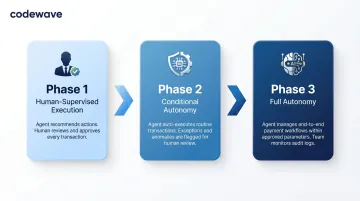
Follow a phased approach:
- Human-supervised execution: Agent surfaces recommendations with supporting data; a human makes the final call before anything executes
- Conditional autonomy: Agent executes routine transactions automatically, but flags anything outside predefined thresholds for human review
- Full autonomy: Agent handles end-to-end execution within approved parameters; teams monitor audit logs rather than individual decisions
Codewave's QuantumAgile™ approach is built for exactly this kind of phased rollout — validating each stage before expanding scope, so organizations don't over-commit to an architecture before it's proven in production.
Build for Trust and Human Oversight
Design agentic payment systems with:
- Human override mechanisms: Give users a real-time kill switch — the ability to pause, review, or reverse any transaction before or after execution
- Clear audit trails: Record every agent decision with a timestamp, the data it acted on, and the rule or model output that drove the action
- User consent frameworks: Implement typed mandates (intent, cart, checkout) that provide transparent authorization
- Explainable decision logic: Surface the reasoning behind each action in plain language — not just a log entry, but something a non-technical user can actually interpret
For high-value or unusual transactions, human touchpoints aren't a workaround — they're a feature. Systems designed with oversight built in tend to earn user trust faster and face fewer compliance challenges as regulations around autonomous payments continue to develop.
Frequently Asked Questions
What is the difference between agentic payments and traditional automated payments like autopay?
Autopay automates when money moves on a fixed schedule. Agentic payments empower AI to decide if, when, and how money moves based on real-time context, conditions, and machine learning — giving the agent genuine decision-making authority rather than just executing a pre-set instruction.
Are agentic AI payments secure?
Security depends on the implementation. Well-designed systems use staged digital wallets, tokenization, bounded financial limits, audit trails, and human override mechanisms. However, identity verification, credential management, and regulatory gaps remain active challenges that businesses must address explicitly in their architecture.
Which industries will benefit most from agentic AI payments?
Fintech, retail/e-commerce, healthcare, logistics, and B2B finance are early beneficiaries — particularly for high-volume, logic-driven transaction workflows like invoice processing, fraud detection, subscription management, and cross-border payment routing.
How do agentic payments handle disputes or unauthorised transactions?
Dispute resolution sits in a gray area — agentic AI laws are largely nonexistent, so accountability currently falls to contractual terms between parties. Businesses should establish clear authorisation frameworks, audit trails, and user consent protocols to define accountability upfront.
What role do stablecoins play in agentic payments?
Stablecoins are appealing because agents can hold smart wallets (unlike bank accounts), enabling permissionless, programmable payments with immutable audit trails. However, stablecoins introduce coordination challenges around fiat on-ramps, merchant acceptance, and blockchain interoperability, trading one set of friction points for another.