Introduction
Last-mile delivery is the final stretch of the supply chain — and consistently the most expensive. Last-mile costs now account for 53% of total shipping expenses, up from 41% in 2018, according to 2023 Statista research. Yet this is the very segment where customer expectations have escalated fastest: same-day delivery, real-time tracking, and guaranteed time windows are now baseline expectations rather than differentiators.
Most enterprises still rely on static route planning locked hours before departure, manual dispatch triage, and reactive exception handling. These models crack under urban congestion, driver shortages, and unpredictable demand swings — and the cost of that friction shows up directly in margins.
What follows is a practical look at how AI shifts last-mile delivery from reactive firefighting to predictive, adaptive operations. We'll cover the economic pressures driving adoption, the core transformations AI enables, high-impact use cases with measurable ROI, the technologies behind these systems, and a realistic implementation path for organizations ready to modernize.
Key Takeaways
- Last-mile delivery accounts for over half of total shipping costs, driven by low drop density, urban congestion, and labor shortages
- AI enables continuous route recalculation, predictive ETAs, automated exception handling, and intelligent driver allocation, cutting costs and failed deliveries
- Data fragmentation and poor system integration — not the algorithms — are the primary barriers to successful AI adoption
- Organizations that embed AI directly into dispatch systems, driver apps, and TMS/WMS see faster ROI than those using it only for reporting
Why Last-Mile Delivery Is Getting Harder (and More Expensive)
The Structural Cost Problem
Unlike linehaul or middle-mile logistics, last-mile costs don't scale linearly with volume. Each additional delivery adds incremental complexity rather than reducing per-unit cost. Urban congestion alone is projected to cost delivery vehicles an additional 34 minutes per day by 2030 — over 200 hours of lost productivity annually per vehicle, according to the World Economic Forum.
Low drop density in suburban and rural zones, narrow delivery windows, and chronic driver shortages pile on further. The U.S. Bureau of Labor Statistics projects 237,600 annual truck driver openings through 2034. Each of these factors compounds the next, and the economics don't improve with scale alone.
The Operational Volatility Problem
Traffic conditions change by the minute, customer availability is unpredictable, and driver schedules shift due to call-outs or fatigue limits. Yet most enterprises finalize route plans hours before trucks roll out.
When disruptions hit — a road closure, a batch of incorrect addresses, a driver calling in sick — static plans cascade into missed SLAs, costly reattempt deliveries, and unplanned overtime. Without real-time adaptability, every disruption requires manual intervention and sends ripple effects down the chain.
The Visibility Gap and Profitability Risk
Many logistics operations still lack real-time visibility into what's happening on the road. Exceptions surface in dashboards only after the intervention window has closed. By then, the delivery has already failed, the customer is frustrated, and the cost is locked in.
The financial exposure is significant:
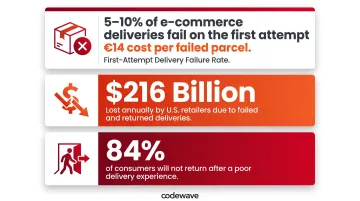
- 5-10% of e-commerce deliveries fail on the first attempt, costing €14 per parcel in Europe in re-delivery, storage, and support overhead
- U.S. retailers lose $216 billion annually from delivery-related issues
- 84% of consumers say they won't return to a brand after a poor delivery experience
The margin for error is razor-thin, and the cost of failure keeps climbing.
How AI Is Transforming Last-Mile Delivery Operations
AI doesn't just speed up existing processes — it replaces static, rule-based planning with continuously adapting decision systems. A traditional route is planned once in the morning based on historical data and locked until the driver returns. An AI-powered route recalculates every few minutes using live traffic, updated order status, driver location, weather conditions, and delivery density. The difference is responding to reality as it unfolds, not executing a plan built on yesterday's assumptions.
Dynamic Route Optimization
AI-powered routing engines process live inputs — traffic congestion, delivery density, vehicle capacity, access restrictions, and real-time stop updates — to continuously reorder and reassign stops throughout the day. The planning cycle no longer ends at 6 a.m.; it runs continuously until the last driver clocks out.
Consider UPS's ORION system: the platform saves 100 million miles annually, cuts fuel consumption by 10 million gallons, and delivers $300-400 million in annual cost savings. ORION processes 200,000 routing options per driver per day across 55,000 vehicles, achieving 10-20% improvement over manual route planning. The initial $1 billion investment paid back in under three years.
Even small per-delivery improvements compound at scale. Reducing idle time by two minutes per stop, improving fuel efficiency by 5%, or increasing stops per hour by 10% translates into millions of dollars across thousands of daily deliveries. The Locus platform, used across 30+ countries, reports over $320 million in logistics costs saved across 1.5 billion optimized deliveries — a 20% cost reduction on average.
Predictive ETAs and Intelligent Dispatching
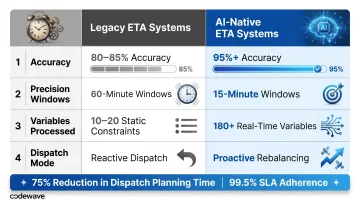
Machine learning models trained on historical delivery patterns, stop-level service times, driver behavior, and real-time signals generate narrower, more accurate delivery windows. Legacy ETA systems plateau at 80-85% accuracy within 60-minute windows, processing 10-20 static constraints. AI-native systems achieve 95%+ accuracy within 15-minute windows by processing 180+ real-time variables — traffic speed, delivery sequence changes, parking availability, building access patterns, and customer interaction history.
Intelligent dispatching takes this further: when a driver hits unexpected delays, the system proactively rebalances loads across nearby drivers, reroutes lower-priority stops, and adjusts downstream ETAs before customers are impacted. This prevents cascading failures — missed windows and costly reattempts — that erode both margins and customer trust. Locus reports 75% reduction in dispatch planning time and 99.5% SLA adherence through AI-powered optimization.
The customer retention impact is measurable:
- 32% of customers stop doing business after one bad delivery experience (PwC)
- Delivery experience is the #1 driver of Net Promoter Score in e-commerce
- A 5% improvement in retention can produce 25-95% profit increases (Bain & Company)
Automated Exception Handling and Warehouse-to-Door Coordination
AI detects delivery anomalies — missed attempts, address discrepancies, vehicle breakdowns, access issues — as they emerge, not after the fact. When an address fails validation or a delivery is flagged as high-risk for failure, the system triggers automatic rerouting, reschedules the stop, or sends a proactive customer confirmation prompt. This eliminates the full cost of a failed attempt plus the reattempt.
The coordination extends upstream as well. AI synchronizes warehouse pick-pack timing and outbound dispatch with last-mile capacity in real time. If a route runs ahead of schedule, the warehouse prioritizes staging those orders. If a route is delayed, outbound dispatch holds the relevant packages to prevent dwell time and missed handoffs. The result is end-to-end visibility that eliminates idle gaps at both ends of the fulfillment chain — and measurably higher throughput without adding headcount.
Top AI Use Cases That Deliver Real ROI in Last-Mile Delivery
AI delivers the most measurable value when applied to specific high-friction decisions rather than broadly across all operations. The use cases below consistently produce ROI across retail, e-commerce, and third-party logistics.
Real-Time Route Optimization
This is typically the highest-ROI entry point. AI continuously adjusts routes based on live conditions rather than locking in plans hours before departure. The system ingests traffic data, order updates, driver status, and delivery density, then recalculates optimal sequencing in seconds.
Track these metrics to validate ROI:
- Fuel spend per delivery
- On-time delivery rate (within promised window)
- Stops per driver hour
- Total miles driven per day
- Driver overtime hours
Even a 5-10% improvement in these metrics compounds into six- or seven-figure annual savings for mid-sized fleets.
Failed Delivery Prediction and Prevention
AI models flag deliveries at risk of failure before trucks leave the depot. Risk factors include:
- Incomplete or unvalidated address data
- Customer availability patterns (history of missed deliveries)
- Route congestion or access restrictions
- Delivery time outside customer preference window
Early flagging allows operations teams to reschedule, reroute, or send customer confirmation prompts, avoiding the full cost of a failed attempt plus reattempt. Industry data points to real-time address validation cutting errors by up to 40%, with proactive customer notifications reducing missed deliveries by around 30% — though results vary by fleet size and delivery density.
The financial stakes are high: failed first attempts contribute to $216 billion in annual U.S. retailer losses, with European logistics benchmarks pegging the cost of a single failed parcel attempt at roughly €14. Even modest gains in first-attempt success rates translate directly to bottom-line savings.
Smart Driver Allocation and Load Balancing
Preventing failures also depends on getting the right driver to the right route. AI matches drivers to routes based on:
- Skill level and historical performance
- Familiarity with delivery zones
- Real-time fatigue or availability signals
- Vehicle type and capacity constraints
This replaces static assignment logic, allowing planners to rebalance capacity dynamically when demand spikes or drivers call out — without manual triage. The system evaluates thousands of driver-route combinations in seconds, balancing cost, delivery speed, and workload in a way no manual planning process can match.
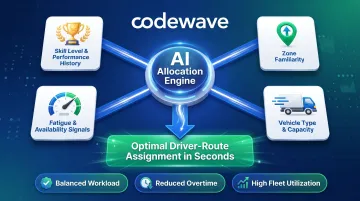
During peak periods or unexpected disruptions, intelligent allocation prevents individual driver overloading while keeping overall fleet utilization high — a critical advantage when volume spikes and staffing is tight.
What to track:
- Driver utilization rate across the fleet
- Overtime hours per route
- Reallocation response time during disruptions