Introduction
According to McKinsey's 2025 Global Survey, 88% of organizations now use AI in at least one business function—up from 78% in 2024. The question is no longer "Should we adopt AI?" but "Which partners actually deliver results?"
The stakes are real. MIT's NANDA research found that 95% of generative AI pilots fail to achieve rapid revenue acceleration—with flawed enterprise integration, not model quality, identified as the core cause.
The RAND Corporation puts it in sharper relief: AI projects fail at more than twice the rate of standard IT initiatives, with 80% of AI work consumed by data engineering challenges before a single business outcome is measured.
That failure context is exactly why provider selection matters. This guide evaluates the top AI implementation service providers for tech businesses in 2026 based on production deployment track records, engineering depth, and outcome accountability—not marketing claims.
Key Takeaways
- AI implementation services translate strategy into operational systems through custom development, integration, and optimization
- Tech businesses need partners who deliver production-grade outcomes, not just prototypes or proofs of concept
- Top providers combine deep engineering capability with business-outcome focus and post-launch support
- Codewave, 10Pearls, Accenture, LeewayHertz, and IBM Consulting offer strong options across different scales and use cases
- When choosing a provider, prioritize delivery maturity, outcome accountability, and tech stack integration depth over brand name alone
What Are AI Implementation Services for Tech Businesses?
AI implementation services encompass the end-to-end process of translating AI strategies into fully operational systems. This includes custom model development, system integration, data pipeline engineering, MLOps infrastructure, and ongoing optimization. Unlike AI consulting—which focuses on strategy, use-case identification, and roadmapping—implementation services cover the actual building, deploying, and operationalizing of AI systems within existing infrastructure.
Tech businesses face unique implementation challenges. They already operate complex codebases, established data infrastructure, and multiple API integrations that AI systems must work within seamlessly. Off-the-shelf AI tools rarely suffice when you need to:
- Integrate intelligent features into existing SaaS platforms
- Embed predictive analytics into fintech or insurance products
- Build agentic workflows into healthcare or logistics applications
- Connect AI layers to legacy APIs without disrupting current operations
The demand for specialized AI implementation is accelerating fast. Gartner predicts 40% of enterprise applications will feature task-specific AI agents by end of 2026, up from less than 5% in 2025.
Menlo Ventures reports the enterprise generative AI market hit $37 billion in 2025, a 3.2x jump from the prior year. At that pace, businesses that rely on generic tools or underprepared vendors will struggle to keep up.
The providers below are evaluated on production deployment track records, engineering depth, and verified business outcomes — not just stated capabilities.
Top AI Implementation Services for Tech Businesses in 2026
These providers were evaluated on engineering depth, production deployment experience, industry breadth, post-launch support capability, and proven ability to deliver measurable business outcomes—not just technical credentials.
Codewave
Codewave is an award-winning AI implementation and product engineering firm that has worked with 400+ businesses across 15+ industries including fintech, healthcare, retail, education, and transportation. The company maintains a 70-80% client retention rate, reflecting sustained delivery quality and partnership continuity.
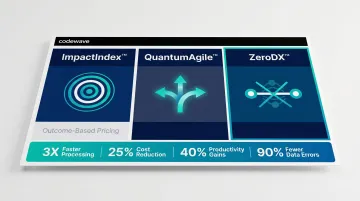
Three proprietary frameworks define how Codewave delivers:
- ImpactIndex™ — clients pay for validated business outcomes, not billable hours
- QuantumAgile™ — simulates multiple implementation paths and deploys only what delivers proven value
- ZeroDX™ — removes middle-management layers so clients work directly with the engineers building their solutions
Reported outcomes across engagements include 3X faster data processing, 25% cost reduction, 40% productivity gains, and 90% fewer data errors.
| Attribute | Details |
|---|---|
| Key Services | Custom AI/ML development, data pipeline engineering, AI-powered analytics, intelligent automation, and product engineering across TensorFlow, Apache Kafka, Snowflake, and Power BI |
| Best Fit For | Mid-market to enterprise tech businesses in fintech, healthcare, retail, and SaaS seeking outcome-driven AI implementation with direct team collaboration |
| Notable Differentiator | ImpactIndex™ outcome-based pricing, QuantumAgile™ rapid validation framework, and 95%+ data accuracy across engagements |
10Pearls
10Pearls is a global digital transformation and AI engineering company founded in 2004, employing 1,000-5,000 professionals worldwide. The firm offers comprehensive AI implementation services including generative AI, agentic AI, machine learning, MLOps, and cloud-native engineering alongside enterprise application development.
10Pearls stands out for its structured AI readiness assessment process, which scopes implementation around actual business problems rather than deploying technology for its own sake. They offer both full-cycle AI development and IT staff augmentation, giving tech businesses flexibility to scale specific capabilities without rebuilding internal teams. The company is a recognized partner of AWS, Google Cloud, and Microsoft, with particular strength in healthcare, financial services, telecom, and retail.
| Attribute | Details |
|---|---|
| Key Services | Generative AI development, agentic AI systems, AI strategy consulting, MLOps, cloud-native engineering, and custom AI solutions for enterprise |
| Best Fit For | Mid-to-large enterprises in healthcare, financial services, telecom, and retail needing scalable, compliance-ready AI implementation |
| Notable Differentiator | Structured AI readiness assessment before development, combined with flexible IT staff augmentation for flexible team scaling |
Accenture
Accenture operates as one of the world's largest AI implementation partners, with 774,000+ professionals globally and a dedicated Data & AI practice covering AI strategy, data engineering, custom model development, and full system integration across every major industry vertical.
Accenture's strength lies in managing complex, multi-year AI transformations at enterprise scale—particularly in retail analytics, financial services automation, and manufacturing optimization. Recognized as a Leader in Forrester's Wave for AI Technical Services Q4 2025, the firm brings deep industry specialization across virtually every sector. However, their scale also means higher engagement costs and longer decision cycles, making them best suited for large enterprises rather than growth-stage tech companies.
| Attribute | Details |
|---|---|
| Key Services | End-to-end AI transformation, advanced analytics, responsible AI frameworks, generative AI deployment, and enterprise system integration |
| Best Fit For | Large enterprises requiring global delivery, multi-system AI integration, and compliance-grade implementation across regulated industries |
| Notable Differentiator | Breadth of industry specialization and ability to manage simultaneous, enterprise-wide AI transformation programs at scale |
LeewayHertz
LeewayHertz is a San Francisco-based AI development and implementation firm founded in 2007, known for delivering production-grade AI systems including NLP solutions, LLM-based products, custom machine learning models, and intelligent automation frameworks for mid-to-large enterprises.
LeewayHertz differentiates through deep technical execution in emerging AI paradigms—particularly LLM integration and generative AI—making them a strong fit for tech businesses building AI-native products. Their experience spans blockchain, IoT, and cloud computing, enabling complex multi-system AI implementations. With 50+ AI projects delivered and Fortune 500 clients including Siemens, 3M, P&G, and Hershey's, they bring specialized expertise to sophisticated technical challenges.
| Attribute | Details |
|---|---|
| Key Services | Custom AI engineering, NLP and LLM development, generative AI implementation, intelligent automation, and enterprise software AI integration |
| Best Fit For | Tech companies building AI-native SaaS products, LLM-powered tools, or automation frameworks requiring deep engineering execution |
| Notable Differentiator | Strong specialization in LLM development and generative AI implementation, combined with multi-technology delivery across blockchain, IoT, and cloud platforms |
IBM Consulting
IBM Consulting brings decades of enterprise AI experience through its watsonx platform, with approximately 160,000 consulting professionals globally. IBM Consulting brings decades of enterprise AI experience through its watsonx platform, with approximately 160,000 consulting professionals globally. The firm's focus on regulated industries — healthcare, financial services, and government — means security, AI transparency, and compliance are built into every engagement rather than treated as afterthoughts.
IBM's AI implementation work emphasizes hybrid cloud environments, AI governance, and mission-critical system integration. Named a Leader in Forrester's Wave for AI Decisioning Platforms Q2 2025, they excel in environments requiring explainable AI and compliance-grade deployment. Case studies include PNC Financial Services achieving an 80-90% reduction in manual loan reviews and Camping World seeing a 40% increase in consumer engagement using watsonx. Their scale provides confidence but can result in slower adoption of newer AI paradigms.
| Attribute | Details |
|---|---|
| Key Services | Enterprise AI implementation via watsonx, AI governance frameworks, hybrid cloud AI deployment, data platform modernization, and regulated industry AI solutions |
| Best Fit For | Large enterprises in healthcare, financial services, and government requiring explainable AI, compliance-grade deployment, and hybrid cloud architecture |
| Notable Differentiator | watsonx platform integration with built-in AI transparency and governance tools, backed by enterprise-grade security and decades of regulated industry experience |
How We Chose the Best AI Implementation Services
The selection process prioritized delivery maturity over brand recognition. A common mistake tech businesses make is choosing implementation partners based on case study aesthetics, company size, or proposal polish — rather than asking for production-grade deployment examples, documented post-launch support models, and transparent outcome metrics.
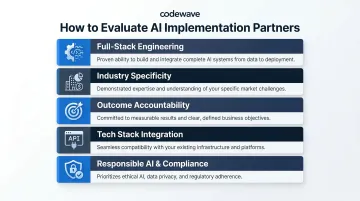
Five key evaluation factors guided this analysis:
- Handles the full ML, NLP, LLM, and MLOps stack in-house — not outsourced to subcontractors
- Understands SaaS, fintech, and healthtech environments specifically, not just generic enterprise patterns
- Ties deliverables to measurable business results rather than billing hours regardless of outcome
- Integrates with existing tech stacks without requiring infrastructure rebuilds, and scales without renegotiation
- Maintains documented frameworks for responsible AI, data privacy, and regulatory compliance
According to a 2025 Fortune report on MIT's NANDA research, vendor partnerships succeed approximately 3x more often than internal builds (67% vs. 22%). The gap comes down to three recurring failure points: poor enterprise integration, data quality problems, and a disconnect between business objectives and technical execution.
The rankings below reflect these criteria directly. Firm size and brand recognition were deprioritized in favor of production track record, client access models, and demonstrated ability to move from scoped problem to working deployment without the friction that stalls most AI initiatives.
Conclusion
Choosing an AI implementation partner in 2026 is a strategic decision that affects product velocity, operational efficiency, and competitive positioning. The right partner builds AI systems that perform, scale, and deliver measurable ROI—not just ones that ship.
Assess potential partners on outcome accountability, depth of tech stack integration experience, post-deployment support, and cultural fit. Proposal quality and brand recognition alone are poor predictors of actual results.
McKinsey's research shows that only 6% of organizations qualify as "AI High Performers". Those leaders are 3x more likely to have fundamentally redesigned workflows and established clear KPI tracking for AI initiatives — the bar is high, and your partner needs to clear it with you.
For tech businesses prioritizing measurable outcomes, Codewave's ImpactIndex™ model ties deliverables to business results, while their ZeroDX™ approach puts you in direct contact with the engineers building your system — no account managers relaying messages, no delays from handoff chains. Connect with the team to explore whether their outcome-driven approach aligns with your AI implementation goals.
Frequently Asked Questions
What is the difference between AI consulting and AI implementation services?
AI consulting focuses on strategy, use-case identification, and roadmapping—helping organizations understand where AI can deliver value. AI implementation services cover the actual engineering, integration, deployment, and optimization of AI systems within existing infrastructure, transforming strategy into operational, production-grade systems.
How much do AI implementation services typically cost for tech businesses?
Costs vary significantly by scope. PoC engagements typically run from thousands to tens of thousands of dollars, MVPs from tens to hundreds of thousands, and full enterprise implementations into the millions. Key cost drivers include infrastructure, integration complexity, ongoing maintenance, and specialized talent. Some providers offer outcome-based pricing—like Codewave's ImpactIndex™—tying fees to delivered results rather than hours billed.
How long does it take to implement an AI solution end-to-end?
Typical timelines span 4-8 weeks for proof-of-concept validation, 3-6 months for MVP deployment, and 6-12 months for full production implementation. However, firms using agile or rapid-validation frameworks can compress these timelines significantly. Deloitte's research shows 70% of organizations expect to operate "AI factories" at scale by 2028, suggesting standardized, repeatable deployment processes are becoming more common.
What should tech businesses prioritize when choosing an AI implementation partner?
Prioritize production deployment track records, engineering depth in relevant AI domains (LLMs, MLOps, generative AI), and clear outcome accountability. Verify they can integrate with your existing tech stack without disruption, and assess post-launch support structures—you'll be working closely with this team for months.
Which AI technologies are most commonly implemented by tech businesses in 2026?
Leading areas include LLM integration, generative AI for content and automation, agentic workflows for autonomous task execution, predictive analytics, NLP, and intelligent process automation. Gartner reports 17% of organizations have already deployed AI agents as of early 2026, with more than 60% planning to within two years.
What are the biggest risks in AI implementation projects and how are they mitigated?
The two most common failure points are data quality issues (affecting 60% of projects per RAND) and poor system integration (linked to 95% of GenAI pilot failures per MIT). Mitigate both with rigorous pre-development data assessments, structured MLOps frameworks for ongoing monitoring, and clear SLAs governing post-launch support.